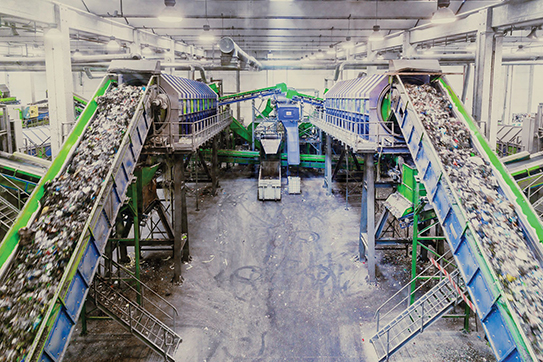
The result: higher levels of waste processing and a reduced cost of ownership
No other industry places a wider, more aggressive range of demands on conveyor belts than the recycling industry. Every time a belt needs to be repaired or replaced operators will incur costs, not only direct costs but also lost processing time. Despite this, belt selection is all too often based on price.
This may be owing to a perceived lack of value of the materials being conveyed and/or a lack of understanding as to why the toughness and longevity of one conveyor belt can differ so enormously from another. Here, leading conveyor belt authority, Leslie David, provides insight into how to select belts that require significantly less repair and maintenance and provide a considerably longer and therefore more cost-efficient working lifetime.
Oils, resins and chemicals
Research shows that organic waste is the largest component of household waste mixture (69%). Surprisingly, plastic represents less than 11%. Household waste contains very high levels of oils and resins that have an extremely detrimental effect on the performance and life expectancy of the rubber conveyor belts that carry it from one recycling stage to the next. Within the waste there is a wide variety of chemical-based domestic products such as cleaning agents, bleach, corrosives and other chemicals harmful to rubber.
There are two distinct sources of oil, resins, fats and greases. Vegetable oil is the most predominant source and is defined as all forms of oil and resin derived from flora and fauna. The other primary source is mineral oil, which is usually a liquid by-product of refining crude oil to make gasoline and other petroleum products.
When oil penetrates the rubber covers of a conveyor belt it causes all kinds of problems. The first is a dramatic reduction in the ability of the rubber to withstand wear.
As the rubber softens it also steadily loses its tensile strength while at the same time becoming much more prone to cutting, ripping and tearing. The next stage is that the rubber begins to swell and distort. This causes steering and handling problems along with a serious reduction in the elongation at break (the amount of stretch before the belt snaps) and recurring splice joint issues.
Oil resistance test methods
There are two recognised methods to measure oil resistance – ISO 1817:2024 and the comparable, slightly less elaborate but equally stringent American ASTM ‘D’ 1460. In both tests, samples of rubber are fully immersed for a specific period of time in test liquids such as petroleum derivatives, organic solvents and chemical reagents, as well as reference test liquids. Changes in the geometry and dimensions of the specimen caused by absorption are then measured when the samples are removed.
Surprisingly, international performance standards for oil and grease resistance do not yet exist. This means that manufacturers and traders can safely claim that the belt they are supplying is sufficiently oil resistant for its intended use. To make things worse, there can be a strong element of deception concerning the matter of test methods.
DIN 22102 G. Not what it seems
Some of the largest manufacturers of belting in the world, especially those in Southeast Asia, use the DIN reference number 22102 G (DIN G) when referring to oil resistant belting. This is misleading because in reality there are no firm requirements, test methods or limits specific to oil resistant belting associated with DIN 22102 G. The letter ‘G’ is simply used to denote some form of resistance against oil or grease, but it is not an indication of the actual level or kind of oil resistance.
Buyers guide: what to look for
There can be a marked difference in the kind of swelling and distortion caused by different oils and resins meaning different types of oil-resistant rubber are required. Despite this, many manufacturers only offer one type, which is commonly designated as ‘Medium oil resistant’ (MOR). After first establishing what test method the manufacturer is using, the next thing to look for is a manufacturer that offers ‘specific task’ oil resistant rubber. For example, Fenner Dunlop offer two main types – ROM (for vegetable oils) and ROS for mineral oils and chemicals. They also have three additional grades that combine fire and oil resistance.
Good quality oil resistant belts should have covers based on a combination of SBR (Styrene Butadiene Rubber) and NBR (Nitrile butadiene rubber). Because of the high cost of nitrile butadiene, manufacturers who engineer their belts based on the principle of price competitiveness rather than performance and longevity, not only use lower-grade nitrile but also use as little of it as possible.
Mineral oil is much more aggressive than most vegetable oils, so a full Nitrile Butadiene Rubber (NBR) synthetic rubber is required. The greater the concentration of nitrile within the polymer, then the greater resistance there is, not only to oil but also to corrosives. This is because nitrile provides protection against a range of aggressive chemical elements such as sodium hydroxide and potassium hydroxide, nitric acid and ammonia. The key point to all this is that although premier brand quality belts come with a ‘higher’ price tag, their vastly superior resistance to oils and chemicals will undoubtably result in much less intervention, increased levels of waste processing and a significantly lower whole life cost.
Rip, wear and tear damage
In recycling, another prolific cause of repair and ultimately destruction is cutting and gouging of the outer rubber and carcass rips and tears. When conveying materials such as scrap metal, wood and rubble for example, the ability to withstand the forces that cause such damage is essential.
The most common misconception is that fitting thicker, heavier belts will help, but this is very rarely the answer. Opting for low-priced ‘sacrificial’ belts is also not an economic solution. The very reason belts are ‘competitively’ priced is that they have been made using low grade raw materials, so they lack the necessary strength and durability. When the cost of incessant repairs and replacement belts are added together with the cost of downtime then the true cost is several times higher than a belt specifically engineered for the task.
Engineered for the task
The fact is that when ripping and tearing is a problem, the most practical and economical solution is to fit a conveyor belt that has a carcass that has been specifically engineered for the task. The big advantage is that they have highly engineered internal fabric plies that have three or more times the resistance to ripping and tearing compared with other conventional heavy-duty belt constructions of a similar tensile strength. Combined with premium grade rubber covers that have higher overall strength and good resistance to cut and tear propagation, these belts are proven to provide up to four or five times longer operational life.
Conclusion
The recycling industry is experiencing more and more instances where belts last only a few months and, in some cases, a matter of weeks before having to be replaced.
Recycling plant operators need to recognise that it is possible for a belt to last many times longer than is currently the case. There will always be pressures to reduce expenditure but belts that need frequent repair and replacement have exactly the opposite effect on the bottom line. Conveyor belts that stand the test of time invariably prove cheaper in the long run.
For more information visit: www.fennerdunlop.com