Chad VanRens explains why thermal management is an overriding design priority for commercial BEVs and FCEVs.
E-mobility platforms continue to proliferate well beyond the passenger vehicle market. Logistics companies are increasingly electrifying their fleets, especially for urban logistics and last-mile fulfillment. This is driving the development of BEV and FCEV commercial vehicles and yard tractors.
Thermal management is an overriding design priority for these vehicle architectures. The cooling systems in these vehicles are far more complex than what are found in typical ICE vehicles. ICE thermal management systems are more focused on rejecting unwanted heat. But e-mobility platforms have more complex thermal requirements and also employ systems that retain, recycle, or even generate heat to keep vital components within their proper operating temperatures.
Because new e-mobility platforms are constantly being developed, OEMs often have to develop new components to meet thermal management needs. This has led to a somewhat surprising trend when it comes to thermal management valves.
VITAL VALVES
Across an OEM’s platforms, there may be a need for valving solutions that are similar but not exactly the same. This can drive OEMs to rely on multiple vendors to supply closely related components, complicating their supply chains and increasing their costs, costs which are inevitably passed on to their customers.
TLX Technologies took notice of this trend when it began receiving inquiries for different valves with similar performance characteristics. The company decided to develop a modular solution that allowed OEMs to change key specifications without altering performance. This approach eliminates the need to develop an entirely new valve concept for each variation.
The intent was to give OEMs and system suppliers a single valve concept that would work across multiple vehicle platforms. This keeps buy-in costs to a minimum and reduces project risk because data from prior durability and performance testing can be leveraged for each variation.
MODULAR MOBILITY
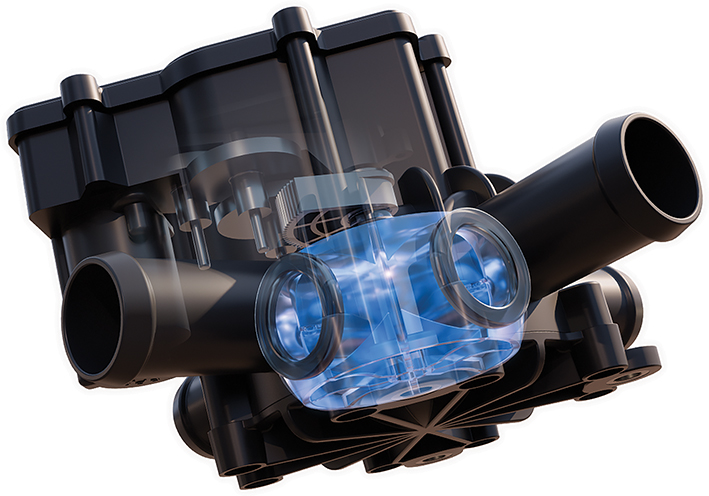
TLX’s modular valve product family is the result of that effort. This product family currently includes a three-way switching valve and a four-way switching valve. These high-flow valves can be specified with port sizes up to 25.4mm, without making any changes to the internal flow paths or diverter.
The valves also meet the power and control requirements of differing platforms by supporting both 12 and 24 Vdc operation and offering a choice of communication protocols with feedback. If the required feedback is a simple fault error, then OEMs can choose PWM. If they require specific fault codes for conditions like overcurrent, motor stall, motor stall lockout, overvoltage, undervoltage, or overtemperature, they can choose LIN. While not yet available, TLX is currently considering adding CAN communication for future revisions.
TLX also understood that its flow control valves would have a downstream impact on the overall performance of the thermal management system. The valves needed the right performance characteristics to ensure that the system’s energy and thermal efficiency are enhanced instead of hindered. The company tackled that challenge through three key features.
First, these valves maintain diverter position without drawing any current. This means the valve itself has minimal impact on the vehicle’s electrical budget.
Second, the flow paths are designed with gradual turns and smooth transitions, which minimises pressure drop. This means the pump is more easily able to handle fluid circulation demands while using less power.
Third, these valves minimise cross-flow leakage. Leakage across the flow paths at the diverter can cause thermal inefficiencies and drive the need for larger coolers, heat exchangers, and pumps. By keeping cross-flow leakage low, the system is more predictable and controllable and can utilise more efficient components within the coolant loop.
REDUCING CONSUMPTION
Together, these features help reduce the thermal management system’s energy consumption and improve its overall thermal efficiency. This results in better range, which is not only important for passenger vehicles but is particularly so for commercial applications, where taking a vehicle out of service to charge can negatively impact operations. The improved thermal control also contributes to the increased longevity of temperature-sensitive components like the traction battery, power inverter, and motor.
TLX’s modular valve product family is also designed to meet the demands of continually evolving thermal management systems. The architecture of these valves is adaptable to changing flow control demands, with a three-way proportional valve, a two-way switching valve, and a two-way proportional valve as the next likely configurations.
Chad VanRens is at TLX Technologies.
Read the October issue of International Design Engineer magazine here, or visit our magazine archive for all our recent publications.