Jake Holmes discovers how the future of driving could be steer-by-wire rather than traditional axle steering
Jake Holmes discovers how the future of driving could be steer-by-wire rather than traditional axle steering
Engineers are often discouraged from reinventing the wheel, but what about the mechanism that operates it? Global technology company ZF is fitting NIO’s flagship electric vehicle, the ET9, with its latest steer-by-wire system.
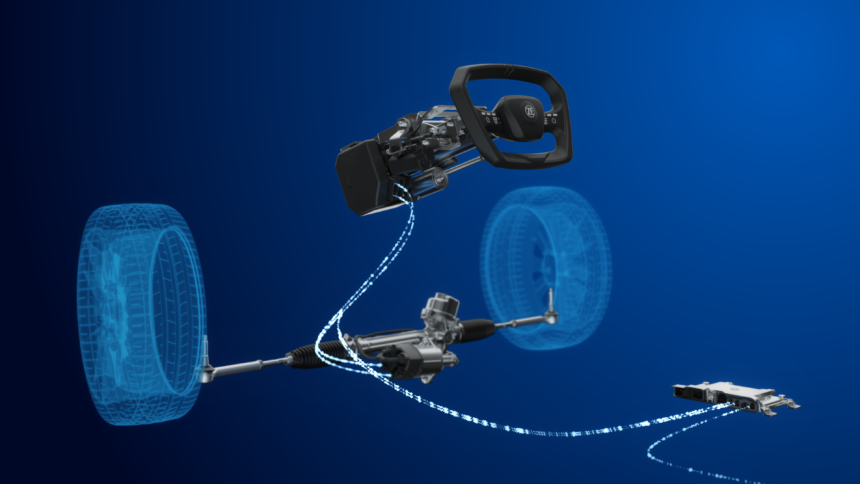
Steer-by-wire does away with traditional axle steering and instead replaces heavy metal poles with lightweight wiring. A mechatronic actuator is situated between the wheels as the sole source of transmitting steering inputs, with no mechanical connection in place.
For the driver, the experience is the same, operating a steering wheel in the cockpit with natural steering feedback reproduced from the so-called torque feedback unit. The technology opens the door to new developments in driving such as smaller steering wheels which may help drivers when parking and manoeuvring.
HOW DOES IT WORK?
Steer-by-wire is electric, intelligent, software-based, and interconnected. These features prime the system for mobility and systems moving forward. ZF’s scalable and modular system makes it easy for companies to transition to steer-by-wire, as integration into existing and future vehicle architectures is supported by its design.
Driving instructions are transmitted by wire to the vehicle’s computer and motors which turn the axel, steering the vehicle. Steering characteristics can be defined specifically for a brand or a particular model using just the software whilst the mechanics remain the same. For deployment in right-hand-drive nations, only the steering wheel actuator needs to be installed on the other side of the cockpit, simplifying the process.
STEERING SAFELY
As with any major change to established technology, safety will be a key concern. It is a key factor for other companies deciding to incorporate the new technology, as mitigating risk is a large part of business. But proven safe and successful, ZF may see many companies want to take advantage of the benefits.
Jake Morris, portfolio director at ZF, explains: “Safety of course also means smooth functioning in operation. ZF’s steer-by-wire has all the necessary fallback levels and safety concepts. Compliance with all automotive standards and cyber security is our top priority. The ZF steer-by-wire system has a redundant design. Basically, the requirements for redundancy in terms of mechanics, electronics and power supply are higher to ensure continued operation in case of a subsystem failure.”
Drive-by-wire requires a similar level of maintenance to traditional steering mechanisms, requiring no additional check-ups. However, a big advantage is the ability to monitor data and access read-out data meaning mechanics can recognise the current operating state and assess it. Data can be accessed both by a mechanic in a workshop or remotely.
The removal of mechanical components means there are fewer potential parts to harm a driver in the event of crashing, meaning they are safer in the cockpit. It also allows for new options in installing an airbag. This creates better passive safety inside the cockpit.
Morris adds: “In emergencies, drivers may overreact or make incorrect steering inputs. Steer-by-wire can automatically correct these inputs, stabilising the vehicle more effectively. This reduces the risk of accidents caused by oversteering or understeering. The elimination of mechanical steering components reduces the number of parts that could endanger occupants in an accident. It also opens up new options for the installation of safety features like airbags.”
ASSESSING THE BENEFITS
Overall vehicle weight can be reduced by removing the unnecessary components associated with traditional steering mechanisms. This is beneficial to the fuel economy of the car, making it cheaper to operate. It also requires less raw materials to manufacture, lowering costs for OEMs.
Both mechanical complexity and weight are overcome by using steer-by-wire, as all these components are removed and the design is simplified. Variable steering ratios can be deployed in steer-by-wheel, meaning there is no need to compromise the steering ratio between low-speed manoeuvrability and high-speed stability. It also allows for customisable driving experiences, such as sport or comfort.
OEMs are also afforded more room inside the cockpit to design, allowing them to improve the ergonomics of various features. This can help inspire innovation and more efficient vehicle designs. Passengers can benefit from more legroom and new steering wheel formats, with the potential for it to even retract into the dashboard.
DRIVING TOWARDS TOMORROW
In the future, it is possible a central high-performing computer will control the system along with all other driving dynamics functions, Morris says. This opens up a pathway for a fully autonomous driving system.
This is not only applicable to passenger cars but also to heavy goods vehicles. Industry could take advantage of this technology for applications such as deliveries. This would empower 24-hour delivery services without the need for paying overtime to staff, or even employing staff who do not need to be able to operate such machinery, reducing overhead costs.