
Ensuring safer energy storage across the transportation sector
This new family of advanced CAN-based environmental sensors is ensuring safer energy storage across the transportation sector
Advanced sensors are a crucial tool for engineers to monitor and mitigate risks within battery packs for electric vehicles (EVs) and hydrogen systems for fuel cell electric vehicles (FCEVs). Metis Engineering’s newest range of configurable CAN-based environmental sensors is designed to address critical challenges surrounding safety, emissions monitoring and operational efficiency in static energy storage, EV and HVAC industries.
The new sensor family is made up of three sensors – Cell Guard, H Guard and Air Wise – that can be deployed across a wide variety of industries, including automotive and aerospace. In particular, their versatile design and CAN compatibility mean they can be easily adapted for use in emerging applications such as hydrogen refuelling stations and next-generation battery systems.
“We are thrilled to launch these innovative sensors that address the safety and sustainability challenges in energy storage head-on,” says Metis Engineering’s founder and CEO, Joe Holdsworth. “With lithium-ion batteries and hydrogen playing a vital role in the clean energy transition and the need for enhanced emissions control in various sectors, our sensors offer critical solutions that ensure safe operations while supporting global climate goals.”
UNIQUE CAPABILITIES
Metis Engineering has designed and produced sensors for a wide range of transport applications, from bicycles and high-performance aircraft to motorsport and autonomous vehicles. With its latest releases, the company hopes to ‘redefine’ how engineers monitor and mitigate risks.
“Metis Engineering’s sensors are unique in that they combine a wide number of sensors into one easy to install package,” Holdsworth explains. “This included an optional accelerometer to give impact detection, an essential parameter that enables integrators to know what vibrations of loads a battery pack has experienced during its life or in the event of a collision. Coupled with easy connectivity via CAN connectors, the sensors are easy to integrate into battery management systems (BMS) where they provide much more information about the health of the pack than is typically available.”
PRECISION MONITORING
Despite Lithium-Ion-based energy storage systems becoming more robust in recent times, safety remains a crucial consideration.
“Sensors such as ours provide confidence and increase the safety for the end user in both electric vehicles of all types and energy storage applications,” says Holdsworth. “Whilst battery packs are inherently very safe, they make the headlines on the rare occasions when they go into thermal runaway.”
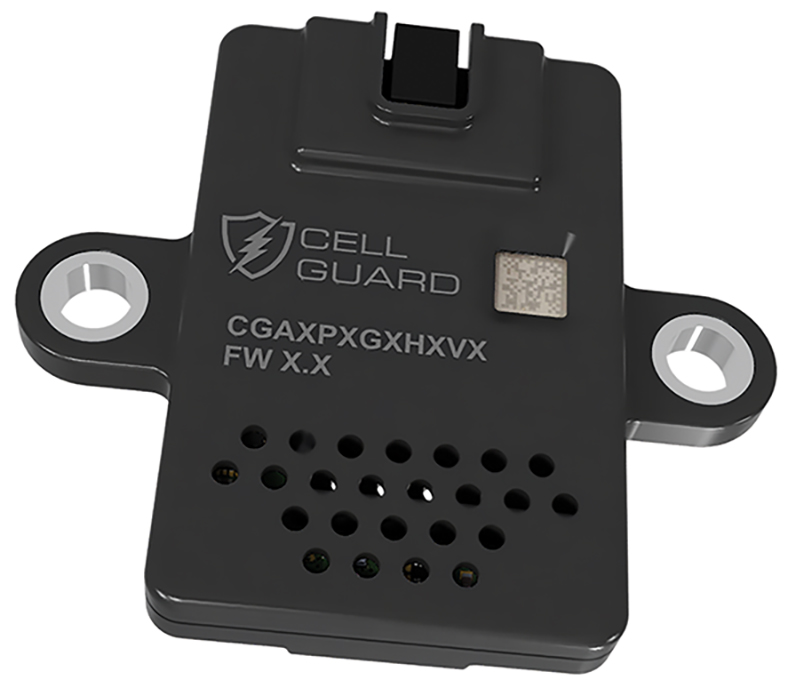
Metis Engineering’s new Cell Guard sensor provides real-time monitoring of LFP and NMC battery health, including early detection of cell venting and moisture ingress, dew point changes, shock loads and hydrogen generated by electrolysis within battery packs. Integrated CAN communication enables seamless data transfer, giving advanced BMSs to detect potential points of failure before they escalate. This enhances the longevity and safety of energy storage systems. Designed as an ideal solution for EVs, grid storage, battery R&D and industrial applications Cell Guard allows predictive battery health management while providing vital information for battery passports.
“The more information available on the environmental health of a battery pack, such as moisture ingress, dewpoint or impact detection, leads to better treatment of batteries to increase their useable life and also enables decisions as to whether they are safe for second life applications, which ultimately means less wastage,” Holdsworth adds.
HYDROGEN LEAK DETECTION
With hydrogen growing in popularity as a means to decarbonise the transportation sector, leak detection is vital to ensuring safe operation. Metis Engineering’s new H Guard sensor is designed to detect even the smallest traces of hydrogen gas, ensuring early intervention prior to it collecting in explosive concentrations. Applicable to hydrogen-powered vehicles, fuel cells and refuelling stations, H Guard provides real-time alerts through CAN-based communication, allowing operators to respond immediately to leaks. According to Metis Engineering, the sensor’s accuracy and responsiveness make it a vital tool in supporting the growth of the clean hydrogen economy.
MONITORING NOX AND CO2
The third new addition to Metis Engineering’s new sensor family is Air Wise, a high-precision sensor designed to detect NOx and CO2 levels within HVAC systems and ensure proper ventilation and compliance with emissions regulations. With CAN integration, the sensor enables dynamic data-driven control of ventilation systems in order to reduce energy waste, maintain optimal air quality and improve environmental sustainability.