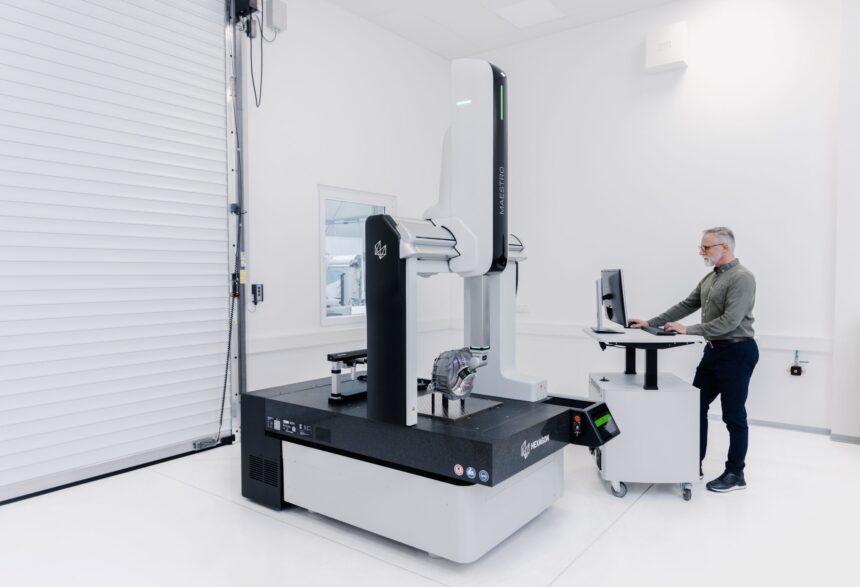
New machine brings speed, precision, and performance
Hexagon has unveiled its new Maestro, a coordinate measuring machine. It provides a new generation of measuring machine capabilities, engineered specifically for meeting growing productivity demand.
Amidst the ongoing skills shortage coinciding with the need for increased product quality, Hexagon has launched the Maestro to remedy these issues. The machine sets new standards for speed, simplicity, and digital integration in metrology.
A digital first architecture allows for an intuitive user experience requiring less training to operate and seamless data integration. Both software and hardware are modular, allowing it to be scaled for applications and growing needs.
It is suited to aerospace, automotive, and high-precision manufacturing environments, as these sectors all require safety, compliance, and performance.
New digital features have been incorporated to support the digital architecture of the machine. Digital sensors, a single cable system, and a new controller with new firmware and been added to the Maestro. This allows for increased throughput, streamlining measurement operations, and ensuring future-ready connectivity for modern production environments.
Jörg Deller, general manager of stationary metrology devices at Hexagon, said: “Manufacturers told us they needed a next-generation system that tackles rising quality demands and skills shortages. By rethinking our hardware and software from the ground up, rather than iterating on existing systems, we’ve had the freedom to create a high-accuracy inspection solution that is so intuitive that anyone from expert to new hires becomes significantly more productive.”
Machine operators can benefit with from the machine's high precision at high speed, industry-leading speed, simple user programming, end-to-end connectivity, and scalable platform.
Deller added: “Meeting the needs of industry head-on, MAESTRO’s digital backbone also makes it straightforward to integrate into modern connected factories, so stakeholders can improve quality quickly and definitively.”
Pilot applications have reported an increase in productivity whilst reduced inspection lead times, due to the speed and accuracy of the new machine. This has helped prevent bottlenecks in the system, preventing slowdowns in production.