Blue Hydrogen Production and Markets 2026-2036: Technologies, Forecasts, Players
IDTechEx has published a new report, “Blue Hydrogen 2026-2036: Markets, Technologies, Challenges and Opportunities, Forecasts, and Players”, which provides a comprehensive assessment of blue hydrogen production technologies, players and projects, supply chains, materials, and regulatory developments in global markets
The report includes a comparison of main blue hydrogen technologies with 10-year market forecasts, segmented by six technologies, seven application areas, and three regions of adoption, as well as examining applicable carbon capture, utilisation, and storage (CCUS) technologies and discusses the drivers, opportunities, and outlook of the blue hydrogen market.
Decarbonisation
Low-carbon hydrogen is becoming a critical solution to climate change. Hydrogen’s potential lies in decarbonising hard-to-abate sectors such as iron and steel, chemical manufacturing, and long-haul transport. Unlike conventional hydrogen, low-carbon hydrogen reduces emissions from the production process, making it critical to achieving global climate targets.
Less than 1% of the current total hydrogen supply is low-carbon, so transitioning to a hydrogen economy will require scaling up low-carbon hydrogen production, with blue hydrogen serving as an essential step.
Blue hydrogen and turquoise hydrogen
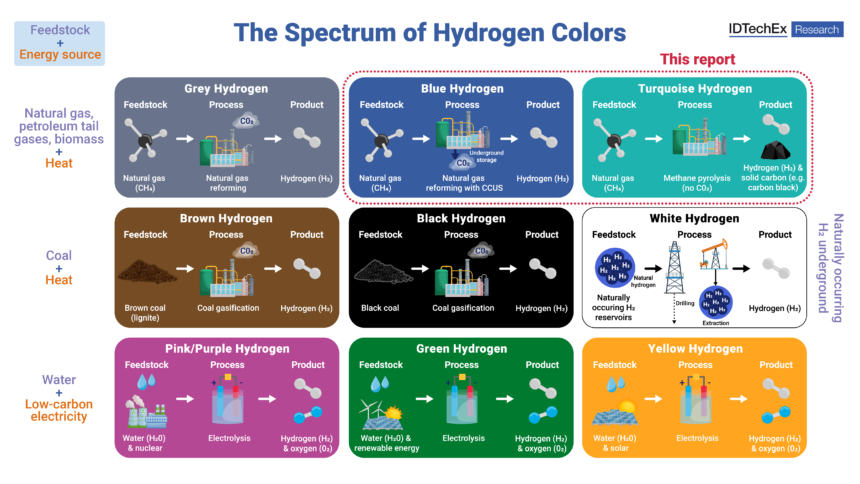
Blue hydrogen is hydrogen produced from fossil fuels using conventional processes integrated with CCUS technologies. Unlike conventional hydrogen production, which emits CO2 into the atmosphere, blue hydrogen captures most of the CO2 for storage or industrial use, reducing its carbon footprint. This IDTechEx report details hydrogen colour classification and different hydrogen technologies.
In blue hydrogen processes, CO2 storage is achieved by injecting captured gas into permanent geological formations, such as saline aquifers or depleted oil fields. CO2 utilisation options include enhanced oil recovery and industrial product manufacturing. Carbon capture technologies can be retrofitted onto existing facilities or integrated into new plants by design. The report offers a detailed discussion of key CCUS technologies and their application to blue hydrogen production.
Turquoise hydrogen is also a low-carbon hydrogen type produced through methane pyrolysis; no CO2 capture is required, and the resulting solid carbon by-product can be used in several industrial applications. While not strictly classified as blue hydrogen, IDTechEx covers turquoise hydrogen in this report, as it uses natural gas as a feedstock and produces low-carbon hydrogen suitable for similar applications.
A green hydrogen future
Blue hydrogen is a transitional solution closing the gap between grey hydrogen production and the long-term goal of green hydrogen. While green hydrogen, produced from water using electrolysers with minimal emissions, is suitable for full decarbonisation, depending on it alone is not feasible.
This is due to high electrolyser costs and the growing demand for renewable electricity, driven by energy-intensive sectors such as data centres. As a result, blue hydrogen is considered an intermediate solution that facilitates the gradual transition to a low-carbon hydrogen economy. This report highlights the strategic role of blue hydrogen and provides cost comparisons and market adoption trends across different hydrogen production pathways.
Strategy and regulatory developments
Over 60 governments worldwide have included hydrogen in their energy transition plans. Leading regions include the US, Canada, and the Netherlands, each implementing different mechanisms to support low-carbon hydrogen development. This report provides a summary of key national hydrogen targets and strategies.
However, not all initiatives are progressing as planned, and recent regulatory changes have slowed the broader hydrogen market's development. Many large-scale hydrogen projects have been delayed or cancelled, leading the market not to expand as rapidly as anticipated.
Production technologies
The report examines conventional processes, including steam methane reforming (SMR), autothermal reforming (ATR), partial oxidation (POX), and coal gasification (CG).
Methane pyrolysis is also an emerging technology that produces hydrogen, with solid carbon as a byproduct. Other production processes in the report include biomass-based processes and novel blue hydrogen technologies. While these represent a small market share, they may attract more interest in the near future.
Technology and market trends
IDTechEx forecasts that the global blue hydrogen market will reach US$52 billion by 2036, with a CAGR of 22%. IDTechEx's analysis shows that most of the capacity growth will come from North America and Europe. The dominant market applications, such as refining and ammonia production, are expected to continue growing. Industrial clusters that integrate multiple blue hydrogen end uses are projected to drive rapid expansion.