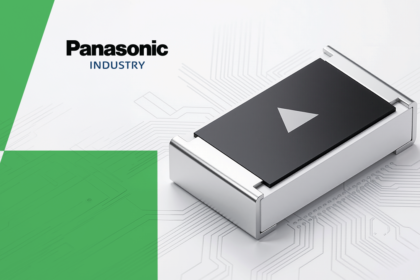
Farnell has begun distributing Panasonic Industry’s ERJPC series of super high-precision thick-film resistors, which combine accuracy associated with thin-film technology with increased power density and a more cost-effective component architecture.
Designed for space-constrained electronic systems, the ERJPC range offers resistance tolerances of ±0.1% and ±0.5%, with a temperature coefficient of resistance (TCR) as low as 25 ppm/K. Panasonic says the components deliver up to twice the power density of traditional thin-film alternatives, enabling designers to reduce PCB footprints without compromising precision.
The resistors are rated at 0.2 W in a 0603 package and 0.25 W in an 0805 package. This allows smaller components to replace larger alternatives in applications where board space and thermal performance are important design considerations.
The series is AEC-Q200 compliant and RoHS certified, making it suitable for automotive and industrial electronics, as well as consumer applications. Potential uses include battery management systems (BMS), engine control units (ECUs), industrial automation and home appliances.
“Many applications – such as BMS, ECUs, home appliances and industrial and factory automation systems – require high precision components.” Clara Lagomarsini, product manager device solution business division at Panasonic Industry, said.
“Our thick film technology is a real alternative to thin film implementations. The new ERJPC thick-film series combine high-precision, environmental stability, while offering a new path towards long-term cost efficiency.”
The ERJPC series is available for delivery through Farnell in EMEA, Newark in North America and element14 in APAC.
“Adding ERJPC to our Panasonic portfolio gives customers a high-precision solution,” said Andy Weatherill, VP global product, supply chain at Farnell. “By using advanced materials and optimised structures, Panasonic enables engineers to achieve thin-film-level accuracy alongside the power-density advantages of thick-film technology — supporting meaningful board downsizing and long-term cost savings in demanding designs.”