High pressure (HP) subsea workovers use a variety of tools and interfaces for routine and emergency situations when managing flow lines. Subsea HP couplings protect personnel, the environment and assets. Allowing subsea hoses and coil tubing to be coupled and decoupled safely.
Whilst dynamic positioning (DP) technology has advanced, the need to protect subsea hydraulic downlines in the event of vessel drift-off or ROV error is still evident.
For routine hydraulic interventions, the requirement for low-cost easy access to allow operators to access subsea assets, intervene and stimulate wells quickly and efficiently is a key consideration for the life of field.
Keeping it flowing.
Whilst nothing new, riserless light well intervention (RLWI) is slowly growing across the subsea intervention sphere — not just in keeping things flowing for mature functioning wells, but in pre-commissioning and the ever-popular decommissioning.
The key driver for RLWI is relatively low cost as compared to other Rig based intervention methods which use Risers. Ultra-light intervention systems open up the use of smaller vessels of opportunity for targeted interventions, further reducing the costs per campaign, where reliable QCDC technology is required.
Shallow and deep-water operations have used quick connect disconnect (QCDC) technology worldwide for more than 20 years. This QCDC technology allows operators to plug and play by connecting and disconnecting hydraulic lines with minimal effort, with zero ingress and zero spill respectively, whilst offering a robust, no-frills emergency release point — one that works passively by hose tension or with a hydraulic override. Whilst most current applications have evolved with 10,000psi technology, deeper wells require the next level for reliable hydraulic intervention at 15,000psi.
Field-driven GAINs
The technology has matured over the last two decades through rigorous research and development testing, proven field history and operator feedback, with design iterations worked through alongside operators. This type of QCDC technology allows operations to get going quickly and safely following an emergency quick disconnect (EQD) incident.
Providing more pressure
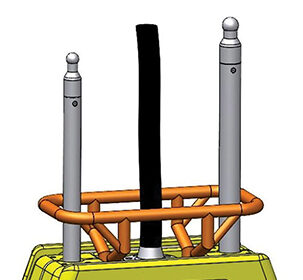
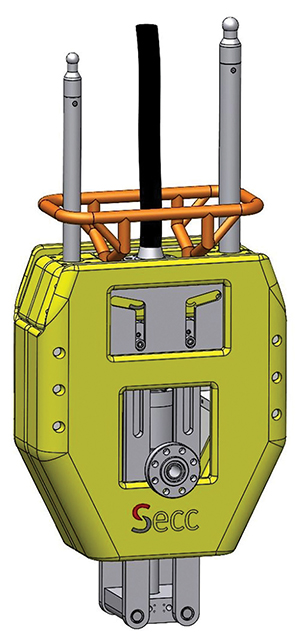
The patented ALTUM QCDC introduces 15,000psi capability, driven by demand in the Gulf of Mexico for ultra deep-water intervention at 10,000ft. Evolved from the Hot Make Hot Break QCDC, it allows operations to reconnect and continue without being pulled to surface.
Manufacturing and performance features brought the design to a high level of performance and reliability, but there was more to solve for operators. The challenge? Stepping from 10,000psi to 15,000psi breakaway technology.
Flexible downlines currently use midline weak links at 15,000psi. These sit between the hoses and act as a cruder “safety fuse”, which must be recovered and reset after activation. The ALTUM doesn’t.
During controlled and emergency activations the ALTUM transitions from the open to the isolated state, simultaneously closing the flexible downline and fixed receptacle, before releasing. This transition during an activation sees internal hydrostatic pressures creating high loads on the frame system of up to 87t, four times as much as the 10,000psi predecessor. The ALTUM masks these loads with pressure balanced seals and retention frame technology allowing the connector to isolate and release with zero external thrust.
This exponential increase in transitional loads created a significant challenge for the engineering team and for the direction of the coupling, which needed to stay within a feasible weight and size envelope whilst meeting the full criteria.
Work is under way with Tier 1 OEMs and service operators to integrate the ALTUM into a range of subsea systems.
For more information visit: https://secc-oilandgas.com