A two-part series on the importance of conveyor belt transfer point maintenance
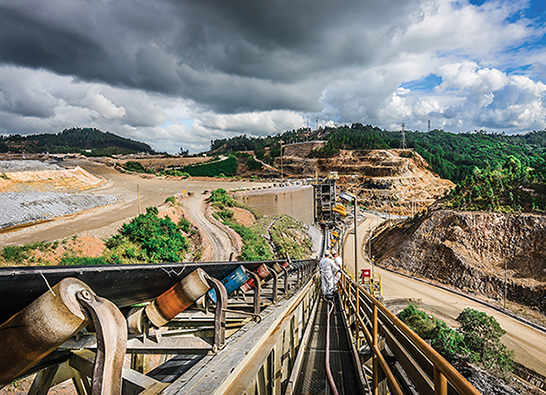
The conveyor system from the Bou Craa mine in Western Sahara to an export point on Africa’s Atlantic coast is widely considered to be the longest in the world.
Spanning almost 100km (61mi) of the Sahara Desert, and carrying around 2,000t of phosphate every hour, the conveyor is well known for being ‘visible from space’. But on closer inspection, it’s not the vast conveyor that’s identifiable from far above the earth; it’s the trail of pale dust that lies up to around 2.4km (1.5mi) to the south of the structure, blown by persistent northerly winds.
Beyond dust emissions, there are many logistical and maintenance considerations for long conveyors. Built to address inefficient, expensive, slow and sometimes dangerous road haulage, long conveyors are critical arteries in the minerals supply chain, especially for transport between two fixed points. With lower maintenance, less labour, continual throughput and better safety, they carry a lot of weight – both literally and figuratively – with high performance expectations, often in harsh environmental conditions.
“We’ve observed that a fleet of trucks involves several logistical factors such as the need for experienced drivers, trained mechanics, safe roads and a lot of fuel,” says Andrew Timmerman, global engineering manager at Martin Engineering. “Long conveyor systems are designed to reduce some of the cost and safety issues. But like any solution, they have their challenges, too.”
Moving materials safely
A priority for any bulk handling operator should be workplace safety and mitigating or eliminating possible hazards. Vehicle transport relies on a fleet of trucks and competent drivers – often sharing public roads – and is directly affected by weather conditions. These, and other risk factors, mean that even the most conservative workplace safety statistics reveal that there are 15 times more fatalities using road transport compared with the equivalent long conveyors. For reasons of safety alone, long conveyors are the right choice wherever appropriate.
Transfer points and servicing
“Access is critical with virtually any conveyor,” Timmerman says. “No matter how well the system is running, transfer points need to be inspected and serviced at least every six months.”
Transfer points give rise to the greatest potential for spillage, with fugitive materials quickly piling up and encapsulating the belt and moving parts. Commonly, it’s the responsibility of maintenance teams to first clear away accumulated material before taking steps to remedy the root causes of carryback, spillages, build-ups and blockages.
However, properly engineered material transfer includes belt cleaning, sealing, chute clog prevention, impact management, tracking and monitoring to control the need for unplanned maintenance and unscheduled downtime. This is especially critical for remote transfer points on long conveyors where the goal should be to minimise the number of service visits and address all of the maintenance issues in a single visit.
Transfer Point Maintenance
Even the best designed transfer points can take some care to maintain. The most common ongoing transfer point maintenance tasks include:
• Primary and secondary belt cleaner blade replacement
• Belt cleaner performance monitoring and tensioner adjustments
• Inspection and servicing of rollers and other moving parts
• Transfer hopper and chute maintenance as well as blockage mitigation
• Belt tracking, signs of misalignment and general condition
• Spillage cleanup (in cases where the control of fugitive materials is inadequate)
When today’s conveyor belt cleaner designs and configurations (primary, secondary and in some cases tertiary) are well maintained, the systems are highly effective at removing material stuck to the belt, controlling the amount of carryback and spillage.
Belt cleaning is essential, because loose cargo pressure and material moisture content on the carrying side can cause the material to cling to the belt after discharge, especially for conveyors exposed to the weather. This fine material drops off releasing dust and fines during the return run. Fascinating as it might be to see a conveyor from space, no operator wants that visibility to be the result of fugitive dust.
Further, having to frequently maintain a primitive belt cleaner to make sure it is adequately tensioned and cleaning properly is costlier in labour over the long run than installing quality belt cleaning equipment from the start. This is known as Return on Performance (ROP), which differs from Return on Investment (ROI) in that it calculates the savings in labour for maintenance and equipment life over the long term, instead of merely the period in which the initial capital investment is recovered regardless of increased costs and replacements afterward. At a transfer point located miles away from a service team, having a reliable belt cleaner tensioning system that is self-adjusting and/or low maintenance drastically reduces the cost of operation.
On a busy mine processing plant, shovelling away spillage can be done daily, but for remote transfer points where fugitive material has built up over time, the job requires transporting people and equipment to the site. Allowing volumes of spillage to build up between visits may lead to serious production issues, as well as environmental permit violations, so sealing transfer points to mitigate spillage saves in more ways than one.
Transfer chutes can also experience build-up due to material properties, such as particle size, moisture content, temperature, abrasiveness and corrosiveness. When clogs happen, production stops fast and backflow fouls components in the discharge zone and spills over the edges of the system. If that happens on a major plant, teams can be on hand quickly to fix the issue. But on extended conveyor lengths, due to the transport and equipment needed, unscheduled downtime can become very costly.
Part two will feature in the August issue of International Mining Engineer. For more information visit: www.martin-eng.co.uk