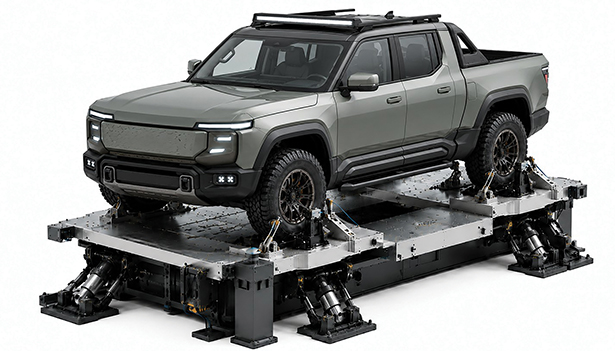
A recent case study from Hottinger Brüel & Kjær demonstrates how sustainability can be integrated into electric vehicle manufacturing processes from the start.
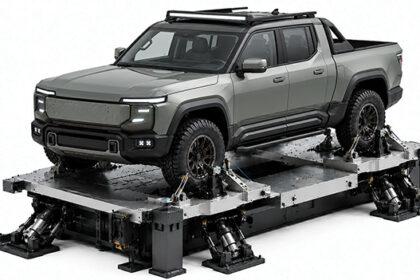
Launching a new electric vehicle (EV) company is fraught with challenges, not least proving long-term product reliability without historical data, and building credibility in a competitive market. This is the problem Hottinger Brüel & Kjær’s (HBK) customer faced, as a new American EV manufacturer that designs and manufactures electric adventure vehicles, commercial delivery vehicles and its own charging infrastructure.
ESTABLISHING TRUST
Unlike legacy car manufacturers, HBK’s customer didn’t have a longstanding reputation of decades of field data to back it up. This means each product needed to prove its reliability from day one and build critical brand loyalty quickly.
The company’s adventure vehicles must withstand extreme environments and temperatures, which place immense stress on the chassis, battery, suspension and propulsion systems. Integrating novel quad-motor propulsion – a large and complex battery pack – also posed a challenge, as did the company’s sophisticated software-defined architecture that created countless potential failure modes.
ENTER HBK
To meet these challenges, the EV manufacturer established a dedicated Design for Reliability (DfR) department, which embedded HBK’s ReliaSoft suite as its core toolset to build its products.
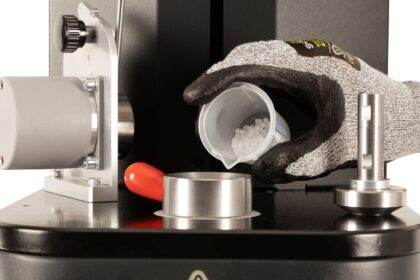
Before physical testing begins, ReliaSoft is used to design statistically robust test plans, including Accelerated Life Tests (ALT). These tests enable the company’s engineers to determine the exact number of samples, stress levels and test durations required to prove a component will meet its life target. As data comes in from lab testing and customer fleets, it is fed into HBK’s Weibull++ tool, which analyses the data to create precise models of a component’s expected life.
Using HBK’s BlockSim tool, the engineering team can model an entire vehicle as an interconnected system. By inputting the lifetime predictions for individual components from Weibull++, the team simulates the overall vehicle reliability and identified which components had the biggest impact on system-level performance.
Throughout the design process, HBK’s XFMEA tool is used to systematically identify potential failure modes and their effects, allowing the engineering team to address risks digitally.
FUTURE FOUNDATION
Integrating a standardised DfR programme with ReliaSoft not only delivered early insights into lifetime performance of components, but also provided a 9% improvement in product development efficiency. By using accelerated testing and predictive models, the EV manufacturer could identify and fix potential weaknesses much earlier in the development cycle.
System modelling also prevented over-engineering on non-critical parts while ensuring the systems essential for safety and adventure were robust. The ability to analyse customer fleet data enabled the manufacturer to create a continuous feedback loop based on real-world data, making future product designs more durable and customer-focused.
Read the October issue of International Design Engineer magazine here, or visit our magazine archive for all our recent publications.