The offshore energy sector is moving towards increasingly autonomous and electrified subsea infrastructure. Longer tiebacks, carbon capture and storage (CCS), subsea processing and the growing use of autonomous underwater vehicles (AUVs) are creating new demands for reliable power at the seabed. At the same time, operators are under pressure to reduce vessel time, installation complexity, operating costs and emissions.
These requirements are changing the role of subsea battery systems. Rather than serving only as independent power sources for instruments, batteries are increasingly becoming part of larger subsea energy architectures. SubCtech has responded by expanding its PowerPacks battery platform and developing a modular Subsea Energy Storage System (ESS) for high-capacity offshore applications.
Designing power for harsh subsea environments
A central engineering challenge is combining high energy density, long service life and reliability under harsh subsea conditions. Depending on the application, systems may need to operate for years with limited physical access while exposed to pressure, low temperatures, vibration, shock and corrosive environments.
SubCtech’s lithium-ion PowerPacks are designed as configurable modules rather than a single battery type. Pressure-tolerant housings can be supplied in titanium (grades two or five) or super-duplex stainless steel for deployments down to 6,000m, while marine-grade aluminium housings are available for shallower applications up to approximately 1,000m. Different module diameters and electrical configurations allow the platform to be adapted to sensors, AUVs, ROVs and larger subsea installations.
The batteries are controlled by SubCtech’s SmartBMS battery management system. It monitors operating parameters from individual cells through to complete module arrangements and provides protection against overvoltage, undervoltage, overcurrent, overheating, overcharging and short circuits. For larger systems, the control architecture also supports automated configuration, diagnostics and redundant operation.
Qualification is particularly important because subsea battery systems must remain dependable when intervention is costly or impossible. The PowerPacks platform is tested for mechanical, thermal and electromagnetic loads and is designed with reference to established offshore and transport requirements including UN 38.3, API 17F/API 17Q, MIL-STD and DNV 2.7-3, depending on the system and application.
From battery modules to megawatt-hour storage
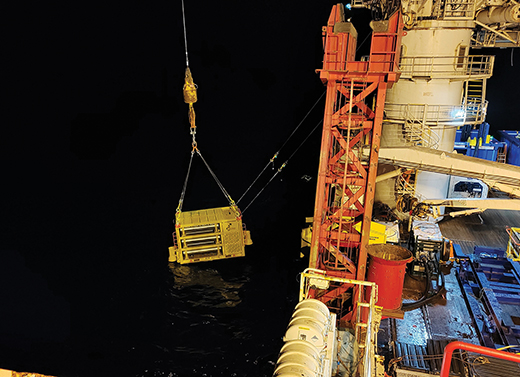
The latest step is a scalable subsea ESS for applications where power requirements exceed those of conventional standalone batteries. Its architecture combines two 1MWh battery storage skids with an integrated power skid containing AC/DC conversion equipment. A battery control module based on SubCtech’s NetDI technology interfaces with the SmartBMS and manages the overall system.
The modular architecture allows storage capacity to be expanded to as much as 6MWh. Redundancy is built into the system so that critical subsea consumers can continue operating if individual elements are unavailable. The system has been engineered for a design life of up to 25 years and, in its current configuration, for deployment at approximately 2,000m water depth, with deeper variants technically feasible.
An important development milestone has been qualification of the ESS to API 17F and validation at Technology Readiness Level 7. The system has therefore progressed beyond laboratory testing and been demonstrated under conditions representative of an offshore operating environment. It has already been applied in the oil and gas sector, where a follow-on order provided an early indication of the practical value operators see in subsea energy storage.
Supporting oil & gas, CCS and autonomous operations
The applications extend beyond conventional production. In CCS projects, local subsea energy storage can support monitoring, injection and control equipment while reducing dependence on long electrical connections to surface facilities. Similar concepts can be used for subsea compression, long tiebacks and offshore renewable energy systems, where local storage can buffer intermittent power.
AUV operations provide another example: Larger vehicles increasingly require hundreds of kilowatt-hours of onboard energy, with some XXL-AUV configurations exceeding 1MWh. Modular battery systems can be connected in series or parallel to achieve the required voltage, capacity and redundancy. Combined with seabed docking and charging stations, this enables longer autonomous missions without routine recovery to a vessel.
This shift has wider operational implications. Vessel mobilisation is a major cost and emissions driver offshore. If subsea assets can operate longer, be monitored remotely and recharge autonomously, vessel interventions can be reduced. Local energy storage may also replace or shorten certain umbilical or cable connections, particularly for remote infrastructure.
Towards more autonomous subsea infrastructure
The next phase of subsea electrification will therefore depend not only on greater battery capacity, but on integrating storage, power conversion, diagnostics and communication into complete systems. For offshore operators, the objective is straightforward: reliable power where it is needed, with less surface infrastructure and fewer interventions.
SubCtech’s development of modular PowerPacks and the subsea ESS reflects this transition from individual underwater batteries towards intelligent, scalable energy systems. As oil and gas, CCS and autonomous subsea operations increasingly converge around electrification, energy storage is becoming an enabling technology for the next generation of offshore infrastructure.
“Our focus is on making subsea operations more autonomous, efficient and reliable,” says CEO Gunnar Tons. “By combining scalable battery systems with intelligent energy management, we can reduce surface dependency and support the next generation of offshore infrastructure.”
For more information visit: www.subctech.com