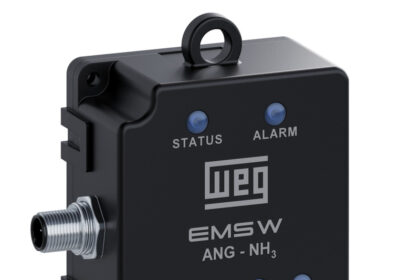
WEG has launched its new EMSW Environmental Monitoring Sensor Line to help operators identify ammonia leaks and changing environmental conditions sooner, reducing safety and operational risks in industrial facilities
Ammonia is commonly encountered in applications ranging from industrial refrigeration to chemical and pharmaceutical processing. The WEG EMSW sensors can continuously monitor ammonia (NH₃), temperature and humidity, combining local audible and visual alarms with connectivity to wider industrial control and monitoring systems.
The technology combines gas and environmental measurements in a single device, providing greater visibility into changing conditions while enabling data to be incorporated into existing automation infrastructure.
Liam Blackshaw, product manager and business development manager of automation and digital at WEG, said, “Operators need to know about changing environmental conditions before they develop into a more serious problem. The EMSW Line has been developed to make environmental monitoring easier to integrate into industrial environments, providing local warning while also making data available to the wider control system.”
Designed for temporary and permanent installations, EMSW sensors have an IP66 protection rating, an operating temperature range of 0 to 50°C, and are CE certified.
WEG offers three EMSW variants to accommodate different control architectures. The EMSW-ANG operates from a 13 to 32Vdc supply and provides selectable 0-10V or 4-20mA analogue output, and IO-Link and NFC connectivity.
The EMSW-MOD operates from 13 to 32 Vdc, communicates using Modbus RTU over RS-485, and includes NFC. For installations requiring relay-based signalling, the EMSW-RLY operates from a 127/220 Vac supply and provides a configurable NO/NC relay contact, along with NFC connectivity. All three models use an M12 four-pin connector.
These communication options allow environmental data to feed into PLCs, gateways, dashboards, supervisory platforms, and wider control systems. As a result, operators can use the sensor for immediate local indication while incorporating its measurements into remote or centralised monitoring.
The range is suitable for ammonia leak detection and environmental monitoring in chemical, petrochemical, and pharmaceutical facilities, refrigerated areas, cold rooms, and other industrial environments. It can also be deployed in farms and livestock facilities, where gas, temperature, and humidity monitoring supports closer control of operating conditions.
Blackshaw said, “As industrial plants become more connected, environmental monitoring should become part of that same digital infrastructure. Giving users a choice of analogue, Modbus, IO-Link, relay and NFC options makes it easier to introduce monitoring without having to redesign the surrounding automation system.”