The advantages of pultruded composites for bus and coach manufacturing
The advantages of pultruded composites for bus and coach manufacturing.
Transportation vehicle manufacturers face mounting challenges, particularly when it comes to the design of buses and coaches. Growing urban populations have placed higher demands on public transport infrastructure, while the need to adapt to ongoing environmental pressures has prompted engineers to look for electric vehicle (EV) solutions. However, the materials used in such vehicles need to accommodate for battery weight and combat corrosion while improving structural integrity and lowering emissions.
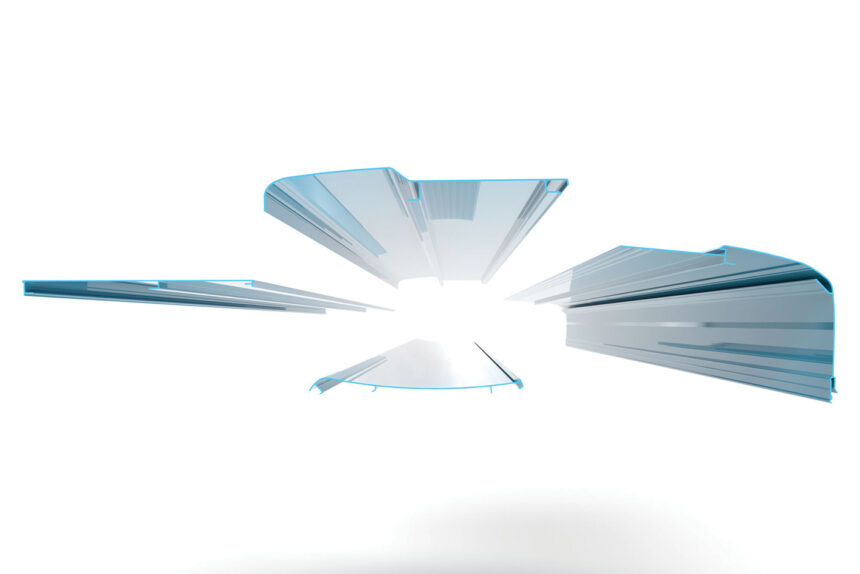
A recent whitepaper from Exel Composites explores the growing role of composite materials in the bus and coach sector. Composite materials are well-suited to meet the challenges of electric buses, as in addition to being lightweight they also offer excellent corrosion resistance and thermal insulation. According to the whitepaper, continuous pultrusion manufacturing techniques enable the creation of wider, longer and more complex composite profiles at high volume and repeatable quality.
“Composite materials are well-suited to meet the challenges of this new generation of buses and coaches,” says Patrick Loock, Sales Director Europe at Exel Composites. “The customisation options are built into the pultrusion manufacturing process, reducing lead times for customers. Many might know about the lightweight, excellent corrosion resistance and thermal insulating properties of composites.
“A less obvious point is the ability to make wider and more complex shapes with pultrusion,” he continues. “Fiberglass side panels of up to 1.2m wide and 12m long are possible, whereas aluminium profiles are more limited in size. Having one continuous panel reduces the complexity of assembly and maintenance compared to using multiple pieces. Additionally, using one panel is cheaper overall than manufacturing or buying fixings and attaching pieces together.”
ENABLING LARGE-VOLUME PRODUCTION
According to the whitepaper, advanced materials such as composites are becoming more accessible and better suited to bus and coach manufacturers’ needs than ever before. Continuous manufacturing techniques such as pultrusion enable large-volume production of high-quality uniform panels and profiles for any 2D components, helping manufacturers to meet increased public transport requirements.
“Over the last 20 years, urban growth has really pushed the limits of our public transport systems, especially buses,” Loock says. “As we move towards more sustainable options, advanced materials like composites will be key. They enable companies to tackle the challenges of EVs head-on, helping us reduce vehicle weight, extend maintenance lifetimes and improve design flexibility.”
Exel Composite’s pultrusion and continuous lamination techniques enable the creation of custom glass reinforced plastic (GRP) and carbon fibre reinforced polymer (CFRP) composites that deliver several benefits across a wide range of bus applications, including bus roofs, body panels, side walls, skirt profiles, coach profiles, luggage racks and internal coves. According to the company, employing composites in bus manufacturing unlocks numerous advantages, from substantial fuel economy improvements to reduced maintenance costs, in addition to opening up new possibilities for creative design.
“Composites are changing how we build transport vehicles,” Loock explains. “Unlike metals, pultrusion lets us create much wider, complex profiles in a single piece, cutting down on connectors. This not only simplifies assembly but also makes it easier to maintain, lowers costs and enhances the overall design.”
He adds: “When it comes to modern transportation, especially in rapidly growing cities, composites offer advantages far beyond just weight savings. Their machinability lets us craft customised profiles that meet today’s demands. This doesn’t just make vehicles lighter; it also boosts durability and eases maintenance requirements, which is vital as population centres continue to expand and demand more from their public transport systems.”
For more information visit www.exelcomposites.com