The second in our series the Age of AI looks at driving automation in energy management
In the second part of our Age of AI series, we look at how Schneider Electric is using AI as a tool to cut through the complexity of current industrial practices and drive automation in energy management
AI is not just a technological advancement; it is a strategic enabler that can help businesses enhance efficiency, reduce emissions, and drive economic growth. Those are the words of Maria Tjader, head of government affairs UK and Ireland at Schneider Electric. The company’s own AI-based solutions have been engineered with the aim of transforming energy management and automation as it pursues its ambitious sustainability and industrial efficiency goals.
“AI really is going to be, and currently already is, the next industrial revolution,” Tjader continues. “By integrating AI into industrial operations, companies can futureproof their business and contribute to the UK’s sustainability and innovation goals.”
With four international ‘AI Hubs’ in India, France, the US and China, Schneider has fully embraced its own digitalisation journey, within which AI is playing an increasingly important role. In light of recent advances in Industry 4.0, the company is now calling for the potential of AI to be fully harnessed in the industrial space to correctly utilise data, streamline production lines and contribute to predictive maintenance strategies.
“The Labour government came into power last year with notable policy priorities,” Tjader says. “One is Clean Power 2030 to decarbonise the power system, and the other big flagship policy is an industrial policy with the aim to reboot UK industry and make it more competitive. In January, the government published an AI opportunities action plan, which sets out its belief that AI is going to be a huge component in delivering its policy priorities.”
The opportunity to optimise with AI across vital sectors such as healthcare, education and manufacturing is huge, Tjader says. According to the International Monetary fund (IMF), fully adopting AI could increase productivity by up to 1.5 percentage points annually, potentially contributing an average of £47 billion per year to the UK economy over the next decade.
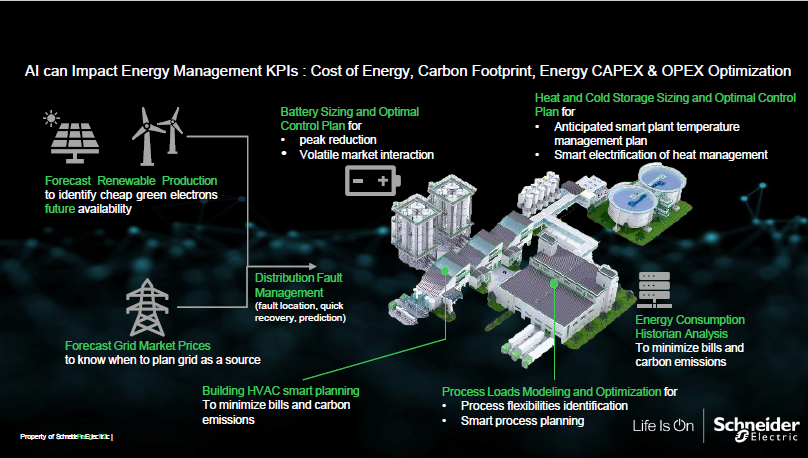
“If you deploy AI in the energy grid, you’re going to be able to monitor and optimise energy consumption and energy use, ultimately leading to being able to reduce energy and optimise and improve energy efficiency,” Says Tjader. “It’s also going to help to integrate renewable sources better. On the industrial strategy side, industries can use AI to optimise, plan and predict demand and output. It can also be used to manage the supply chain both for industry and in the energy system and to forecast energy demand and production.”
AI FOR INDUSTRY
Schneider Electric recognised the need to become an AI-driven company early on, establishing its Global AI Hub shortly after 2016. Today, the hub is filled with over 350 AI specialists.
“This strategic investment enabled us to develop and deploy AI capabilities internally across our own production lines, distribution centres and facilities,” says Francois Disch, digital transformation delivery lead at Schneider Electric. “Now, we are extending this expertise to assist other businesses to harness AI for industrial automation, energy management and sustainability in the most responsible way possible. Government strategies provide a strong direction for industry and support solution providers and end users in committing to innovation to reach a more sustainable,
profitable future.”
As Disch explains, AI can impact industrial automation in numerous ways. Within asset management, AI enables remaining part lifetime estimation, economic strategy optimisation and maintenance planning, while also identifying opportunities for waste reduction. Meanwhile, AI can improve process yield optimisation via throughput maximisation, while the technology’s automation capabilities can aid in anomaly detection, risk estimation, risk source identification, patter recognition, and preventative action recommendation.
Elsewhere, AI can enhance data analysis and data value identification, in addition to optimising production plans and forecasting production consumption to adapt optimal power supply planning. In short, there are countless opportunities for AI to make a sizeable impact within industrial production sites and supply chains across the globe.
SUSTAINABLE AI
Crucial to the continued acceleration of AI is managing the technology’s energy consumption, however, and sustainable AI is an area Schneider Electric is fully focused on. To ensure sustainable growth of AI, the company believes technological advancement must be balanced with environmental stewardship. Achieving this will not only require efficient and resilient digital infrastructure, but also incentives for AI adoption, quantifying, assessing and prioritising AI’s impact on sustainability, and establishing and maintaining robust AI governance frameworks.
“It’s really important that businesses, governments and academia continue to assess and quantify what the impact is of AI on sustainability, the environment and the planet,” says Tjader. “At the moment, this feels like the biggest challenge, considering the volatility of geopolitics at the moment, but it is something that is going to be critical if we’re going to be able to use AI for sustainability, energy and industry without negative effects.”