Automating composite manufacturing
Airborne has entered a strategic collaboration with Lockheed Martin to develop next-generation automation systems for composite manufacturing, addressing growing demands for agility, throughput and digital integration in aerospace production
Announced in November, the project – Enhancing the digital thread for composites manufacturing – focuses on automated laminating and kitting systems capable of handling increasingly complex material types and geometries.
The collaboration is being delivered under a Lockheed Martin Industrial Participation Programme and strengthens long-standing cooperation between Lockheed Martin and Dutch industry. From a manufacturing engineering perspective, the initiative targets one of the most challenging areas of composite fabrication: the efficient, repeatable preparation and placement of diverse ply materials while maintaining full digital traceability.
DELVING INTO THE TECH
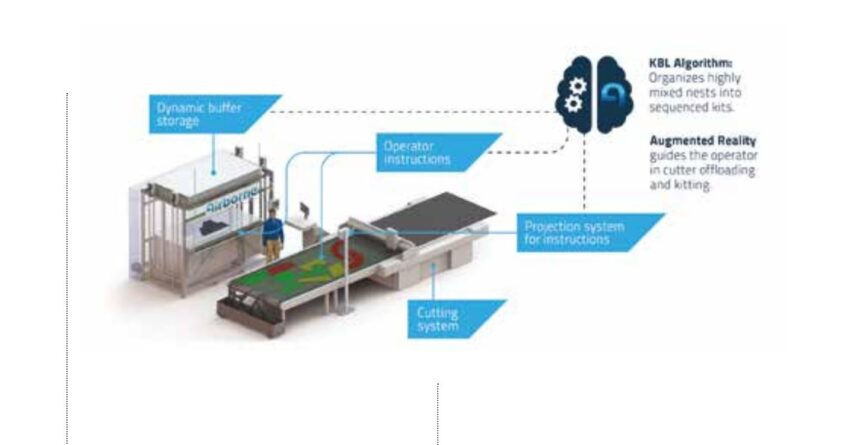
At the technical core of the project is the evolution of Airborne’s existing Kit by Light (KBL) and Automated Ply Placement (APP) technologies. KBL systems guide operators through complex kitting processes using digitally driven visual cues, reducing errors and improving consistency when assembling multi-ply kits. APP extends automation into the placement phase, enabling precise deposition of composite plies with controlled orientation, overlap and material handling. By integrating these platforms more tightly, the partners aim to create an automated laminating and kitting system capable of packaging non-standard material shapes and mixed material systems with minimal manual intervention.
A central objective is to strengthen the digital thread across composites manufacturing. This involves improved software integration between design data, material preparation, layup and inspection. For aerospace OEMs, such integration is critical to maintaining configuration control, ensuring compliance and supporting scalable production rates. The enhanced systems are expected to support higher output rates, broader material compatibility, including advanced prepregs and dry fibre formats, and more sophisticated in-process inspection capabilities.
KNOWLEDGE-SHARING IS KEY
Lockheed Martin’s role in the project includes sharing technical knowledge and production requirements from its aerospace and defence programmes, ensuring that the resulting systems align with real-world manufacturing constraints. The developments will be tailored to support the specific needs of Lockheed Martin business units, but the underlying technologies are intended to be adaptable across a range of composite-intensive platforms.
APPLIED EXPERIENCE
Airborne brings more than three decades of experience in composites, having evolved from a composite parts manufacturer into a specialist developer of automated production systems for aerospace, defence, automotive and renewable energy sectors. This background enables the company to approach automation challenges with a deep understanding of both material behaviour and production engineering.
James McLachlan, head of sales at Airborne, described the collaboration as a validation of the company’s technical direction, stating that it, “will enable us to accelerate our mission of pushing the boundaries of automated composites manufacturing.” From Lockheed Martin’s perspective, the project represents an opportunity to integrate smart material kit creation with data-driven automation to support flexible, next-generation production systems. As Tara Thomasson, Lockheed Martin technical fellow, noted, the collaboration will “integrate smart material kit creation with advanced data-driven automation for a flexible production system.”
STRONGER TOGETHER
Beyond the technical outcomes, the project highlights the role of international industrial partnerships in advancing manufacturing innovation. Joe Krapf, Lockheed Martin industrial participation country manager, emphasised the mutual benefits, with Airborne gaining enhanced capabilities and Lockheed Martin securing access to advanced kitting and laminating systems for future production lines. Jan Cristiaan Dicke, commissioner for military production of the Netherlands, underscored the strategic importance of such collaborations in strengthening the Dutch Defence Technology Industrial Base through innovation in production processes as well as products.
For professional engineers, the Airborne–Lockheed Martin collaboration signals a continued shift toward digitally integrated, highly automated composite manufacturing systems capable of meeting the aerospace industry’s increasing complexity, rate and quality demands.