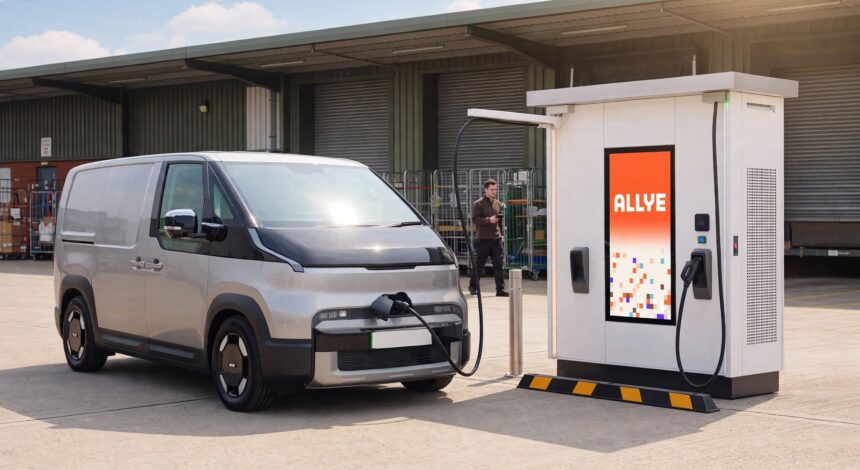
Allye Energy has launched the MEV (MAX for EV), a battery-buffered DC ultra-rapid charging system designed to overcome grid capacity constraints affecting electric vehicle (EV) fleet electrification.
Built using whole repurposed EV battery packs, the system can deliver up to 400kW of charging power to two vehicles simultaneously, drawing energy from an existing, limited electrical supply.
“MEV is the direct result of our work on the MAX300,” said Robert Carter, chief technology officer at Allye Energy. “The hard part was never the battery. It was making packs of different sizes and ages behave as one system and deliver up to 400kW of DC charging through an 800V architecture and our in-house technology stack.
“Once we had solved that, MEV was the obvious next step: the same architecture in a cabinet that only ever charges, where one pack can slide out for service while the others keep charging.”
Available in two variants, the MEV200 and MEV300, the system integrates energy storage, power electronics and DC charging in a dedicated cabinet. The respective configurations provide 155kWh and 232kWh of storage, enabling depots to accumulate energy over several hours and deliver it rapidly when vehicles require charging.
The system uses an 800V architecture to support both 400V and 800V vehicles. It is designed to operate from supplies as limited as a 16A connection, potentially eliminating the need for costly grid upgrades and lengthy connection delays.
Installation can be completed within hours of delivery, using industrial sockets or hard-wired connections, while the unit can be relocated if a depot moves.
Repurposed batteries and modular power control
At the heart of the MEV is Allye’s PackFlex technology, which provides independent battery management and power control for individual packs. This allows batteries of different sizes, ages and chemistries to operate together within a single system.
The approach supports the reuse of existing EV battery packs while maintaining control over their operation. According to Allye, using repurposed packs avoids an estimated 15–24 tonnes of CO₂-equivalent emissions per unit compared with manufacturing new cells.
The modular design also enables storage capacity and power to be upgraded on site, with minimal disruption and no additional groundworks. Individual packs can be removed for servicing while the remaining packs continue operating.
“We have built two ranges, not two versions of the same thing. If the charger stays put and only ever charges vehicles, MEV does it on the supply you already have, often for less than the connection works it replaces,” added Jonathan Carrier, founder and CEO of Allye Energy.
“If the energy needs to move, towed behind a van or feeding a row of chargers, that is the MAX300. But better products are only half the answer. To deploy charging at the pace the transition needs, we have to make it far cheaper, and that takes innovation in the business model and the supply chain as well as the product. Charging as a service, a monthly fee instead of a capital bill, is how fleets, depots and local authorities get more charging for less.”
Safety, energy management and deployment
Safety features include pyro fuses to isolate high-voltage circuits within individual battery packs, off-gas detection and fire barriers between packs. Charging cables incorporate cut detection, forensic marking and quick-release terminals to help reduce downtime from cable theft.
The system’s energy management capabilities allow it to recharge during off-peak periods and supply vehicles when electricity costs and network charges are higher. Allye estimates that the MEV200 could recover its additional cost compared with a conventional 200kW charger within two to three years, with potential ten-year savings of £50,000–£110,000, excluding avoided grid upgrades.
The MEV starts at £70,000, with a charging-as-a-service option from £1,900 per month for the MEV200. Deliveries are expected in Q2 2027, ahead of round two of the UK Government’s Depot Charging Scheme.