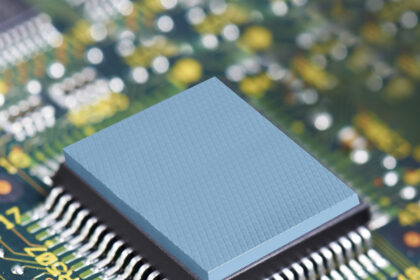
Parker Hannifin’s Chomerics Division has introduced THERM-A-GAP PAD 30RB, a thermally conductive gap filler designed to maintain thermal performance through repeated compression and reassembly cycles.
Offering thermal conductivity of 3.0W/m·K and thermal impedance of 2.9°C·cm²/W, the material is engineered to accommodate component stack-up tolerances while minimising compressive loads within demanding electronics applications. Its conformability and rebound characteristics allow it to be compressed and reapplied multiple times with minimal permanent thickness loss, supporting applications where components require repeated access or assembly.
The gap filler pad also provides vibration damping and shock absorption, with low compression force requirements. These properties make it suitable for chipset testing, automotive electronic control units (ECUs), telecommunications equipment, consumer electronics and computing hardware, including desktop PCs, laptops and servers.
THERM-A-GAP PAD 30RB features naturally tacky surfaces on both sides to help secure the material during assembly. An alternative configuration with one non-tacky surface is available to accommodate different manufacturing and installation requirements.
The electrically insulating material has a volume resistivity of 10¹³Ω·cm, measured in accordance with ASTM D257, and a dielectric strength of 0.02kVac/mm, according to ASTM D149. It is RoHS-compliant, carries a UL 94 flammability rating and operates across temperatures from −55°C to +200°C. Its stated shelf life is 24 months from shipment.
Available thicknesses range from 0.51mm to 5.08mm in 0.254mm increments, with standard sheet dimensions of 228.6 x 228.6mm. Carrier options include aluminium foil and Kapton thermally enhanced polyimide film. Parts can be supplied with or without pressure-sensitive adhesive, although adhesive options are limited to the aluminium foil carrier.
For applications requiring specific geometries, Parker Chomerics also offers custom widths, lengths and die-cut components, supplied individually or in sheets.
The combination of thermal conductivity, low compression force and repeated-use capability provides engineers with an option for managing heat transfer in assemblies where dimensional tolerances, mechanical stress and serviceability must be considered alongside thermal performance.