
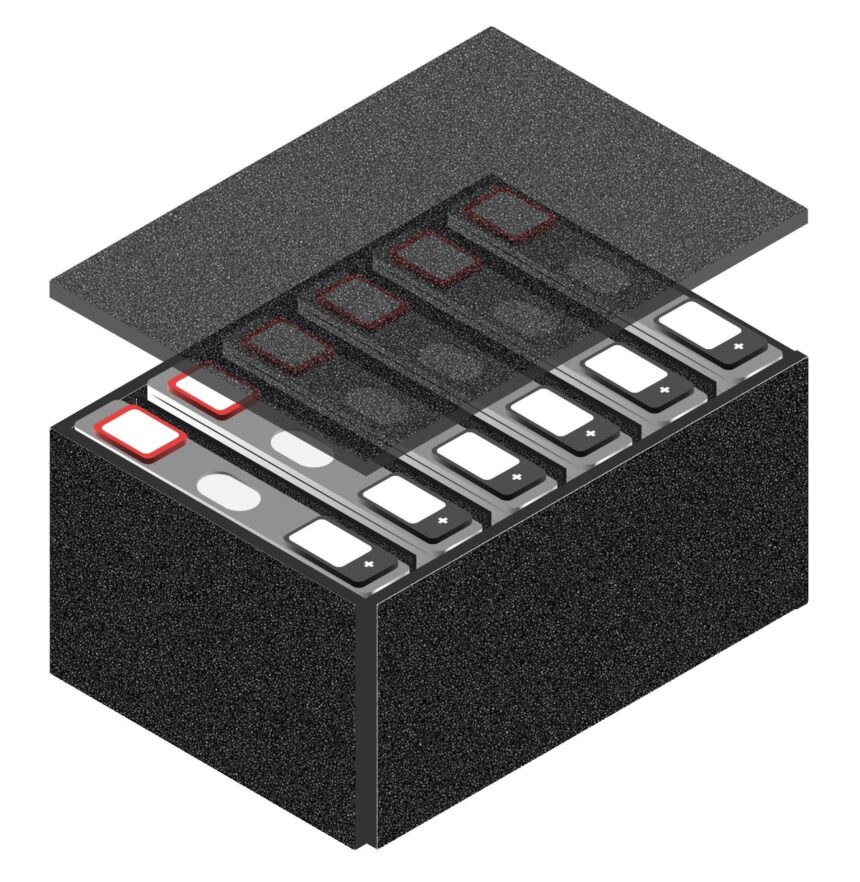
New lastan nonwoven solution for improved battery safety
Japanese technology company Asahi Kasei has unveiled its new flame-retardant nonwoven fabric designed as an alternative to conventional materials for thermal runaway protection on electric vehicle (EV) batteries. It can be used within EV battery packs in top covers, busbar protection sleeves and other areas.
Lastan is a non-mineral flame-resistant fabric created by air-baking acrylic fibre between 200 –300°C. The material has a high flame resistance as well as good electrical insulation. A special coating process increases these qualities whilst also augmenting abrasion resistance. This combination provides protection effective protection against particle bombardment from venting gas.
The material has low levels of heat conduction, meaning a 1,300°C flame can be applied to one side of the material, and the other will remain below 400°C. This is supported by the materials limiting oxygen index (LOI) of 50 or higher, with 27 or higher being the standard for indicating flame retardance. No holes appear after one minute of 1,300°C flame being applied to the material and Lastan has passed the highest rating of 5VA certification during UL94 testing.
Lastan is resistant to high-pressure impact by particles of 200–500μm. At a thickness of 1mm, the material grants electrical insulation up to 3.5kV. It can help make the manufacturing process, due to its flexibility and still being effective at 0.8mm thickness.
Improved safety is a primary consideration for 34% of respondents to the Asahi Kasei automotive consumer survey in China, highlighting the importance of safety in the field. This is the driving factor towards the estimations of a 15% annual growth in the materials to prevent thermal runaway market, according to IDTechEx.