EV battery diagnostics firm Aviloo has launched its Certified EV Battery Report, built on data from used electric vehicles (EVs) and tested via its independent Aviloo Flash Test.
Claimed to be the world’s largest independent study of battery health in used EVs, this edition of the report analyses over 500,000 individual independent tests carried out on used EVs between 2022 and 2026. The report, which will be published twice a year, draws on a subset of Aviloo’s diagnostic database, which now spans more than one million independent tests worldwide.
Rather than using data readings from vehicle dashboards which can vary between manufacturers, the report is based upon Aviloo’s own physical measurement of the battery. According to the report, overall battery health remains strong, however the data shows meaningful differences both between models and between individual examples of the same model.
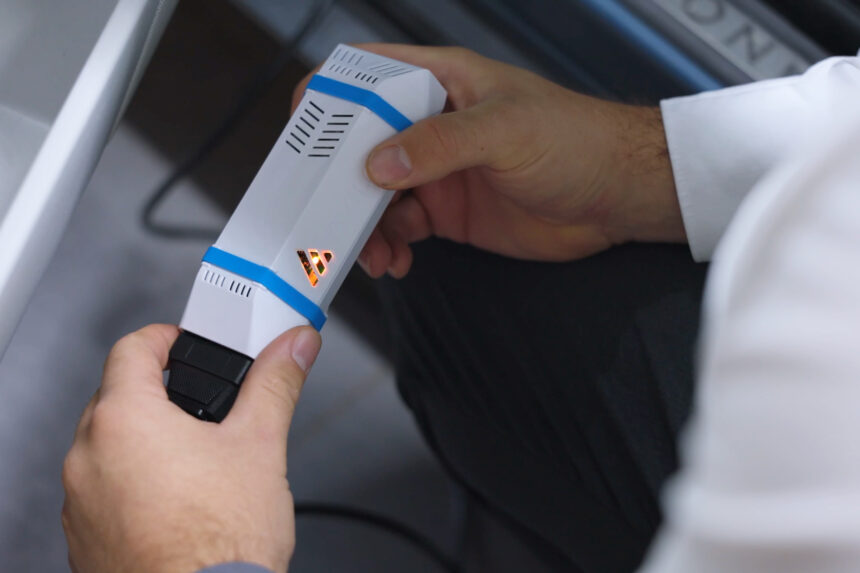
The company’s Flash Test is an independent, three-minute diagnostic performance via a vehicle’s OBD port. SoH is then calculated using a statistical model trained on hundreds of thousands of comparable, real used EVs. In addition to the car’s internal health assessment, Aviloo also takes into account battery SoH, mileage, age, cycles, cell voltage spread, energy counts and numerous other diagnostic signals.
For each model tested in the new report, Aviloo calculated the median state of health (SoH) at three mileage milestones – 50,000km, 100,000km and 150,000km – along with the range expected to cover 99% of vehicles at each point. The charts below shows Aviloo Flash Test results at each of these mileage milestones.
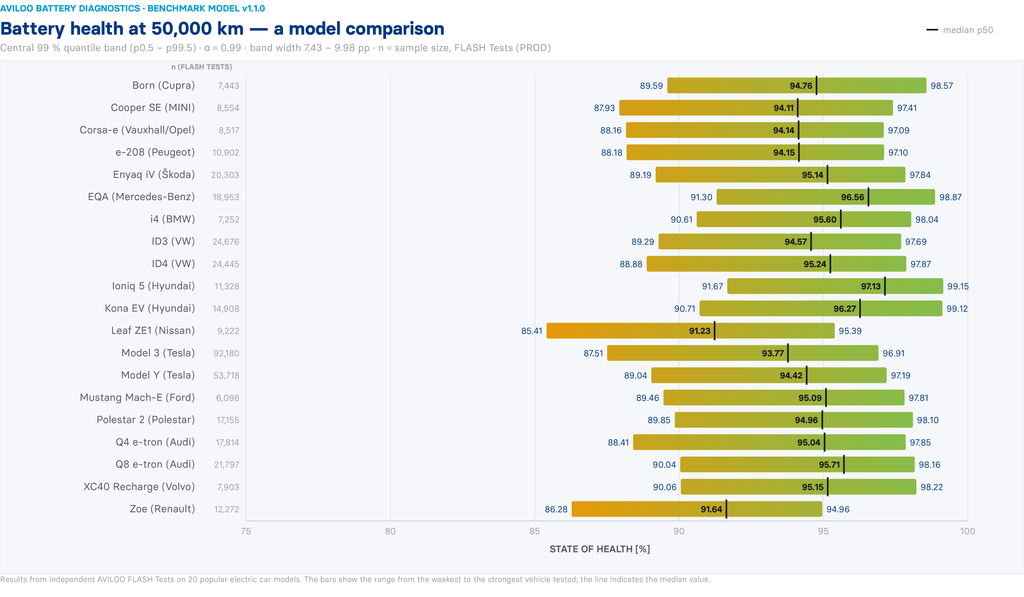
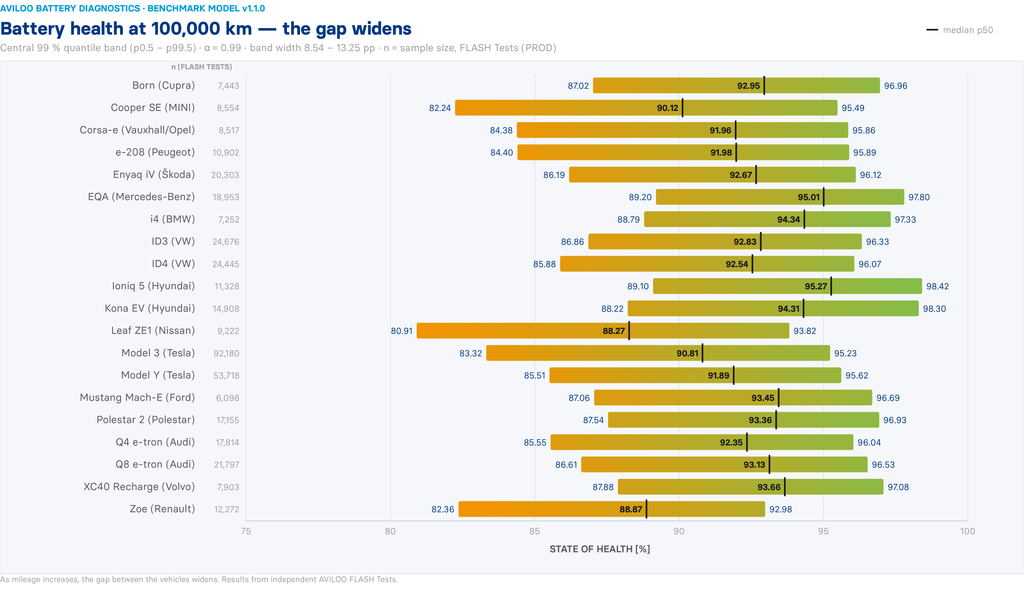

Comparing the mileage snapshots side-by-side reveals that median battery health drops as mileage increases, while the spread between individual cars widens with distance. The data also shows consistent differences between models at every mileage point.
“The truth in this data is that averages hide a lot,” said Marcus Berger, CEO of Aviloo. “Yes, EV batteries are ageing better than the ‘they wear out fast’ myth suggests – but that’s not the most useful thing this report tells you. What matters is that battery health varies significantly between models, and even more between individual cars of the same model.”

For instance, The Tesla Model Y (78.8kWh) has been the best-selling car globally of any kind for three consecutive years, according to the manufacturer’s own claims. In AVILOO’s data, used Model Ys show a median SoH of 94.5% at 50,000km, falling to 90.3% at 150,000km. This is equivalent to a real-world range per charge of around 379km, dropping to roughly 362km. According to Aviloo’s data, individual cars vary by up to 11% of SoH across that range, which is worth around 46km of real-world range per charge.
The median battery health of the Volkswagen ID.4 (77kWh), by comparison, runs from 95.3% at 50,000km to 90.6% at 150,000km – a real-world range per charge of around 335km, dropping to 319km. The data indicates individual cars vary by up to 11-12% of SoH at higher mileages, worth around 45km of real-world range per charge.
The Hyundai IONIQ 5 (72.6kWh), meanwhile, has a median SoH that runs from 97.2% at 50,000km to 92.8% at 150,000km according to Aviloo’s data, equalling a real-world range per charge of around 335km, dropping to 319km. The report shows the spread between individual cars grows to over 12% of SoH by 150,000km, worth around 42km of real-world range per charge.
The Nissan Leaf ZE1 (40 kWh) has the smallest battery of the four models highlighted in the report – around half the capacity of the others. This means the EV needs far more frequent charging to cover the same distance. Aviloo’s data shows the median SoH falls from 91.1% at 50,000km to 86.3% at 150,000km, the lowest of the four models throughout, with the widest spread: Up to 13.5% of SoH by 150,000km, worth around 29km of real-world range per charge.
In real-world terms, that median SoH is worth around 196km of range per charge at 50,000km, dropping to roughly 185km at 150,000km – markedly less than the other three models, reflecting its smaller battery and suiting it best to shorter, more local journeys. According to Aviloo, the Leaf ZE1 is the clearest illustration in the report of how battery size and charging frequency interact with real-world degradation, and why independent testing matters most for this kind of higher-use EV.
“A gap of 10 or 15% in SoH is a real difference in range, in what a car is worth, and in what you can rely on it for,” said Berger. “You simply can’t know where your car sits in that range without testing it independently.
“That’s why we built the Aviloo Flash Test, and why we’re now publishing this Aviloo Certified EV Battery Report twice a year – to give the whole market, from individual buyers to fleets and insurers, an honest, independent and genuinely global picture of how these batteries perform.”
Earlier this year, Aviloo launched its Battery Warranty across Europe, extending the diagnostics behind its Flash Tests into a financially-backed guarantee on battery health for EV buyers. For each vehicle, the company uses its global diagnostics database to calculate an individual SoH limit – the minimum the battery must maintain at 20,000km within the one-year warranty period. If the battery falls below that limit, buyers receive £2,700 in the UK ($3,600) and €3,000 in most European countries.
The guarantee is now live in the UK, Germany, the Netherlands, Finland, Austria, Belgium, Ireland, Switzerland, France, Sweden, Norway and Denmark.