A short guide to dust safety characteristics and explosion prevention
The topic of ‘explosion safety’ is widespread for plant operators and OEMs when it comes to handling or transporting combustible dusts. Despite the common assumption that an increased risk of explosion only exists for gases, enormous forces can also be released by explosive dust air mixtures.
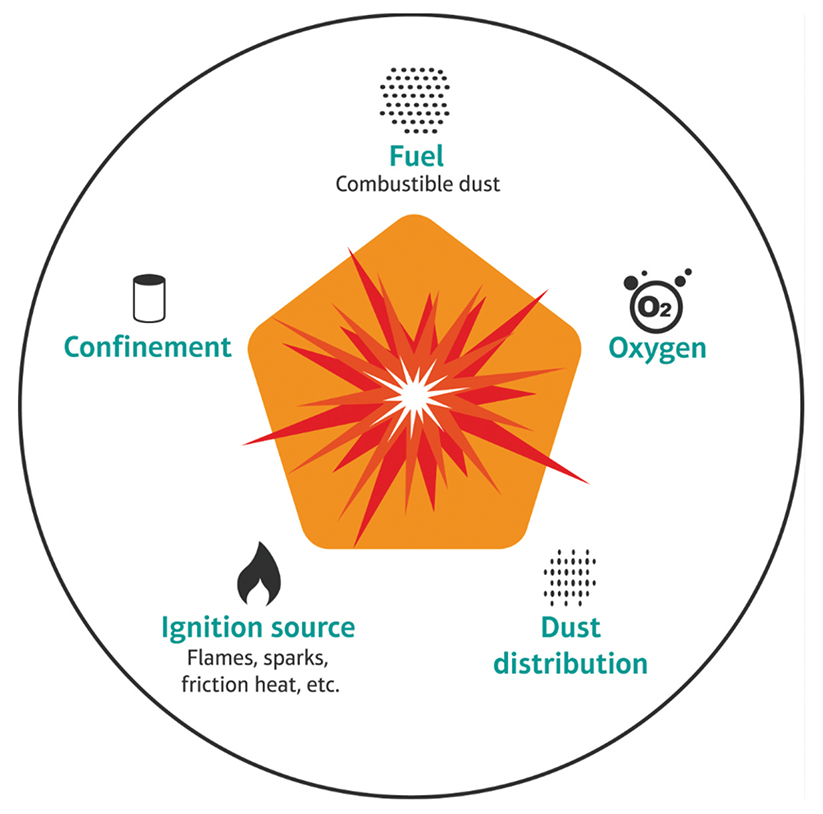
To help minimise the risk of explosions when handing combustible dusts, it is important to understand the requirements for an explosion and the respective dust safety characteristics. Figure 1 uses the explosion pentagon to outline the elements that should be considered by safety engineers.
Every condition within the explosion pentagram must exist for an explosion to occur within a production facility or machine.
If any one of the aforementioned prerequisites is eliminated, explosion prevention is being effectively practiced. However, if this is not possible at all times and in all operating states, explosion hazards will still be present. In that case, it is necessary to divide any potentially explosive atmospheres into zones and systematically apply safety measures.
Drying processes in particular are used in many industries to produce material, for easier storage, more efficient transport and a longer shelf life. However, the combination of moisture extraction and high temperatures creates an increased risk of both fire and explosions.
If fires and/or explosions occur in drying plants, which are usually very large, the situation is not only extremely dangerous for the machines and the business, but the employees on site too.
Operators of spray dryers must combat a particular type of ignition source – namely smouldering nests that can lead to spontaneous combustion if the material undergoes excessive caking. Caking occurs owing to sub-optimal drying of the material and its initially high moisture content. The caked material is then insulated against the surrounding air by a build-up of moist material. The high temperatures ensure that the caked material is continuously heated until a biological reaction takes place involving protein, carbohydrates and water – known as the Maillard reaction. The Maillard reaction generates additional heat that cannot be dissipated owing to the insulating layer of caked material. This exothermic process continues to accelerate until spontaneous combustion finally occurs.
Caking of this kind can build up both on the nozzles and the inner wall of the spray dryers. If the nozzle malfunctions, droplets may drip into the fluid bed and cause further clumping. If a smouldering nest is able to form, this can ignite the explosive atmosphere inside the dryer or the downstream machinery.