Bdtronic and Hönle combine in the name of creating a flawless process solution for dispensing and curing liquid gaskets for cell module controllers.
Battery sensors are responsible for monitoring temperature, current, voltage and then informing the battery management system (BMS). It plays a large role in assessing the performance of electric vehicle batteries.
High viscous liquid sealants are used during production to ensure the batteries are protected from exposure to external impurities that may damage the sensitive electric components inside. This protects the battery from dust, moisture, road salt and any other stresses that may be put on the battery such as temperature.
Sealants are better known as Cured-In-Place-Gaskets (CIPG), which bdtronic is a global supplier of automated dispensing systems for CIPG. Plasma pretreatment, surface treatment, UV curing as well as camera inspection are also performable on these systems.
Fabian Tremmel, Head of Engineering Dispensing at bdtronic said: “To achieve the best possible process, it is essential to work closely with the customer and all involved technology providers from the very beginning. We need to understand the requirements and collaboratively develop their technical implementation."
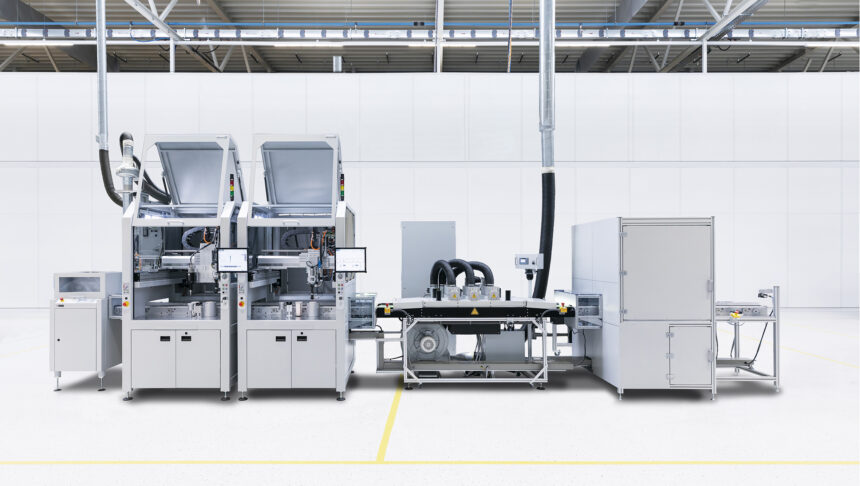
The collaboration sees the creation of a new five-step process for CIPG dispensing and curing. The first step sees the component contours being pretreated with atmospheric pressure plasma. This creates a better adhesion of the sealant. The second and third steps involve the highly viscous CIPG being applied in contours. In the fourth step, curing using Hönle UV curing system takes place. Finally, the fifth step is where the optical inspection of the finished procedure takes place. This is to ensure the highest level of both quality and consistency.
Mina Kamal, Sales Engineer at Hönle said: “At Hönle, we strive to always find the best possible solution for our customers' processes. Our decades of experience in UV curing and our uniquely extensive portfolio of LED-UV and UV systems allow us to quickly find the optimal solution for the customer."
TIER 1 suppliers normally approach the engineering company with target requirements, expecting a high volume of production. These battery sensors are normally provided by suppliers in the automotive industry.
In this instance, the customer has requested specific requirements of; 6,000 battery sensors every 24 hours (1 part every 13 seconds), 1-component sealing compound, metal material and shape of the part.
Bdtronic has partnered on this project with Hönle due to the importance of how sealing compounds and UV curing devices interact. This is key in ensuring the efficiency and reliability of the manufacturing process.
Suitable UV ranges, intensity and dose are required for an optimal curing result. Testing shows that only a high UV dose is required to form the polymerisation in the broadband spectrum. Hönle’s UVAPRINT was identified as being the best material for this process. This is because of its Cold-Mirror technology prevents the temperatures on the substrate don’t exceed limits despite the high intensity.
Components go through three consecutively installed UVAPRINT modules, these provide a full cure. Once this is complete, sensors move to step five for optical inspection.