
When operating in high-purity environments
The integrity of a filtration system is often judged by its smallest details.
While the filter media does the primary work of separation, the filter plates provide the essential structural foundation. In high-purity environments, the surface quality of these plates is not merely an aesthetic choice; it is a critical regulatory and functional requirement that dictates the success of sterilisation and the prevention of cross-contamination, this is particularly true when processing pharmaceuticals.
Improving from recessed chamber plates to membrane filter plates
When we transition from standard recessed chamber plates to membrane filter plates, the ‘surface request’ (the technical requirements for surface quality) becomes significantly more complex.
In these systems, the plate isn’t just a rigid wall; it’s a dynamic component that uses a flexible membrane (inflated with air or water) to physically squeeze the filter cake. This mechanical movement creates unique surface challenges that go beyond simple roughness.
High flexibility and smooth surface
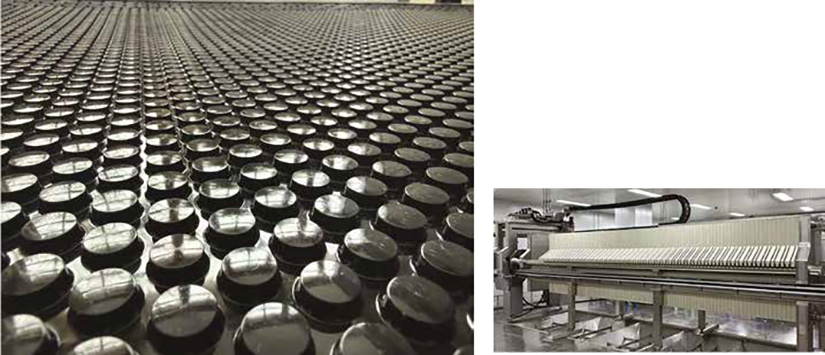
New technologies provide a new set point in the membrane technology. With a high flex material around 90ShA and a surface roughness lower than 0,5 Ra, the pharmaceutical application can work with new dimensions, round pips and developed geometrical structures.
Improved process steps besides compression
In many pharmaceutical processes, the goal isn’t just to dry the cake, but to wash it. If the plate surface is rough:
1. The wash liquid will follow the ‘path of least resistance’ through the surface valleys.
2. This causes channelling, leaving pockets of unwashed impurities in the cake.
3. A high-spec, smooth surface ensures the wash liquid is forced through the cake uniformly, maximising purity.
Cleaning is also very important
A low-roughness surface finish is essential for effective cleaning of pharma membrane filter plates, minimising product adhesion and biofilm formation while enabling rapid, reproducible CIP. The smooth surface design supports hygienic operation, reduces cleaning time and chemical consumption, and contributes to reliable compliance with stringent pharmaceutical cleaning and validation requirements.
Conclusion of new dimensions
By integrating high flexible membrane material in filter plates, pharmaceutical manufacturers achieve controlled filtration performance, higher product purity, and reduced risk of contamination. These systems not only enhance operational efficiency but also align with regulatory compliance and sustainability goals—making them an essential component in modern pharmaceutical processes.
For more information visit: www.jvk.de