
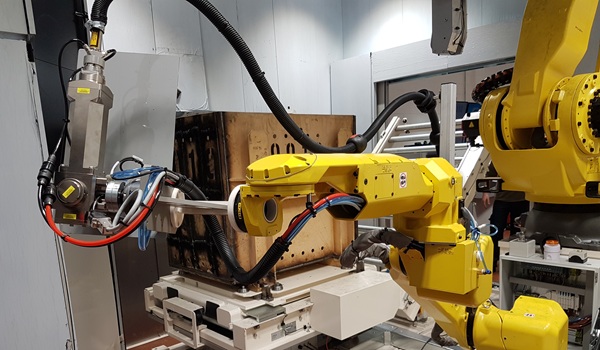
The first COTS-based robotic installation in the UK nuclear industry has been successfully completed
Fanuc's ARC Mate 120iC and M-900iB/360 robots have contributed to a pioneering waste-size-reduction project as part of Stellafield's ongoing decommissioning process
In an autonomous application developed and delivered by integrator Cyan Tec, the skip sorting and laser cutting cell reduced the space required to store radioactive waste to a third of its original footprint.
The cell also reduced the time required to dismantle and repack radioactive skips from months to minutes and eliminated human involvement in this operation.
A pond cleanup operation
Cleaning and decommissioning First Generation Magnox Storage Ponds (FGMSP) has become a significant part of Stellafield's nuclear cleanup efforts. To facilitate this, the skips stored in the ponds need to be removed.
The limited storage space for these skips after extraction poses a challenge. Cyan Tec was tasked with devising a solution for a localised size reduction process to minimise the storage footprint of the removed skips.
Tony Jones, managing director of Cyan Tec, said, “Our idea was to cut up the skips so they would occupy less space; in this way, three skips could effectively be reduced to one.”
In the past, this type of work was always manual because it was assumed the task could not be automated. Operators in hazmat suits would use angle grinders to cut storage containers into pieces, but they could only work for very short intervals to limit radiation exposure, meaning it would take one month to break down each skip.
The challenges
Automating this operation was not easy due to three reasons:
- The cell needed to fit into a small area and, once operational, be completely autonomous.
- The skips were all welded fabrications, but their dimensions and their construction varied, and Cyan Tec had no visibility on the range of these dimensional differences.
- The considerations around safety and radioactivity meant there were limited opportunities to commission and test the system before installation.
The solution
Cyan Tec designed and installed a turnkey laser-cutting and handling system that operates autonomously within a nuclear bunker. The entire cell is operated remotely from a control room 100m away.
The system was built at Cyan Tec's Leicester facility, installed at Stellafield, and tested on non-radioactive skips before being put into operation on contaminated skips, under the supervision of project partner TKE Nuclear.
The system contains two six-axis Fanuc robots: a compact ARC Mate 120iC for cutting, and a heavy-duty M-900iB/360 equipped with interchangeable end-effectors- a scanning head and an electromagnet for handling panels.
When in scanning mode, the M-900iB builds a 3D image of the skip within the machine's control system. MeshLab software compares the scanned skip with a reference skip, allowing the control system to adjust the ARC Mate 120iC robot's parameters and determine the most suitable cutting pattern.
Jones said, “The cell had to be 100% reliable, as there was no opportunity for going in and fixing it if anything went wrong. That was why we chose technology that had already been proven in demanding industries. FANUC’s robots have a strong track record of working in demanding automotive plants with very high uptime figures, and demonstrate the highest reliability of any robot manufacturer.”
FANUC’s robots also aligned with Cyan Tec’s strategy of using commercially available technology wherever possible, as this was a test case for a COTS (Commercial Off-The-Shelf) project in an industry where a bespoke approach has traditionally been the norm.
The results
The robotic cell was initially designed to reduce the size of 50 skips of nuclear waste. Its success has led to its utilisation to process additional skips of waste in less time, without the health and safety implications of a manual operation.
Jones said, “This system has revolutionised the handling and size reduction of skips and demonstrated that a COTS approach can work in the nuclear industry. It is incredible to think that by automating this task, we have been able to reduce the time it takes to cut down and repack a skip of waste from approximately one month to just 60 minutes. FANUC’s technology has been pivotal in achieving this outcome, and our confidence in the solution we have delivered is rooted in our confidence in FANUC’s reliability and support.”