


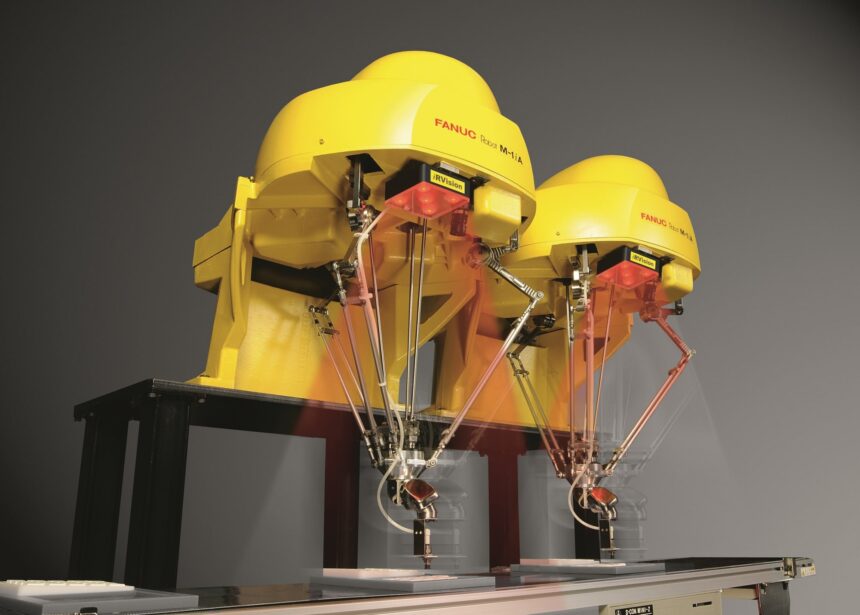
Fanuc has released its recommendations to keep production lines in line with modern developments.
Oliver Selby head of sales for FANUC UK shares his thoughts on automation in the workplace. Selby warns that the UK's position as a top ten manufacturer is under threat if the UK does not start automating significantly more. This is why Selby, head of sales for FANUC which has 20 years of experience in factory automation, has issued his six recommendations for how companies can future-proof itself.
Embrace automation
Automation for the sake of automation will have minimal impact on production. The process of manufacturing needs to benefit from automation and there are various ways this can be achieved. By incorporating automation into product design, it allows for automation to take place seamlessly in the workplace. This could be something as simple as providing handles for a robot to pick up the package. Production must be restructured with automation in mind if it is to have any success.
Traditional methods of production often use multiple materials as well as joining techniques that are not automatable. This would need to change if the automation process is to be of high success. Designers need to factor in automation to their design process and adapt products to only using materials and methods that require no adjustments for automation. Companies may be glad to hear that reducing the variety of materials being used to implement automation can reduce overall production costs.
Prioritise parts
An estimated 20% to 30% of project costs are incurred purely on locating and fixturing parts. This is before automation can even begin. If parts are kept in order, be that on a conveyor or in a stack, it can reduce these costs significantly and allow for automation to take over quickly and easily. Having an ordered process with a clear understanding of where machinery is, can improve speed and reduce cost.
One-way assembly can again reduce the costs of production. This process should be considered best practice. This is where parts stack on top of each other to create a completed product or even common part features that allow common fixturing.
Consider TCO
Producers need to think about the lifetime impact of automation. Often, producers attempt to see a return on its investment. Two years is not a realistic timeline for companies to expect to see this impact. Purchasing alone only tends to account for 15%-25% of the costs of ownership, with running costs and maintenance costs taking up the rest. By using the theory of constraints (TCO) instead of return on investment (ROI) as a measure, you can measure the cost of automation over its lifecycle.
Remember the process
By putting undue emphasis on the customer, instead of the process it can hinder overall production. This is because changes to a product, regardless of how minor they may appear, can cause major issues with automation and its capabilities. This can massively increase costs as new plants will not be able to produce the same volume of output and will require more labour to do so. It is important to remember what processes and designs are best suited to automation.
Talk to automation suppliers
Seeking expert advice from automation suppliers can give companies a far greater idea of the reality of automating and the real terms costs in doing so, or not doing so. Guidance can be provided on what part of its processes can be automated and how to streamline production with the use of automation. Automation companies have worked throughout industries and have expert advice in a long line of production processes, allowing them to advise you on what is best for the company. Collaborating between automation companies and designers may provide the best possible production process for a company's manufacturing.
Try before you buy
Automation suppliers are starting to offer low-risk/low-cost routes into automating processes. Robots as a service (RaaS) is a subscription-based service that allows manufacturers to pay as they use it, allowing them to trial automation and see what impact it has on its process. RaaS is not accessible to everyone, as the nature of a rental automation service is it can only do simple tasks and will not be able to take on the more demanding tasks that automation and improve. It is best to speak to a supplier to determine if RaaS is something a company would benefit from. By testing out automation in a company's processes, it can best gauge if this is an investment worth making.




