Fronius helps companies develop standards-compliant welding products through a range of products and services, including standard welding procedure specifications for manual and automated welding, hands-on training, and digital welding data management
The company also provides the expertise companies need to navigate challenges with ease while ensuring reproducible quality and complete traceability, especially when facing demanding standards and documentation obligations.
Manufacturing facilities strive to produce high-quality weld seams, especially as a defective seam can be costly and even dangerous. Across the steel, plant construction, and rail vehicle industries, strict standards shape welding practices and the manufacturing process. While compliance with these standards requires extra effort, it is not merely bureaucracy; it forms the basis for reproducible quality and safe products.
Franziska Eichhorn, strategic product manager at Fronius International, said, “Quality doesn’t come about by accident; it is the result of precise standards and high-quality welding.”
However, getting there is no easy task, as certifications, welder examinations, and documentation require time and resources. Fronius supports customers throughout the process, from ready-to-use welding procedure specifications for manual and automated welding to training and digital documentation.
Safe and efficient welding
Welding in compliance with standards is always founded on a detailed welding procedure specification.
Eichhorn said, “It’s only possible to guarantee lasting and efficient quality if the weld seams are reproducible and the manufacturing process is traceable. However, the costs of process certification are high, especially for small and medium-sized businesses. Our cost-effective Fronius Standard Welding Procedure Specification packages (SWPS) make it easier to formulate a complete welding procedure specification.”
The standardised SWPS packages simplify getting started by providing fully defined, standards-compliant procedures that specify the material, component thickness, filler metal, and energy per unit length as binding parameters.
Fronius also offers SWPS packages for automated and robotic welding of steel and CrNi materials, giving customers confidence in clear instructions across cobots, industrial robots, and hard automation, and saving time and costs on procedure tests.
A portfolio of approved welding procedure specifications is available, ranging from manual TIG welding of CrNi alloys and partly mechanised MAG welding of steel and CrNi alloys to automated MAG processes. For many use cases, this eliminates the need for additional procedure tests and, therefore, the time, expense, and organisational effort they entail.
Putting theory into practice
Modern machines alone do not guarantee a high-quality weld seam; it is their combination with welder expertise that does. In addition to internationally recognised qualifications and certifications for welders and machine operators, Fronius offers Welducation, which is a training ecosystem featuring welding simulations, e-learning courses, and on-site assessments.
Eichhorn said, “On its own, technology is unable to guarantee quality. It’s the expertise of skilled welders, combined with hands-on training and ongoing development, that makes all the difference.”
Alongside personnel training and qualifications, Fronius handles regular calibration and safety inspections of the welding machines, ensuring the foundation for quality standards is secured for the long term.
Digital management for welding manufacturing
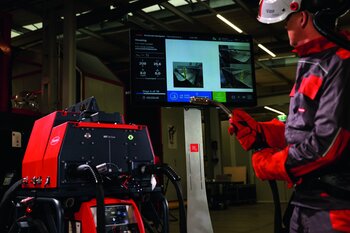
Once procedures, qualifications, and certifications are in place, the goal is to ensure operational continuity. This requires the welding process to proceed as planned and be traceable at all times. WeldCube Navigator enables step-by-step workflow instructions and clearly identifies components and materials. WeldCube Air supports welding supervisors in managing welding procedure specifications and certificates in compliance with the applicable standards, and assists with the traceability and validation of this documentation.
Eichhorn added, “Accurate digital documentation forms the foundation for sustainable quality assurance. Complete traceability of process parameters makes it possible to identify and correct the causes of errors at an early stage. This prevents time-consuming and costly rework.”