
A look at the engineering behind Cummins all-new S29 mining engine, by Rebecky Chen, director of Product Strategy & Management for Cummins Components and Software, China
Cummins recently introduced the S29, a clean-sheet 29l V-12 engine developed primarily for 90t to 120t haul trucks and 150t to 220t excavators. With an intermittent rating of up to 1,300hp (969kW) at 2,100rpm, it’s designed for mining duty cycles where sustained high loads put significant demands on fuel delivery, efficiency and durability.
That combination of output and sustained high-load operation created a fuel-system challenge: delivering greater fuel flow without giving up precise injection control, durability or compact packaging. Cummins evaluated several available fuel system options against those requirements and ultimately selected XPI, a high-pressure common-rail fuel system, as the foundation. From there, the engine and fuel system teams then developed the new high-flow XPI system alongside the S29 combustion system, allowing the injector design and combustion requirements to be refined together.
Why High-Flow XPI?
From the outset, the S29 was developed to deliver strong performance and competitive total cost of ownership in demanding mining applications. This placed particular emphasis on power density and fuel economy.
The Modular Common Rail System (MCRS) has driven proven performance across Cummins’ high-horsepower mining portfolio since its first use in 2008. The clean-sheet S29 gave the development team an opportunity to evaluate that experience alongside advances in the Cummins XPI fuel system, which has also been in production since 2008, with extensive operating experience in heavy-duty, industrial and high-horsepower applications. For the S29, XPI offered the lighter, more compact foundation best suited to the engine’s power-density goals, as well as the flexibility to optimise fuel delivery and combustion for its performance, fuel economy and durability targets.
The S29’s displacement and power targets required substantially greater fuel-flow capability than existing XPI configurations provided. Cummins engine and fuel system teams therefore worked together to develop the new high-flow XPI specifically for the S29, combining a high-capacity pump and purpose-designed injectors with durability enhancements for demanding mining duty cycles.
A purpose-designed injector and combustion system
The S29 uses a high-flow injector developed specifically for the engine. The teams used simulation and iterative testing to refine fuel-flow capacity, spray-hole configuration, spray angle and rate shape — the way fuel delivery changes as the injector opens and closes. Those variables were refined alongside the combustion system, with results from each helping guide the next design iteration.
That work produced a high-flow XPI configuration that supports injection pressures up to 2,200bar, helping provide precise fuel metering and atomisation for efficient combustion. The combined XPI injector and combustion optimisation contributes to a brake-specific fuel consumption (BSFC) improvement of about 2.5g/kWh, supporting the S29 engine’s best-point BSFC target of 180g/kWh.
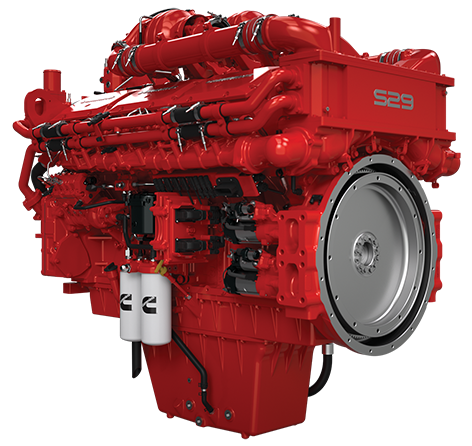
The injector also incorporates durability enhancements, including a reinforced architecture, wear-resistant materials and improvements to sealing, nozzle and valve-seat design. Cummins designed the S29 high-flow XPI system around a 20,000hr life target, drawing on previous XPI field experience as well as accelerated and comparative validation.
International collaboration and smarter validation
Cummins engine and fuel system specialists worked as one international team, sharing models, designs and test data throughout development. Because Cummins develops both the base engine and key component technologies, including the fuel system, the teams could evaluate technologies against the S29’s requirements and integrate them as a complete system rather than treating the fuel system as a separate component. That approach allowed specialists from different disciplines to challenge assumptions as the design evolved.
The same integration carried into validation. Using simulation, field-return experience and mining duty-cycle data, the team developed targeted tests around specific durability risks. For example, an accelerated rig test reproduced evidence of a cavitation risk that could otherwise require 1,000 to 2,000hrs of engine testing in about 300hrs.
Fuel delivery tailored to mining demands
Bringing together Cummins engine, fuel system and application expertise allowed the S29 development team to select and tailor technologies for demanding mining duty cycles. For high-flow XPI, that meant combining compact packaging, precise high-load fuel delivery and a purpose-designed injector and combustion system to support the S29’s fuel-efficiency and total-cost-of-ownership targets.
For miners, the result is a fuel system developed alongside the engine, with performance, durability and operating cost considered together from the start.
For more information visit: https://link.cummins.com/syxia4