The value of industrial 3D printing is no longer up for debate
Manufacturing is undergoing one of the most significant shifts in decades. Companies face growing pressure to deliver complex parts faster, at lower cost, and with greater sustainability. Traditional processes often stand in the way – high tooling expenses, long setup times, and rigid workflows slow innovation and make scaling difficult
What’s different today? The value of industrial 3D printing is no longer up for debate. Instead, the question has shifted: How can additive manufacturing (AM) scale efficiently – delivering more lasers per square metre to meet the growing demand for serial AM parts?
THE MARKET REALITY
AM has dipped its toes into small and medium scale production (think hip cups or satellite parts), and with the development of the EOS M4 ONYX we are ready to deliver large scale serial production (3 shifts, 24/7, 97% uptime) This shift requires lowest cost per part, certified repeatability, high throughput, automation readiness, and seamless integration into digital factory ecosystems.
Yet many AM systems still struggle with insufficient build rates, low uptime, manual job handling, and high consumable usage – factors that can turn AM into a bottleneck instead of an enabler. Manufacturers increasingly need platforms specifically engineered for continuous, scalable output, including automation to maximise uptime.
CUSTOMER FOCUS: SCALING AM WITH REAL IMPACT
KSB, a global leader in pump and valve solutions, produces a complex particle separator for removing solids from liquids – a critical component for pump performance and longevity. KSB engineered this as a true AM part, only buildable with metal industrial 3D printing. Once design constraints were overcome, the next challenge was scaling production to meet cost-per-part targets. Seeking higher productivity and lower operational costs, KSB introduced and built the component on an industrial metal AM platform by EOS, achieving the following results:
- Powder utilisation: 80% sintered into the part, 19% recyclable, only 1% waste
- Productivity: Increased by more than 60% thanks to 97% system uptime and less than 30-minute job changeover
- Build time per part: Reduced by over 40%
- Cycle Details: 55 hours total build time
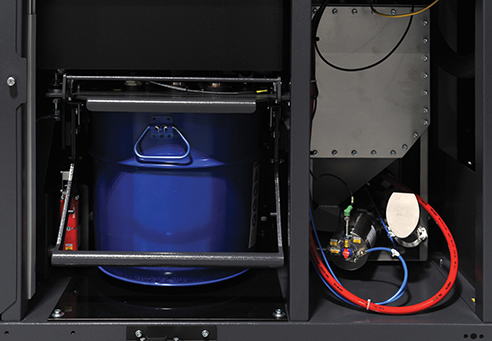
The key to this success was the combination of a large 450 × 450 × 400mm build volume with high-performance multi-laser technology, enabling up to 50% higher throughput. Smart Fusion optimises exposure strategies to minimise rework and reduce cost per part. Automated job changeovers minimise downtime, while the RFS Pro filter system – cutting hazardous waste by up to 90% – strengthens sustainability. Together, these elements deliver measurable gains in efficiency, cost performance, and environmental responsibility.
A NEW ERA FOR INDUSTRIAL AM
As industries accelerate their digital transformation, scalable metal AM has become an essential part of competitive manufacturing. By moving beyond the limits of traditional processes and adopting next generation AM systems, companies can increase productivity, flexibility, and sustainability today.
The KSB case demonstrates how businesses are evolving from limited output to reliable, industrial scale AM with clear, quantifiable results. Powered by multi-laser capability, intelligent software, and automated workflows, metal AM has fully arrived in industrial production – delivering real performance and competitiveness now.
Contributed by Sebastian Becker, head of product management metal at EOS.