
Siobhan Doyle explores how mobile robots are helping make the oil and gas industry safer and more efficient
Siobhan Doyle explores how mobile robots are helping make the oil and gas industry safer and more efficient.
Across the oil and gas sector, asset maintenance and worker safety are top priorities. Mobile robots are increasingly used to support these goals by capturing valuable on-site data while keeping employees away from hazards. Central to this work is American engineering and robotics design company Boston Dynamics and its canine-inspired robot, Spot.
Within the oil and gas sector, Spot can identify air and gas leaks, as well as other equipment maintenance requirements, from anomolies in temperature for example. Equipped with acoustic imagers, gas sensors and thermal cameras, Spot can identify potential hazards, identify equipment with degraded performance, and help ensure compliance for safer, more reliable operations, according to its developers.
In this article, we look at the ways in which this Massachusetts Institute of Technology spin-off company’s agile robot is helping energy companies inspect and maintain their equipment on-site, ultimately optimising site performance and helping operators make informed decisions.
Across the pond
Oil and gas companies are facing evolving market demands, regulatory pressures, and competition from alternative energy sources. California-based petroleum refineries company Chevron, has been responding to these pressures by adopting products and solutions that improve reliability and lower carbon emissions across their operations.
This has led to using Spot at its cogeneration facility in the Chevron Pipeline and Power Upstream Bakersfield, California location to validate several critical use cases. In the summer of 2023, the company expanded its fleet of Spot robots and deployed them to refineries in Pascagoula, Mississippi, and El Segundo, California. With this expansion, Chevron now owns more Spot robots than any other oil and gas company, marking a significant step toward incorporating advanced robotics capabilities throughout its asset portfolio.
“Mobile robotics have proven invaluable in our operations,” says Joshua Hofstatter, technology and digital innovation manager at Chevron’s refinery in El Segundo, California. “Spot has the ability to walk into a facility and gather key data which can be presented into a fit-for-purpose dashboard. This really helps with decision making.”
Jason Bohr, Chevron’s enterprise process mining product owner, explains that Spot, equipped with various payloads, can monitor thousands of pieces of equipment at the refineries. This capability ensures that plant operators receive a continuous stream of real-time, accurate data to maintain smooth operations.
The robot helps with safety inspections
According to the team at Chevron, Spot can utilise an acoustic imager to detect anomalies and alert operations about potential air leaks, enhancing the efficiency of its refineries. Spot CAM+IR, a payload with purpose-built cameras, can capture visual and thermal images of equipment and gauges. Chevron then processes these images through its own computer vision programme to identify any anomalies.
Spot is not only aiding Chevron in existing inspection processes but also advancing them. Previously, operators would walk the sites and rely on their senses to analyse equipment, listening for unusual sounds or detecting excessive heat. “With Spot, we can take precise measurements of acoustics and temperatures, and then track that data over time,” says Zach Pringnitz, a robotics engineer at the Chevron Technical Centre.
Boston Dynamics also collaborated with Chevron to develop an industry-specific safety feature for Spot: a sensor that detects the presence of explosive gas. When Spot senses the gas, it immediately sits down and shuts off, reducing the risk of a spark from the robot igniting the gas. This new safety feature enables Chevron to use Spot autonomously in hazardous and electrically classified areas.
Chris McCasky at Boston Dynamics says that Chevron’s investment in Spot demonstrates the company’s commitment to technology and innovation. “Robotics have become essential to this industry – they assist with worker safety, help clean up operations, and meet consumers’ energy demands. In short, robots are empowering more efficient and effective ways of working.”
The ‘Spector’ project
Located on a remote stretch of coastline in northwestern Australia lies one of the most technologically advanced liquified natural gas (LNG) production facilities in the world. The Pluto LNG facility is a towering maze of pipes, platforms, and machinery with capacity to produce 4.9 million tonnes of LNG each year from two offshore gas fields.
Given the scale of operations at Pluto LNG and the site’s critical importance to the region, it is important to reduce downtime. This requires early and frequent identification of potential problems before they escalate. Woodside turned to Boston Dynamics and Spot to help address this.
Woodside launched a data capture service at Pluto LNG featuring the robot, which Woodside calls ‘Spector’. It conducts routine inspections throughout the site and reduces the exposure of operators to potential hazards. Images captured by Spector have helped experts at Woodside complete regulatory visual inspections for electrical equipment under the company’s performance standards.
The oil and gas production company has also partnered with Boston Dynamics and software company DroneDeploy to create a platform called ‘FUSE’. This platform – which combines Spector with Woodside’s in-house digital twin of the Pluto LNG facility – allows operators and analysts to pinpoint the exact location of issues within a virtual environment.
Before the Spector programme, it took up to 90 minutes to find equipment and complete an end-to-end visual inspection. But experts at Woodside say that with Spector, inspectors can review images first to determine their response and then bring exactly what they need. “One of the biggest benefits of the robot-captured images is that they can be used to identify issues before arriving in the field,” says Bruce Hill, electrical inspection coordinator at Woodside. “This means we can bring spares and fix any issues as soon as possible, saving even more time.”
An offshore journey
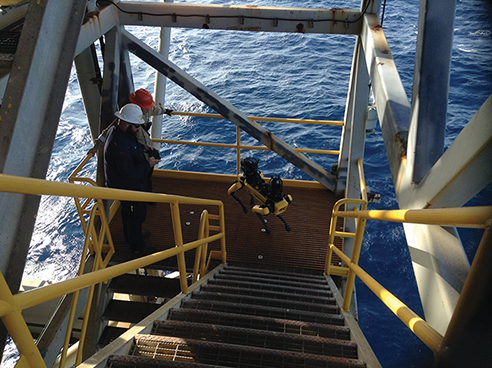
In 2020, British oil company BP pledged to reach net-zero emissions by the year 2050 while simultaneously boosting employee safety and operational efficiency. To achieve this, BP set out new ways to remove employees from potentially hazardous situations and environments. And although the company operates its facilities with a strong focus on safety, the work remains inherently risky. For example, since production sites are remote – in hard-to-reach locations such as the middle of the ocean – there is a risk in transporting employees back and forth.
Strategic approach to driving digital transformation
As highlighted by Adam Ballard, former facilities technology manager at BP, employing robots to inspect remote facilities is a strategic approach to driving digital transformation while enhancing employee safety on site. In this capacity, robots can undertake tasks traditionally carried out by personnel, including scanning for abnormalities, monitoring corrosion, and checking gauges.
BP turned to Boston Dynamics and tested Spot multiple times before deploying one robot offshore. The initial phase involved a proof of concept (POC) at the Texas A&M Engineering Extension Service (TEEX) facility, replicating a typical production site. Tests included navigating various terrains and confined spaces to assess Spot’s mobility and autonomous capabilities. While initial trials revealed issues on grated stairs, Boston Dynamics quickly addressed these.
Working with vendors
Collaborating with BP, Boston Dynamics also connected with vendors to customise sensor payloads, including a methane sensor for high-risk environments. Pleased with Spot’s performance, the BP team trialled the robot at its Whiting refinery in Chicago, where its performance improved with updates. This success gave the team the confidence to deploy Spot offshore.
Advancing spot’s programmed capabilities
Ballard explained that the company’s strategy involves advancing the programmed capabilities of Spot, and said this helped the team develop a practical understanding of the site. “It’s about imbuing Spot with that experiential knowledge,” he explained. “Spot should possess the ability to observe, listen, detect odours, and scan to assess the plant’s status. Once fully integrated into our facility, Spot will require analytical reasoning to differentiate between normal operations and anomalies. In the near future, we envision robots like Spot becoming mobile inspectors capable of providing comprehensive insights into a facility’s condition.”
Spot the robot: changing how companies operate
Boston Dynamics’ most notable robot is changing how companies monitor and operate their sites, as well as how they ensure the safety of their teams, and make data-driven decisions. Spot is a compact, nimble four-legged robot designed with what the company calls ‘athletic intelligence’ – a form of artificial intelligence (AI) that allows it to walk, climb stairs, avoid obstacles, traverse difficult terrain, and autonomously follow preset routes with little or no input from users.
According to Spot’s developers, the robot is easy to use and learns intuitively, making it quick to deploy for both manual operations and autonomous missions. The robot has a payload of 14kg, is capable of moving up steps with a height of 30cm and a slope of ±30°, and has a maximum speed of 1.6m/s.
The robot’s terrain sensing capabilities help with inspections and feature a 360° horizontal field of view, a range of up to four metres and a collision avoidance system allowing the robot to maintain a set distance from station obstacles. As for its walking control system, Boston Dynamics has leveraged model predictive control (MPC), a strategy that predicts and optimises the robot’s future state in order to decide what action to take in the moment.
Spot can also operate at temperatures of between -20°C to 55°C, making it an ideal choice for environments such as oil and gas facilities. It also has an ingress protection level of IP54, meaning its electrical components are protected by dust and water that it is likely to encounter on site.