Caracol founder Francesco De Stefano shares
Large-scale additive manufacturing (AM) is rapidly moving from prototyping into production across industries such as automotive, rail, maritime and aerospace. One of the companies driving this transition is Caracol, which has developed robotic platforms designed specifically for the large-format production of composite components
According to founder and CEO Francesco De Stefano, the company’s technology was created to address a gap in additive manufacturing capabilities at industrial scale. “Caracol was a company founded from a research programme to start from the advantages of additive manufacturing, but bring them to the large scale,” he explains. “Back in 2015 there were very few solutions for printing over the metre, we had the intuition of combining a six-axis robotic tool with geometrical flexibility to build an integrated platform.”
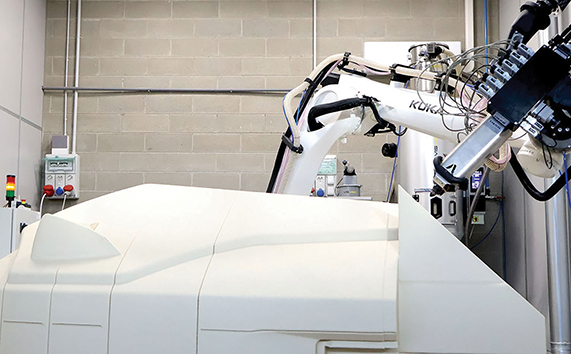
This approach resulted in the Heron AM robotic additive manufacturing system capable of producing large composite components using industrial robots, extrusion-based printing systems and integrated automation software.
FROM SERVICE BUREAU TO TECHNOLOGY PLATFORM
In the early stages of its development, Caracol validated its technology through internal manufacturing services before commercialising its systems. “We started as a service bureau using our own technology, created the applications for it, and then scaled up to offer our turnkey platform,” De Stefano explains.
A key differentiator for the company is the vertical integration of hardware, software, materials and process development. “We develop our software, hardware and automation in-house to offer a complete solution, as well as a full ecosystem with application support and materials,” De Stefano adds.
Caracol maintains production facilities in Italy where the company designs, manufactures and tests its systems. The facilities include R&D, machine assembly and an aerospace-certified manufacturing centre. Operating internal production environments allows the company to continuously refine its manufacturing technology.
ROBOTIC AM FOR COMPOSITE STRUCTURES
Caracol’s Heron AM platform integrates an industrial robotic arm, extrusion system, modular build surfaces and proprietary automation software.
“We started with our platform, integrated robotic arm, extruder feeding system, different types of printing beds, as well as our automation and software behind to program the machine,” De Stefano explains.
The system enables large composite structures to be produced directly from digital models. One example being demonstrated live at JEC World 2026 was a maritime air-grid structure. “Finished parts for maritime were one of the first applications of production we unlocked three years ago and now certified parts from Caracol systems are all over the yachting industry, shipbuilding industry, as well as different types of maritime applications,” De Stefano says.
These applications highlight how large-scale additive manufacturing can move beyond prototyping into functional end-use production components.
IMPROVING TRADITIONAL MOULDING
One significant benefit of the technology lies in its ability to remove traditional mould-based manufacturing steps. This is particularly relevant in industries where production volumes are relatively low but part complexity is high, such as motorsport. De Stefano describes a project involving a composite roof component for a motorsport vehicle.
“The process today is still very manual, so you need to make a mould for such a complex geometry which has a long lead time and generates a lot of waste across the process if you’re milling out the parts of the mould. And of course, the high cost to put together the mould for low volumes,” he explains. “Our approach replaces all that by printing the part directly and post-processing it with the addition of glass fibre, lamination and wrapping wherever needed to increase the mechanical strength.”
This hybrid workflow retains traditional finishing techniques while eliminating costly tooling. “We’re removing a step that does not allow composite companies to be flexible, one that is very expensive, time-intensive and unable to be customised,” he adds.
CERTIFIED PRODUCTION IN RAIL APPLICATIONS
The company has also demonstrated the technology in rail transportation through collaboration with French rail manufacturer Alstom. Rail vehicles often involve large composite components produced in limited volumes, making them well suited for large-format AM.
“With Alstom, we did a two-year qualification programme in which we eliminated the mould, again, printed the part directly, and then finished with a material that is fulfilling the railway standards in terms of interior and exterior,” De Stefano says. “We are the only company in the world that is certified for printing railway parts for interior and exterior in the large-scale application segment, and we’re very proud of this collaboration, because rail standards are very, very complex.”
AUTOMATION AND AI-DRIVEN MANUFACTURING
Automation and AI play a central role in the platform’s manufacturing workflow. Caracol’s software converts CAD models into robotic toolpaths and simplifies programming for operators. “Through our software, we try to make it as automated as possible to programme the part,” De Stefano says. “You don’t need to be a robotic operator, the way we have developed the software allows you to have a user-friendly interface to guide you through simulation,” De Stefano explains.
Caracol has also introduced digital monitoring and AI capabilities throughout its software ecosystem. “Our second module is an IoT platform that allows you to manage printer fleets, read what the system is printing, gather data around it and generate statistics, but most importantly, to monitor the process,” De Stefano says. The company is now integrating machine learning into the system to enable adaptive printing. “The ability to use the data that you’re gathering allows the machine to become smart, learn and adjust as it prints, not only to automate and shorten the process, but also to reduce downtime and eventual mistakes,” he explains.
Looking ahead, Caracol is targeting more demanding applications in aerospace and space systems. “The next step is enabling production for the aerospace industry not only at the tooling level but for applications such as manufacturing the fuselage for unmanned drones and producing high-strength composite parts for the space sector.”