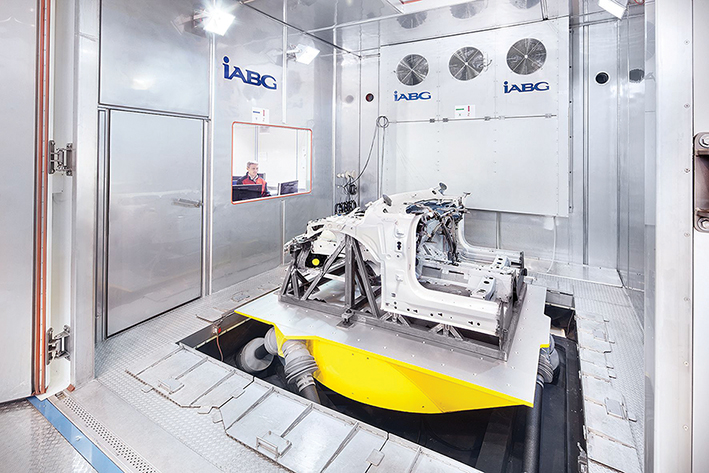
IABG runs a state-of-the-art simulation centre near Munich to evaluate and ensure functional safety
How are sensor solutions being deployed for vehicle safety testing?
For over 60 years, the German safety testing provider IABG has been carrying out simulations to monitor, analyse and secure the safe and smooth operation of vehicles, critical infrastructure and other assets. In 2011, the company began integrating specially adapted ASC accelerometers, which are primarily used in vehicle test benches and safety tests of components for energy production.
POWERING TEST RIGS
“We decided to use capacitive sensors from ASC after discovering that the piezo-electric sensors initially selected were unable to deliver the desired quality,” says Arbo Simon, Team Leader Vibration tests and Earthquake Simulation at IABG. “We then looked for a specialist who was willing and able to support us with the right technical expertise and an ‘open mind’.”
Both companies have been partnering with the automotive industry for many years. As a leading provider of vehicle testing facilities, IABG runs a state-of-the-art simulation centre near Munich to evaluate and ensure functional safety.
“This incudes vehicles and transport systems, as well as newly developed hi-tech components, systems and materials used in them,” Simon explains. “The technical quality and diverse range of ASC sensors, as well as the company’s great flexibility, allow them to explore new avenues with us and tailor solutions for our innovative test benches.”
AUTOMOTIVE SAFETY EVALUATION
IABG’s test rigs involved in automotive safety testing include the HyMAS (Heavy Multi-Axial Shaker), a multi-axis vibration rig for earthquake simulation and fatigue strength evaluation of heavy objects weighing up to 14 tonnes. In contrast, the LiMAS (Light Multi-Axial Shaker) is a multi-axis vibration test bench with combined environmental simulation for specimens up to 1,000kg, used in evaluating the environmental impact of objects or wind gusts.
IABG’s single-axis vertical vibration test bench SILAS-V (Single-Axis Shaker Vertical) helps verify the fatigue strength of mass-excited parts and components of up to 500kg under vibration loads up to 80m/s2, in a 0.5-200Hz frequency range, at temperatures from -40°C to 120°C. Finally, the vertical dynamic structural test bench VESPA is used in the comprehensive, combined testing
and analysis of overall vehicle safety and reliability.
LOW-NOISE DENSITY FOR SEISMIC ACCURACY
“Across our test rigs, we analyse the impact of acceleration forces from less than 1m/s2 continuous vibration load all the way up to 2,000m/s2 peak acceleration,” Simon says. “These high-precision sensors register dynamic (AC) and constant, static accelerations (DC) and thus operate from nearly 0Hz.”
The triaxial capacitive low-noise (LN) accelerometers of the ASC 5711LN series, which are specially configured to meet the needs of the various applications at IABG, have very low noise density even in high measuring ranges of +/-200g. In combination with the MEMS-based sensors’ excellent response behaviour, this leads to feasible resolutions of only a few millionths of gravity (µg).
COMPLEX VEHICLE TESTS
In difficult off-road conditions on test tracks, for example, truck or commercial vehicle brakes can be subjected to up to 90 times the acceleration of gravity. Using ASC sensors, the SILAS-V test bench can simulate similarly extreme loads. The test is carried out using purely vertical accelerations of a maximum of 600m/s2 to precisely analyse components weighing up to 40kg.
In the context of modern mobility concepts, design requirements for vehicles are becoming increasingly demanding. Reliability and safety are crucial for increasingly complex vehicles and their growing range of functions. IABG’s VESPA test bench evaluates and ensures these parameters for vehicles of all kinds of drives.
The VESPA combines test types of operational stability, fatigue, vibration and noise analyses of vehicles with conventional and electric drives. Customers can choose from a wide range of services to be individually tailored, from fatigue strength tests on car bodies and motorcycles to the monitoring of electric vehicle behaviours, noise interference analyses and the simulation of ageing processes for vehicle components under harsh climatic conditions, as well as solar simulation or the impact of simultaneous exposure to vertical vehicle excitation.
STABILITY AND LONGEVITY
“Most of our applications are in the range up to 200Hz. For this, we use a sampling rate of over 2kHz to be able to record all relevant data,” Simon explains. The sensitivity of the sensors used played a major role here. “The DKD calibration capability of ASC’s sensors is also critically important for us as an accredited laboratory.”
This also applies to the operational stability of the sensor technology in use. “ASC sensors’ easy handling and installation, their lightweight but robust housing, flexible usage between our test benches and DKD calibration are decisive advantages. As we aim for good availability of our test rigs, sensors of high accuracy with a long, stable service life are of the essence,” Simon concludes.