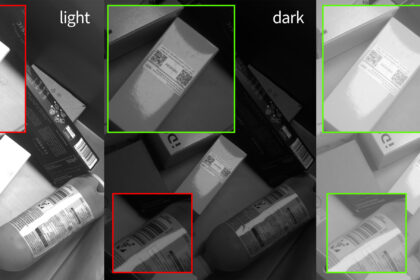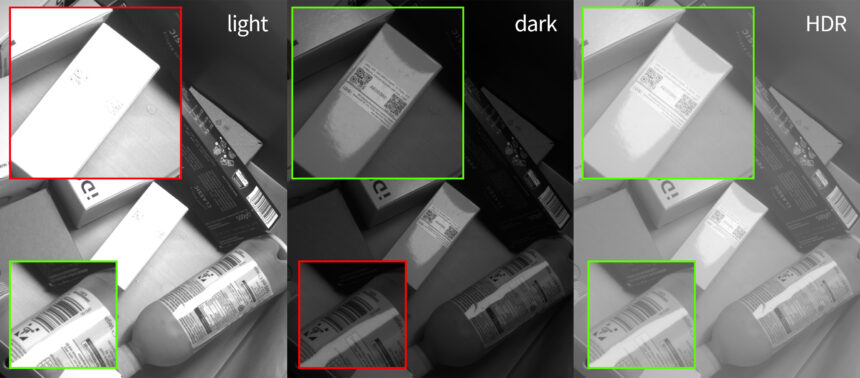
Industrial image-processing applications can be complicated by strong reflections, changing light conditions, and large brightness differences. High Dynamic Range (HDR) extends the measurable dynamic range and reveals details that could be lost in overexposed or underexposed areas
As different applications have different requirements, choosing the appropriate HDR method is essential. Depending on the application, the focus may be on dynamic range, resolution, or motion tolerance.
IDS Imaging Development Systems bundles various HDR technologies into a single software environment, enabling users to more easily compare, test, and integrate the respective features into their applications.
With Clear HDR, Quad HDR, and Sequence HDR, IDS supports three HDR modes for different requirements regarding dynamic range, resolution, and motion. With IDS peak, HDR-capable IDS cameras can be configured, output data can be acquired, and HDR results can be processed and visualised.
Heiko Seitz, product marketing manager at IDS Imaging Development Systems, said, “Users want to use HDR, not develop HDR. Therefore, we bundle various HDR technologies as continuous software support from capture to the finished HDR result in IDS peak. This simplifies the evaluation, reduces the integration effort, and accelerates the path to the right solution.”
HDR is more than a function of the image sensor; only the interaction of the camera’s sensor and firmware with the image processing on the PC makes the additional image information practically usable. Therefore, IDS integrates core functions such as camera recording control, multiple image data formats, and merging HDR sensor data with tone mapping algorithms into the IDS peak SDK.
Users gain access to individual HDR exposures as well as calculated HDR and LDR results. The IDS peak cockpit enables users to explore, test, and visualise the resulting HDR images across the entire HDR toolchain. This is all possible without prior programming, and source code samples further simplify integration into users’ own applications.
Many industrial image-processing applications benefit from this approach, including quality control of reflective components, logistics and OCR applications, robotics and automation, welding processes, and traffic and outdoor applications. In medical technology and microscopy, HDR can capture more image information from high-contrast scenes.