How Aimplas’ ongoing projects are helping aeronautics and transport vehicle manufacturers reduce weight and improve energy efficiency
With over three decades of experience in the plastics industry, Aimplas is a technology partner to hundreds of companies, from raw material manufacturers through to plastic processors and end users. As such, the company’s R&D arm is extensive, with 307 projects either completed or ongoing.
Two of these projects are currently addressing the major challenges facing the aeronautics and vehicle manufacturing industries: weight reduction and energy efficiency. As these sectors transition to more sustainable technologies – in light of global emissions targets and decarbonisation – innovative composite technologies and materials are gaining increasing traction.
A PARADIGM SHIFT IN AERONAUTICAL COMPONENT DESIGN
Aimplas’ RE-CELL project is developing a novel generation of supercapacitors and structural batteries based on recycled carbon fibre, capable of storing energy while simultaneously forming part of the aircraft structure itself. The initiative is coordinated by Sofitec with participation from Aimplas, the Plastics Technology Centre and I2CON.
The project is using multifunctional materials that combine mechanical properties with energy-storage capacity to design lighter, more energy efficient aeronautical components.
“The major challenge in aviation electrification is not only to store more energy, but to do so without adding a weight penalty,” says Esteban Castro, R&D engineer at Sofitec. “Structural batteries make precisely that possible: the component itself performs both a structural and an energy function.”
The project will initially focus on non-critical applications such as cabin lighting systems, with broader integration planned in future. Recycled carbon fibre will be used as the basis for developing these new materials, which the partners say will not only help to reduce waste in composite-intensive sectors but also support progress towards a circular economy model.
“In RE-CELL, we are not only seeking more efficient new materials, but also more sustainable ones,” adds Fernando Ramos, researcher in sustainable and future mobility at Aimplas. “We are working to give carbon fibre a second life and turn it into a high-value resource for demanding applications such as aeronautics.”
The project is also addressing some of the scientific challenges that have so far limited the real-world application of structural batteries, such as the development of functional solid electrolytes and the variability of recycled fibres.
Florin Ardelean, a researcher in computational modelling and simulation at I2CON, explains: “One of the project’s main advances is to address together phenomena that until now have been studied separately, such as ionic conduction and the material’s mechanical behaviour. This integrated approach is essential to leap to real applications.”
The project will culminate in the manufacture and validation of a full-scale demonstrator integrated into a component linked to an aircraft landing gear. This step will make it possible to assess the technology’s performance under representative conditions and advance towards future industrialisation.
ULTRALIGHT AND RECYCLABLE VEHICLE PANELS
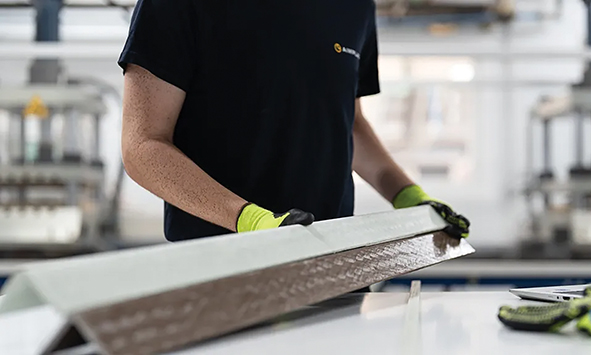
Aimplas is also looking to address lightweighting in the SUPERPAN project, an initiative led by Birka Composites with participation from Ideko, which aims to develop a new generation of multi-directionally reinforced panels for use in structural transport components. With vehicle weight a decisive factor in reducing energy consumption and emissions, the ultralight panels will have greater recycling potential.
“The aim is to advance towards more efficient materials that reduce the weight of structures without compromising safety or performance,” says Manuel Guerrero of Birka.
One of the project’s main advances is a focus on materials that are easier to recycle at the end of their useful life. At present, many components used in transport are difficult to recover. SUPERPAN proposes an alternative based on thermoplastic matrices, which improve the recyclability of composite materials and support the development of solutions aligned with circular-economy principles. Materials are designed and selected from a global perspective that considers the component’s entire service life and adapts established manufacturing processes that currently use thermosetting resins.
The project integrates automated manufacturing technologies such as dual pullbraiding (DPB), a technology patented by Birka, and ultraviolet (UV)-assisted curing of prepregs. These technologies improve process efficiency, reduce costs and decrease the variability associated with manual processes. Controllers are also integrated into the manufacturing line to collect process data. This automation enables products to be manufactured with greater quality control and fewer defects, while increasing productivity and scalability.
Aimplas is contributing its expertise in polymer materials, recyclability, material characterisation and validation, as well as supporting the development of advanced manufacturing processes. Ideko, meanwhile, will supply its knowledge of automated manufacturing technologies and industrial digitalisation.
Vehicle weight is a decisive factor in reducing energy consumption and emissions. As such, composite materials have become a strategic alternative because they offer high strength and lower weight than traditional materials such as metals.
Read the October issue of International Design Engineer magazine here, or visit our magazine archive for all our recent publications.