
Dr James Edmondson shares his findings on how to best optimise motors
Motor efficiency can improve both driving and reduce vehicle costs. Greater range can be extracted from a motor the more efficient it is, meaning the same batteries can power a car to travel further. Even a small drop in efficiency percentage can result in hundreds of USD difference in operating costs.
According to Dr James Edmondson of IDTechEx electric vehicle (EV) has “significantly” slowed in Europe and the US during the first half of 2024. By reducing prices and making EVs more affordable demand can be grown. Battery is an expensive feature of EVs, but other components such as motors can also play a role in reducing costs.
IDTechEx predicts in 2035 160 million electric motors will be required and 30% of the automotive market will use rare earth-free technologies. IDTechEx has also published a report forecasting the next 10 years, predicting what technologies and materials will be used along with how the markets will look.
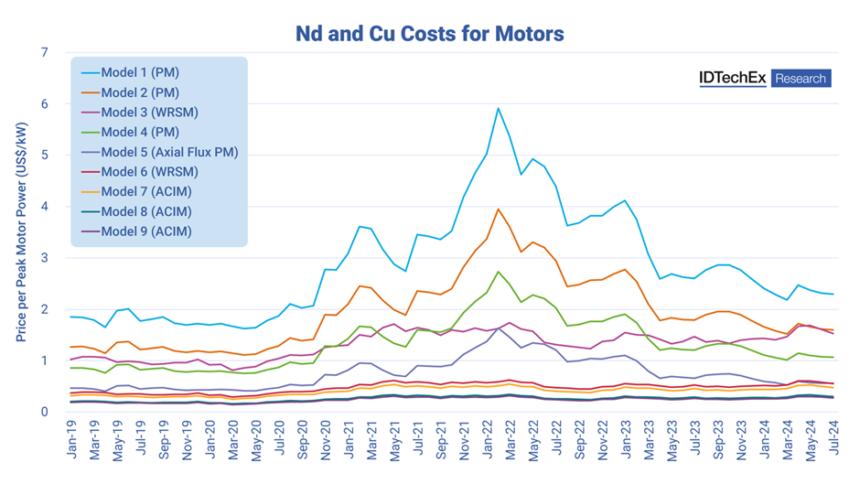
The battery electric and plug-in hybrid car market is dominated by permanent management (PM) motors, consuming 85% of the market share in 2023. This is an expensive way to manufacture motors as permanent magnets contain rare earths, the motors can take up around a third of the motor’s bill of materials despite being a relatively small part of the motor.
Rare earth metals have always had a volatile price, as since 2010 neodymium’s maximum price has reached nearly five times of its minimum price.
Wound rotor synchronous motors (WRSM) are a magnet-free alternative and have a lower bill of materials as the permanent magnet is replaced with copper wiring. Replacing a permanent magnet with copper wiring may reduce material costs, but increases manufacturing costs due to the winding required on the rotor along with the mechanism to provide current to the rotor and associated control electronics.
The cost of a permanent magnet would have to be high to offset the additional costs in manufacturing to make the rotor competitive. WRSM’s are typically better for high-speed cruising, the rotor does not operate as efficiently as PM motors.
Sourcing rare earth-free magnets is another cost-effective solution but impacts performance. Ferrites, AINiCo and other rare earth-free magnets can be competitive with Nd magnets in select properties, but not all key properties.
A larger motor for the same level of performance is required when using rare earth-free magnets, due to the lower power density, meaning more magnetic material is required. For a small city car, a much lower-performance motor could be fitted and still be sufficient for its needs, achieving a low-cost vehicle.
The manufacturing costs of rotors could be increased by fitting more magnetic material to offset the large performance drop using rare earth free materials.
Long term, moving away from rare earth magnets will be beneficial for the environment and supply chain security, but will not be economical unless the cost of materials significantly outweighs the cost of manufacturing.