Dr Jiayi Cen, IDTechEx, shares her findings on the future of direct lithium extraction
New direct lithium extraction (DLE) technologies are being developed to aid lithium mining extraction methods from brines. The aim of these new methods is to give quicker extraction times and higher yields, whilst potentially increasing the amount of usable brine sources across locations.
IDTechEx predicts in its DLE 2025-2035 forecast DLE will disrupt the brine mining market, as the compound annual growth rate (CAGR) of 19.6% makes it the fastest-growing segment in the industry, whilst the global lithium market is expected to expand at a CAGR of 9.7% in the same time window.
Dr Jiayi Cen outlines her predictions for the future and what the current landscape is for DLEs.
DLE making lithium extraction viable
Salt lakes or flats are the most exploited source of lithium brines, typically found in the ‘lithium triangle’ located across Bolivia, Chile and Argentina. Lithium producers such as SQM and Albemarle are currently based in Salar de Atacama, Chile due to its rich salt lakes/flats.
DLE has increased the attention placed on extracting lithium from geothermal and oilfield brines. Lithium concentration (known as grade) is a key factor in determining if it can be extracted as well as impurity content, pH and temperature.
Brine quality requirements are stricter for traditional methods such as using evaporation ponds, this is good for brines with high lithium concentration and low impurity content. These sources can be found in Nevada, USA and Salar de Atacama, Chile.
The expansion of DLE technologies allows for a range of brine resources to be used, enabling extraction from lower-grade brines.
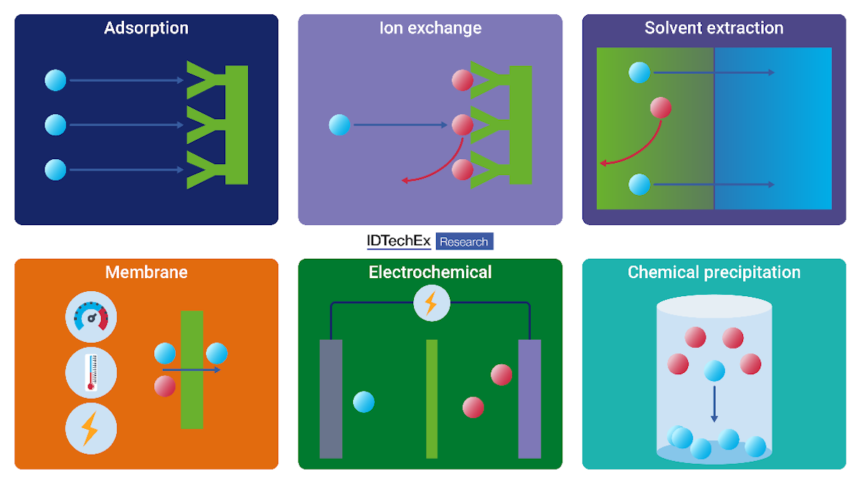
Six different classes have been identified as DLE, all at varying points in its development.
Absorption-based DLE has received the most attention. This method involves using aluminium-based sorbents to capture lithium and water to release lithium salts, typically lithium chloride. Brines with high salinity have weakly hydrated and stabilised lithium ions, making this process very effective.
Lithium ions are coupled with matching anions, such as chloride, and are transported to the sorbent material. This is washed with water, leaving the excess of free water molecules to become available to lithium ions. This creates strongly hydrated and stabilised solutions.
Releasing lithium salts from the sorbent and creating lithium salt solutions requires a higher volume of water. Water recycling techniques can be implemented to reduce water waste, but this does increase energy consumption. The trade-off between water and energy consumption can create a costly dilemma.
The second most advanced DLE technology is Ion exchange. This uses manganese or titanium-based sorbents to capture lithium and release lithium salts such as lithium chloride or lithium sulphate). This is created by washing the salts with acid, such as hydrochloric acid.
Ion exchange can extract lithium from low-grade brines whilst producing brines with high lithium concentrations compared to absorption DLE methods. The need for water separation and brine concentration is reduced compared to absorption DLE.
Using acids can be challenging logistically. Sourcing and transporting appropriate acids and transporting them to extraction sites can be difficult as well as costly. More maintenance on ion exchange facilities is required, due to increased rates of degradation caused by using acid.
Ion exchange is yet to be commercially proven, unlike absorption which requires economic and performance improvements before it can be commercialised. Standard lithium and controlled thermal resources prefer absorption over ion exchange due to the issues with using acid.
Adsorption and ion exchange techniques have led the way for DLE technologies.
Solvent extraction is the process of selectively dissolving lithium from brines into solvents, this uses multi-component solvent systems comprising of extractants, co-extractants and bulk solvents. This technique has been underdeveloped and so has limited activity in the field, despite it producing high-purity lithium solutions. A lack of effective lithium extractants as well as a limited understanding of process optimisation for efficiency and high lithium selectivity has held back this method.
Versatile solutions for recovering lithium from brines are offered by membrane methods. Membrane techniques can be split into pressure-driven, thermally-driven and electrically-driven processes. Selective electrodialysis and nanofiltration are useful methods for lithium extraction. This differs from reverse osmosis and membrane distillation are mainly used for water separation inside DLE workflows.
These techniques were originally developed for water treatment and desalination but can be adapted for lithium separation. This can help with membrane scaling and fouling. Additional purification stages are needed to achieve a high-purity lithium stream from non-lithium selective membranes.
Lithium-selective membranes remain in the laboratory stage of development as chemical stability and scalability must be achieved before practical use is possible. Electrochemical and chemical precipitation DLE are predominantly in the laboratory research phase, needing more development before they can be used for commercial purposes.
Customised lithium extraction
DLE technologies can vary between being energy-intensive and requiring high amounts of reagents. Effectiveness can vary along with the cost profile depending on the brine composition and location. Normally lithium recovery workflow and equipment are specifically designed for a resource but more and more companies are leaning towards absorption-based DLE methods.
Absorption is the most understood method whilst also being the only commercially proven method of producing lithium. Another benefit is no/minimal chemical usage is required. IDTechEx expects adsorption DLE to dominate the market for the next five to 10 years.