A new range of methods and techniques for the transportation and installation of floating offshore wind turbines
Kongsberg Maritime has launched its new methods for the transportation and installation of floating wind turbines, aiming to industrialise the process. The company is aiming to streamline the process from first mooring installation up to the electrical cable pull-in. This prepares windfarms to be connected to the grid.
Gunnar Thorsen, senior vice president of Business Concepts at Kongsberg Maritime, said: "We aim to offer a full package of equipment and technology, from the point the floating turbines leave their assembly site to the moment they are connected to the power grid. Our new methods for anchor tensioning, mooring installation, tow-out, and cable pull-in will represent a big leap forward in the industrialisation of floating wind installation. They are also applicable to other offshore energy structures, so our investment in these novel solutions will also be relevant and benefit oil and gas-related operations."
The new approach is contingent on four elements; new vessel designs and methodology for anchor and mooring installation, a new approach for towing turbines to site, a new integrated tensioning concept for mooring lines, and an innovative cable pull-in system.
An additional two new vessel concepts which are designed for large-scale mooring and installation operations are important to the new novel solution. Floating Wind Installation Vessels (FWIVs) are created to carry the materials for floating wind turbines along with other offshore and subsea structures.
A triple cross-tensioning winch system, capable of tensioning and proof-loading up to three mooring lines simultaneously whilst reducing bollard pull requirements, has been fitted into the anchor handling version UT 7900 FWIV AH. The vessel has the capacity to pull 900 tonnes in a single fall configuration, reducing energy consumption in an efficient and safe anchor handling.
Thorsen added: “This vessel offers a new approach, and because of the high volume and repetitive nature of the operations, we’ve built in additional rope and chain storage. The whole point behind this new set-up is that you deploy the rope, while preparing the next one, and do it in a safe environment, which you can’t do on a normal anchor handler.”
Advanced systems for handling, storing, and deploying mooring elements have been fitted onto the subsea construction vessel design concept UT 7600 FWIV Subsea, making it ideal for high-volume floating wind installations.
Tow Assist has been developed by Kongsberg Maritime to remedy the difficulties in transporting giant turbines to offshore fields. This allows for leading-edge technology Dynamic Positioning (DP) which features operational analysis to improve situational awareness, safety, and efficiency throughout all stages of the towing operation.
Tow Assist adds onto the existing K-Pos DP system, allowing for unpowered floating structures to become DP-enabled, even during complex towing operations. This works by calculating and distributing the optimal allocation of connected vessels.
The technology was successfully trailed in the North Sea last year. Real-time situational awareness, via graphical guidance for precise and efficient positioning, allows for new methods of floating offshore structures are moved and positioned.
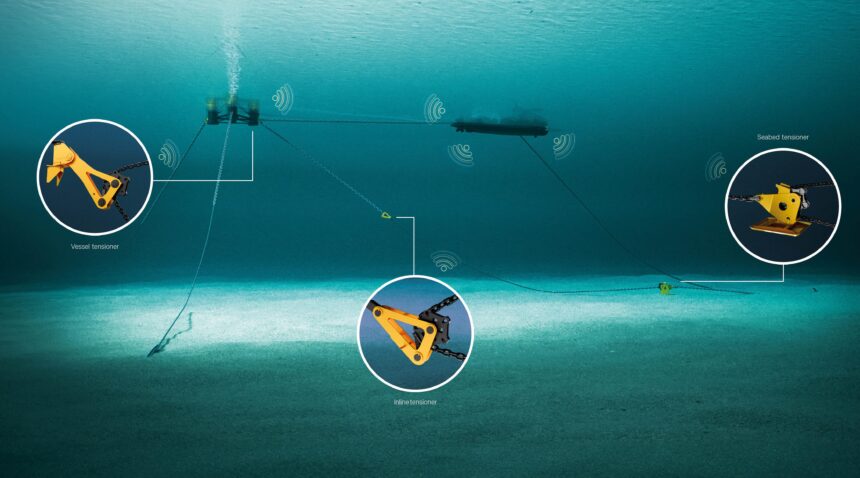
The integrated tension concept was created to enhance the efficiency and safety of mooring line hook-up operations. Compensation is made by the system for relative movements between floater and vessel. The operational weather window is increased significantly and provides smoother operations.
Kongsberg Maritime’s Permanent Magnet (PM) winches play a vital role in the concept. These winches have high torque and dynamic capabilities, they provide responsiveness and motion compensation required for precise and efficient tensioning of mooring lines. The PM winch was chosen due to its ability to handle large loads with fast response times, making it suitable for offshore operations.
Runar Hjelle, sales director offshore construction and support at Kongsberg Maritime, said: "The Integrated Tensioning Concept monitors the motion of the floater, allowing the vessel winch to compensate, removing peak loads and hazardous situations. This results in a much smoother hook-up process and significantly increases the operational weather window."
Requirements for equipment and people on the floater and reduced through the use of the new pull-in operations method, an important part of the end-to-end process. Safety is enhanced and the overall speed of installation is sped up.
Thorsen adds: “At present, cable pull-in operations require mobilising equipment such as winches, power packs and fuel tanks on the floating turbine. Personnel must be on board the floater after it has been hooked up to perform the cable pull-in. However, with the new, patented method, all necessary equipment is placed on the vessel, significantly reducing the complexity and risk associated with the operation.
“This new approach offers several advantages, including enhanced safety by reducing the number of people onboard the floater, to a minimum during the pull-in operation. Equipment lifting operations and personnel transfer are minimised which allows operations to continue in harsher weather conditions. This is crucial for maintaining year-round productivity and speeds up the overall rate of installation of the wind farm array.”