MathWorks, a developer of mathematical computing software for designing engineered systems, has expanded the TÜV SÜD certification of MATLAB, Simulink, Stateflow, and System Composer included with the IEC Certification Kit to cover generic AI tool classification guidance under the automotive standard ISO 26262
MathWorks is the first tool vendor to provide guidance for select AI-assisted engineering workflows in functional safety applications, informed by specific use cases evaluated by TÜV SÜD.
The guidance includes practical applications of AI-assisted Model-Based Design, focusing on workflows that use Simulink Agentic Toolkit for agentic model development, model review, and test case generation.
The guidance helps organisations accelerate development while preserving engineering rigour, traceability, and standards compliance by showing how to integrate these use cases into safety-critical development processes in a controlled, auditable way.
Agentic AI Capabilities Extend Model-Based Design
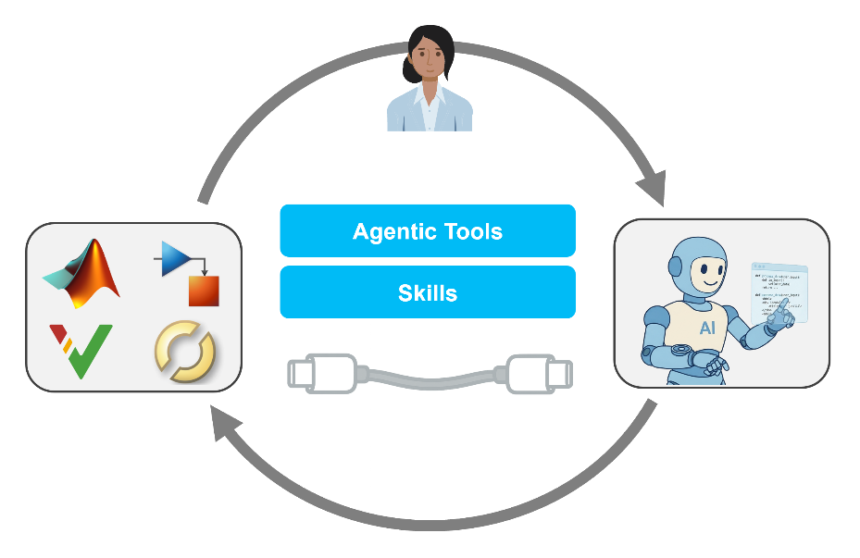
The MathWorks technology behind this approach integrates agentic AI capabilities with Model-Based Design workflows. These capabilities allow engineers to move beyond prompting AI systems to AI agents that operate directly on Simulink models and engineering workflows. MathWorks continues to expand its agentic AI capabilities with new skills that can guide agents in applying MATLAB and Simulink functionality to engineering tasks.
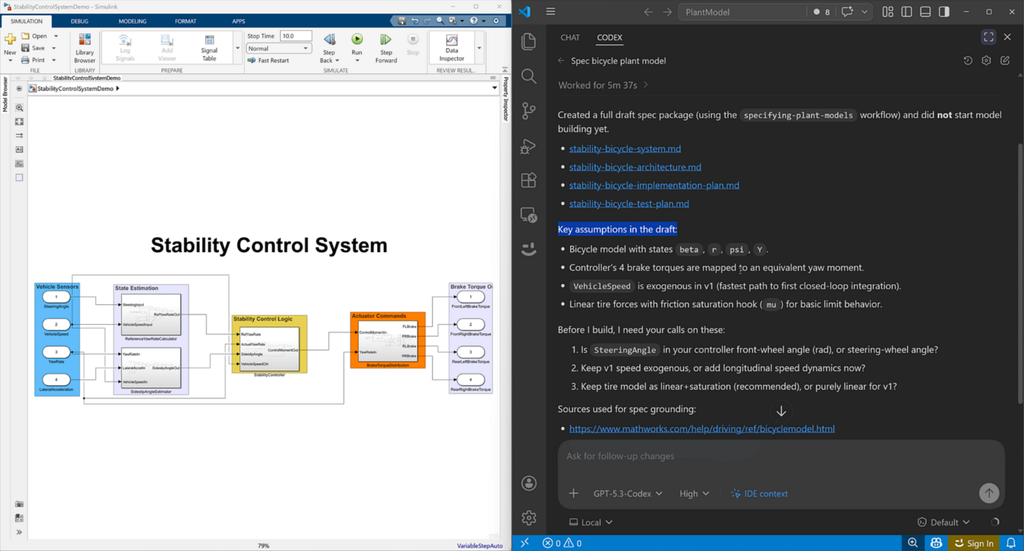
Simulink Agentic Toolkit enables AI agents to understand model structure, create and modify designs, run simulations, generate tests, and connect requirements to models. The toolkit integrates Simulink-specific tools with expert-authored skills for Model-Based Design workflows.
Skills authored by MathWorks engineers and domain experts guide agents through model development, algorithm specification, plant modelling, testing, validation, and requirements generation. Expert-authored skills help agents to apply the appropriate functionality for each task while engineers retain responsibility for validating results.
Polyspace Agentic Toolkit extends these workflows to software analysis and verification activities, supporting code robustness analysis, coding-standard compliance, and defect detection. In combination, the toolkits enable organisations to incorporate AI agents across the development lifecycle while maintaining established validation and review practices.
Michael Carone, principal product marketing manager, Simulink Platform, MathWorks, said, “Engineering teams are looking for ways to benefit from agentic AI without sacrificing the rigour that system development demands. By connecting AI agents to Simulink models, simulations, and testing workflows, MathWorks is helping engineers apply agentic AI within established engineering processes while preserving the accountability required for complex engineered systems.”
As organisations expand the use of agentic AI in engineering, they require approaches that combine AI capabilities with the domain-specific engineering context and deterministic verification needed for engineering workflows. MathWorks can help teams to apply AI within established engineering processes by connecting AI agents to executable engineering assets such as models, simulations, and tests.
Built on the Model Context Protocol (MCP), these capabilities support AI agent platforms such as GitHub Copilot, Codex, Gemini CLI, Claude Code, and other MCP-compatible agents, giving organisations the flexibility to incorporate agentic AI through the platforms they choose for their engineering workflows. Engineers can automate more development activities with AI assistance that is grounded in engineering results while remaining responsible for final decisions and approvals.