Stanislav Suchovsky explains how integrated power ICs create new options between pre-qualified modules and fully discrete power architectures.
Isolated DC/DC conversion has traditionally presented design teams with a straightforward choice: use a pre-qualified module to minimise development risk, or build the power stage from discrete components to gain greater control over cost, layout and electrical performance. That distinction is becoming less clear. A new generation of highly integrated transformer-driver, flyback-controller and synchronous-rectifier ICs allows engineers to retain many of the practical advantages of a module while gaining more freedom over the final power architecture.
This matters because isolation requirements are becoming more varied. Industrial automation, sensing, communications and wide-bandgap semiconductor (WBG) gate driver power supplies may require non-standard voltages, multiple isolated outputs, asymmetric rails or unusual mechanical constraints. A fixed module remains attractive when the electrical specification is conventional and time-to-market (TTM) is the main priority. When the power stage has to fit the application rather than the other way around, however, an integrated circuit (IC)-based approach can provide greater system-level flexibility.
WHY THE BUILD VERSUS BUY EQUATION IS CHANGING
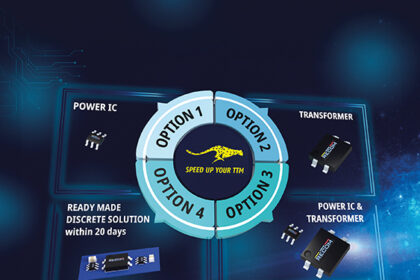
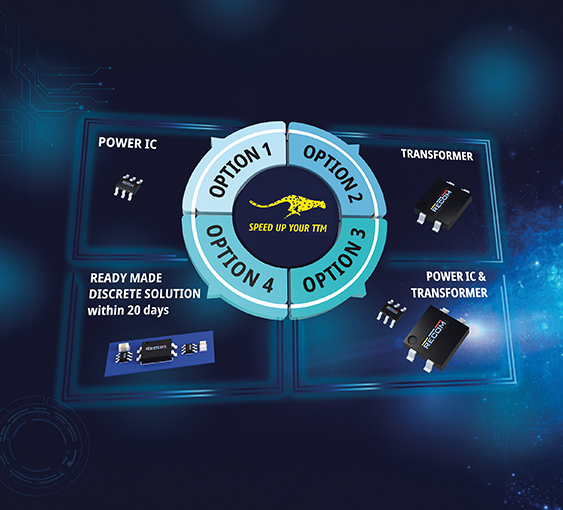
One important enabler is integration at semiconductor level. Instead of implementing switching, timing, protection and rectification with numerous discrete devices, designers can use power ICs that combine several of these functions in compact packages. Recom, for example, offers push-pull transformer drivers, full-bridge transformer drivers, regulated flyback controllers and synchronous rectifier controllers that support discrete isolated power architectures.
On the primary side, intelligent transformer drivers generate the alternating waveform required by the isolation transformer and can integrate protection and switching-control functions. Adaptive dead-time control is particularly important. In push-pull and full-bridge circuits, unwanted switch overlap can cause shoot-through, while switching asymmetry can contribute to magnetic flux imbalance and core saturation. Precisely controlled dead time reduces these risks and helps maintain predictable operation as temperature, load and component characteristics change.
Topology still matters. A push-pull converter is well suited to low-voltage, higher-current systems. It uses a centre-tapped primary winding and alternates current through the two halves of the transformer. A full-bridge topology energises the complete primary winding and does not require a centre tap, making it attractive where higher input voltages and lower currents dominate. For applications that need a wide input voltage range, tighter regulation or higher power, a flyback controller adds closed-loop pulse-width modulation (PWM) regulation. Recom’s RVPW series supports regulated flyback designs up to 30W.
EFFICIENCY DOESN’T END AT THE TRANSFORMER
The secondary side is equally important. Conventional rectifier diodes are simple and robust, but their forward voltage drop becomes increasingly significant as output voltage falls or current rises. Synchronous rectification replaces the diode conduction path with metal-oxide-semiconductor field-effect transistor “MOSFET switches”, reducing conduction losses and the associated thermal load.
Smart rectifier and synchronous rectifier controller ICs can also simplify secondary-side control. Recom’s RVS and RVSY families use self-synchronising concepts that reduce the need for separate control signals from the primary side. This can simplify the implementation of compact isolated converters while improving efficiency compared with conventional diode rectification.
The transformer remains a central part of the architecture. Its turns ratio establishes the relationship between input and output voltages, while winding construction influences isolation, leakage inductance, isolation capacitance and available printed circuit board (PCB) space. Standard surface-mount device (SMD) transformers cover many common requirements, while custom magnetics can address multiple outputs, asymmetric gate-drive rails or specific creepage and clearance distances.
FROM PROTOTYPE TO PRODUCTION
The strongest argument for an integrated power module is still development speed. A pre-qualified module arrives as a known electrical and mechanical building block, reducing schematic work, layout iteration and qualification effort. At lower volumes, it can also simplify the bill of materials (BOM), supplier qualification and assembly planning by consolidating the isolated supply into a defined component.
An IC-based solution requires more engineering, particularly in magnetics, electromagnetic compatibility (EMC), thermal design and PCB layout. Critical current loops should be short, the driver and transformer should be placed close together, and input and output capacitors should be positioned to minimise parasitic inductance and output ripple voltage.
The economic balance can change with production volume. Recom’s internal total-cost analysis indicates a typical crossover point at around 50,000 units per year, although the actual threshold depends on assembly processes, component sharing, qualification effort and engineering resources. Above that level, a discrete architecture may become more attractive because the transformer, silicon and passive components can be optimised for the exact application.
The wider significance is that the choice between an integrated power module and discrete components is no longer necessarily an all-or-nothing decision. Engineers can prototype with a module, move to validated component sets of ICs and transformers as requirements stabilise, and adopt a more customised power stage for high-volume production. Intelligent power ICs therefore provide another level of architectural flexibility, allowing design teams to select the degree of integration that best matches each stage of the product lifecycle.
Stanislav Suchovsky MSc is technology engineer at Recom Power