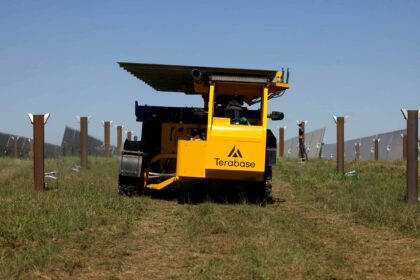
Renewable energy platform Matrix Renewables has deployed autonomous rovers at its 475 MWdc Tormes Solar project in Texas for the first time.
The next-gen Terafab V2 rovers offer a new approach to utility-scale solar projects with the potential for automated, AI-driven, around-the-clock construction.
The Tormes Solar site brings together an on-site robotic factory, AI-driven automation and quality control—and now autonomous and remote-controlled rovers—in a coordinated process that Matrix Renewables says changes how solar modules are assembled, transported and positioned for installation.
The project brings together Matrix Renewables’ strategic direction as project owner, Terabase Energy’s expertise in robotics and automation, and SOLV Energy’s experience in large-scale solar construction.
“Construction automation remains one of the biggest opportunities to disrupt and improve how utility-scale solar projects are delivered,” said Giora Salita, COO of Matrix Renewables. “At Matrix, innovation and operational excellence go hand in hand. We want to lead the change, not simply follow it.
“Tormes Solar reflects our commitment to challenging conventional construction methods, testing new technologies under real conditions, and using the insights from this proof of concept to shape the delivery of our future projects.”
The rovers’ deployment at Tormes Solar represents a ‘pioneering’ proof of concept for 24/7 automated solar construction, the company says.
The technology is being deployed on a portion of the 457 MWdc project to evaluate how standardised processes, AI-driven autonomous rovers delivering assembled PV tables, and advanced robotics operate under real-world conditions.
The initiative aims to evaluate five potential benefits: improved efficiency, faster construction, greater quality consistency, enhanced worker safety and increased cost competitiveness.
“Every other industry that had to scale learned to industrialise, and energy construction is next,” said Matt Campbell, CEO and co-founder of Terabase Energy. “Terafab V2 builds on years of field deployments with an on-site robotic factory and autonomous rovers that turn solar installation into a repeatable, continuous process.
“Tormes Solar, with partners like Matrix and SOLV, is where we show what physical AI can do at commercial scale, and how it will build the energy infrastructure the terawatt era demands.”
The deployment of the Terafab V2 will give Matrix Renewables operational insights into the performance, integration and scalability of automated construction methods. These findings will help the company assess where industrialised processes can deliver the greatest value across its portfolio, supporting an evidence-based approach to future construction technologies.
“At SOLV, we’re always looking for ways to build smarter while maintaining our commitment to safety, quality and execution,” said George Hershman, CEO of SOLV Energy. “Given that our average project size continues to increase alongside the demand for renewable power, we have bee exploring automation across the full lifecycle of our projects.
“We are uniquely proud of the Tormes Solar project, which provided an early-mover opportunity to explore Terabase and the 24/7 capabilities of their platform. We value our partnership with Matric and Terabase and look forward to expanding upon our shared vision.”