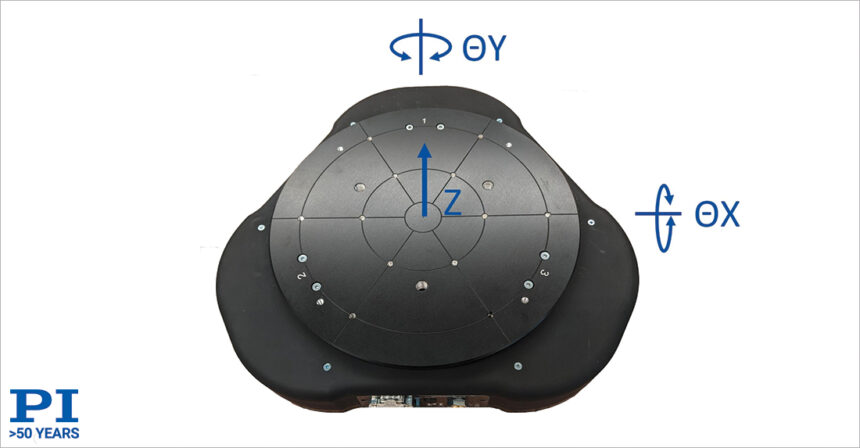
The A-523 Z-Tip-Tilt stage is new tool for the photonics, semiconductor and precision assembly industries
Motion control manufacturer Physik Instrumente (PI) has released the A-523 Z-Tip-Tilt stage, a nano positioning system for rigorous alignment applications in optics, semiconductors, precision assembly and photonics.
The cleanroom-compatible stage is based on air bearings and linear motos and requires minimal maintenance.
“The A-523 Z-Tip-Tilt stage was designed for metrology and alignment applications in the semiconductor and photonics industry,” said Stefan Vorndran, the vice president of marketing at PI. “Its low profile, high dynamics, and high precision, based on the parallel-kinematic and frictionless air-bearing design, make it a unique tool.”
Three-phase linear motors encourage high speed, while a closed-loop operation with linear encoders ensure high, one nanometre resolution and precision for direct position feedback.
The A-523 Z-Tip-Tilt stage’s clean design, which is free of drive screws and gears, allows for high dynamics with acceleration up to one g and positional repeatability.
Despite being able to withstand high loads of up to 18 pounds, the compact platform is less than 10 inches in diameter, providing five millimetres of Z-travel and a rotation range of two degrees for the tilt axes.
Consisting of just one moving platform, the potential for errors commonly seen in Z-Tip-Tilt systems is greatly reduced, as is the stage’s height, centre of gravity and inertia.
The stage can be paired with a two-axis planar air-bearing stage, providing five-axis precision motion for semiconductor and laser processing automation.
A variety of high-precision alignment automation tasks will be made easier with the application of the A-523 Z-Tip-Tilt stage, including optics testing and positioning, fibre positioning, wafer inspection, flat-screen inspection, lens alignment, maskless lithography and µ-LED manufacturing.
Earlier this year, PI unveiled its S-335 fast steering motor for precise, high-speed laser beam control and high resolution imaging applications, approved for outer space use. Both innovations follow PI’s 2023 pledge to intensify its cooperation with leading universities and research institutions.