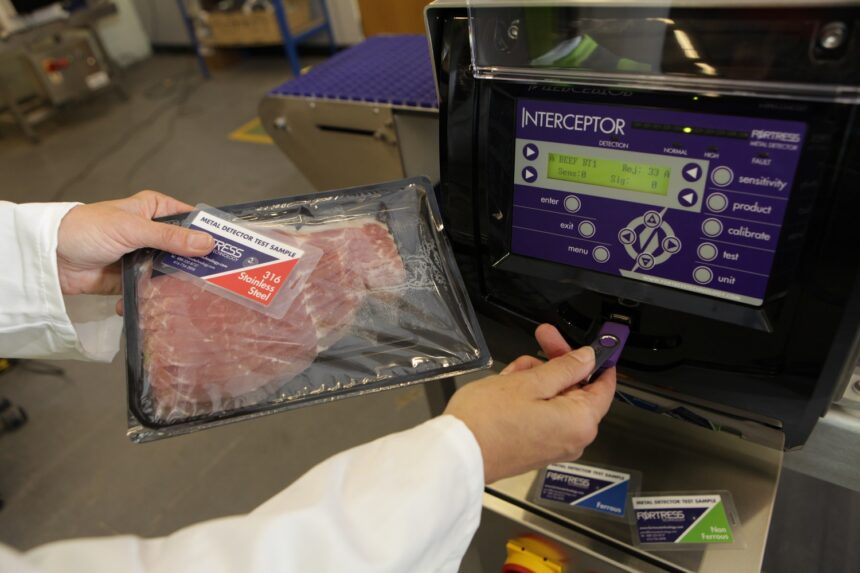
In food safety management, metal detection and X-ray inspection have evolved from precautionary measures into a pillar of food safety integrity
However, food manufacturers face unprecedented pressure from workforce shortages and rising production costs, as regulatory standards tighten and production speeds increase. As a result, manual testing of inspection systems has become increasingly inconsistent, labour-intensive, costly, and prone to human error.
The operational risk of depending on manual testing methods can be significant. For example, compliance gaps can undermine food safety protocols and increase the likelihood of missed contaminants. Manual testing also increases the risk of unexpected machine downtime. This downtime can disrupt production schedules, causing delays and reduced manufacturing productivity.
Verification to address vulnerabilities
A key benefit of adopting automatic testing is that it eliminates the inherent vulnerabilities associated with manual inspection, Fortress Technology’s European commercial manager Jodie Curry explains.
By moving from human-dependent testing to a repeatable, technology-driven approach, organisations can ensure that their detection capabilities are consistently verified under actual production conditions, improving consistency, accuracy, and traceability and reducing the burden on production staff.
Corson Grain Products is one of the most recent Fortress Technology customers to activate automatic testing on its new Stealth Gravity Metal Detector. Positioned under a grain storage silo, the metal detector’s performance was previously validated by manually dropping ferrous, non-ferrous, and stainless steel test balls through the aperture every hour of production. This can be hard to access in gravity applications, and the results are inconsistent.
Integrating Halo Automatic Testing has helped Corson Grain Products strengthen and future-proof its inspection programme, ensuring it remains robust and adaptable as compliance and verification standards evolve.
On-demand documentation
For any inspection system designated as a CCP, regular performance testing is a non-negotiable requirement of food safety management. In the eyes of auditors and regulatory bodies, the governing philosophy remains absolute: “if it isn’t documented, it is like the test never happened”.
Failing to maintain rigorous records can lead to failed audits and create systemic liability that can result in Class I recalls and erode brand equity and trust.
A comprehensive test log must capture specific, granular data to ensure compliance with new rules, including the EU General Food Law and the upcoming FDA Food Traceability Rule in North America.
These records should include:
- Facility information: Locations and exact date
- Metal detector configuration: Specific model, line ID, and reject mechanism type
- Test sample specifications: Verified sphere sizes for ferrous, non-ferrous and stainless steel
- Precise time of test: Including exact pass/fail status for both detection and rejection
- Documented corrective actions taken: For each verification failure.
Despite these records being vital for demonstrating compliance and ensuring food safety, relying on manual methods to meet documentation mandates can create inconsistencies and operator-introduced errors. This variability undermines documentation reliability and potentially compromises the integrity of a food processor’s entire record-keeping process.
Configuration and sector-specific testing challenges
Several operational environmental factors can influence the reliability of test sequences. These vary by application and the physical layout of production lines and inspection equipment.
Gravity metal detectors inspecting ingredients and snacks are difficult to test because enclosed systems are often positioned between hoppers and bagging systems, making drop points inaccessible. Climbing ladders to access points is time-consuming, labour-intensive, and a workforce health and safety risk.
Test balls are also rarely dropped from a height sufficient to challenge the reject fully. It is also impossible to ensure the sample passes through the aperture’s weakest point every time.
Proper inline testing of pipeline metal detectors is just as time-consuming and can cause significant machine downtime to retrieve test pieces and sanitise every machine part between each manual test. As a result, operators often perform tests ‘alongside the pipe’ close to the coils. This completely bypasses the geometric centre, rendering the test scientifically invalid for the product that is flowing inside the pipe.
Conveyor tests are also less reliable, as machine operators often use preconstructed test packages and do not consistently place the metal in the most challenging geometric centre, meaning the metal detector’s sensitivity limits are not fully challenged.
A global producer of frozen fries installed Halo Automatic Testing on 25 Fortress Technology Stealth Metal Detectors to eliminate human error and reduce operational and labour costs. Testing bags of fries ranging from 225g to 9kg, the Halo system automatically adapts to each SKU and adheres to individual customer standards. Production halts only if the metal detector or reject check fails.
Tests are pre-programmed hourly for three metals in three separate positions to counteract masking and verify the reject system is working. This gives the customer standardised testing, continuous verification, and secure digital records that support traceability and future AI initiatives.
Scientific simulation
Automatic testing tools address these systemic weaknesses. When implemented alongside HACCP plans, they also add a high-frequency verification layer that ensures every metal detector is functioning at peak capability without human intervention.
Strategic quality assurance requires testing the ‘worst-case’ scenario and replicating true production conditions. Halo does this by replicating the electromagnetic field disturbances of specific test spheres at each aperture position. For example, signals increase exponentially as they move closer to the aperture walls.
Another important consideration is that manual tests can inadvertently ‘cheat’ the system by passing samples near the coils or off-centre in the aperture. Instead, automatic testing replicates performance verification at the exact geometric centre of a metal detector aperture, providing a true ‘worst-case’ challenge.
Lastly, automatic testing should adapt to product effects. Rather than static verification, Halo Automatic Testing introduces its signal directly into the product flow, simulating a contaminant hidden inside a moving package.
Repeatable and robust
Any CCP is only as robust as its reject mechanism. If a system detects metal but fails to remove it, it is not considered a functioning system.
To ensure effective rejection, Halo is designed to operate with Fortress Technology’s robust reject monitoring and tracking software built into all Fortress digital detector models. This integrated approach enables the monitoring of the entire reject cycle, including the precise timing of each reject action and product position.
For optimal reliability, any automated testing system must use independent hardware for signal generation, ensuring that the process remains autonomous and prevents the system from ‘grading its own homework’.
The shift to automated testing signifies a fundamental change, transforming quality assurance from a perceived burden into a strategic asset, explains Curry. Manual reporting practices divert valuable resources from higher-value tasks related to quality and operational efficiency.
Minimising manual input lets teams redirect resources to more strategic responsibilities. This shift delivers substantial labour savings and enhances Overall Equipment Effectiveness (OEE).