Avnet Silica’s latest Trendliner report indicates a stronger market outlook for semiconductors than earlier in the year, with AI creating both opportunities and constraints.
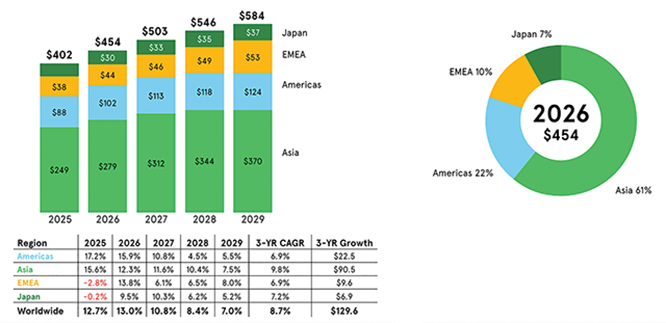
Avnet Silica’s Trendliner report for the third quarter of 2026 values the semiconductor market at $454 billion, with further growth of 10.8% projected for 2027. This points to a stronger market outlook than earlier in the year, with semiconductor demand strengthening. As indicated by the report, however, supply conditions still remain uneven, with AI infrastructure driving much of the expansion while creating significant pressure on supply chains.
“The stronger market outlook is encouraging, but it should not be mistaken for a return to simple or predictable supply conditions,” says Thomas Foj, vice president supplier management, solutions and digitalisation EMEA at Avnet Silica. “AI investment is supporting demand well beyond data centres, while the prioritisation of HBM and other high-value products is placing pressure on memory and wider component availability. For industrial customers, early visibility, realistic forecasting, and long-term planning is essential to securing supply.”
EUROPEAN MANUFACTURING IMPROVES
According to the Trendliner report, European manufacturing had its strongest quarter since 2022 during Q2 2026. Eurozone Manufacturing PMI remained above the 50 threshold for a fifth consecutive month, although it eased slightly from 51.6 to 51.4 in June. Manufacturing output increased to 51.7, with new orders also increasing modestly. Export demand remains weak, however, and the International Monetary Fund (IMF) has reduced its 2026 European Union growth forecast from 1.1% to 0.9%.
Automotive accounts for 39% of EMEA’s 2026 served semiconductor market, excluding DRAM, Flash, MPU compute, GPU and AI processors. Industrial electronics represents another 27%. That makes automotive by far the largest semiconductor-consuming vertical in the region. In particular, automotive high-performance computing (HPC) is growing at 21.5% CAGR. This points to increasing semiconductor content associated with software-defined vehicles, ADAS, automated driving and increasingly compute-intensive vehicle architectures.
AI DRIVES DEMAND AND PRESSURE
The report indicates that AI infrastructure continues to underpin sector growth in areas such as memory, high-bandwidth memory (HMB), advanced compute, power management, high-speed interconnect and thermal management. However, this is creating a significant supply side effect. Avnet Silica says prioritisation of HBM production is tightening supply across other memory categories, creating cost pressure for PCs, smartphones, servers and other electronics.
The report also highlights Edge AI as an increasingly important growth driver, extending AI-related semiconductor demand into industrial and embedded systems and boosting demand for analogue devices, sensors, MCUs and power-management components.
RECOVERY ISN’T LINEAR
Although Avnet Silica describes the market as entering a broad-based recovery, growth remains concentrated in AI infrastructure, memory and advanced compute, rather than representing a completely normalised recovery across all electronics markets.
The report cites memory availability and pricing as the biggest supply chain concern at present. DRAM prices continues to rise because of AI demand and declining DDR4 production. NAND and eMMC prices are also on the rise, with lead times extending beyond 30 weeks for high-density and automotive products. Price increases are also being felt across NOR and SSD, with tighter availability for PCIe Gen5 and industrial SSDs.
MCUs and programmable logic are also under pressure, with 26+ week lead times across 8-bit, 16-bit and 32-bit-and-higher devices. Within programmable logic, Avnet Silica says many parts have lead times of over a year and recommends customers provide visibility through the end of 2027.
Alongside memory availability, the report identifies advanced packaging, semiconductor testing and wafer-fab capacity as areas to watch, because AI hardware is becoming more complex faster than traditional capacity expansion cycles can accommodate.
THE IMPACT OF GEOPOLITICS
The report argues that tariffs, export controls and localisation requirements are moving from temporary disruptions towards long-term considerations. Diversification is improving resilience, but it also introduces additional complexity and cost. Regionalisation therefore helps reduce risk but isn’t a quick solution to capacity constraints – particularly for memory.
Asia continues to lead the market’s growth, supported by sustained investment and accelerated technology adoption across multiple sectors.
In essence, the report shows that while the industry is no longer facing the same broad-based shortages seen earlier in the decade, shortages and price pressure are becoming more selective, concentrated around AI-driven demand, memory, certain MCUs, sensors, programmable logic and automotive and industrial components. The coming months will show whether recent order strength across Europe, in particular, can translate into a broader recovery for the semiconductor market as a whole.
Read the October issue of International Design Engineer magazine here, or visit our magazine archive for all our recent publications.