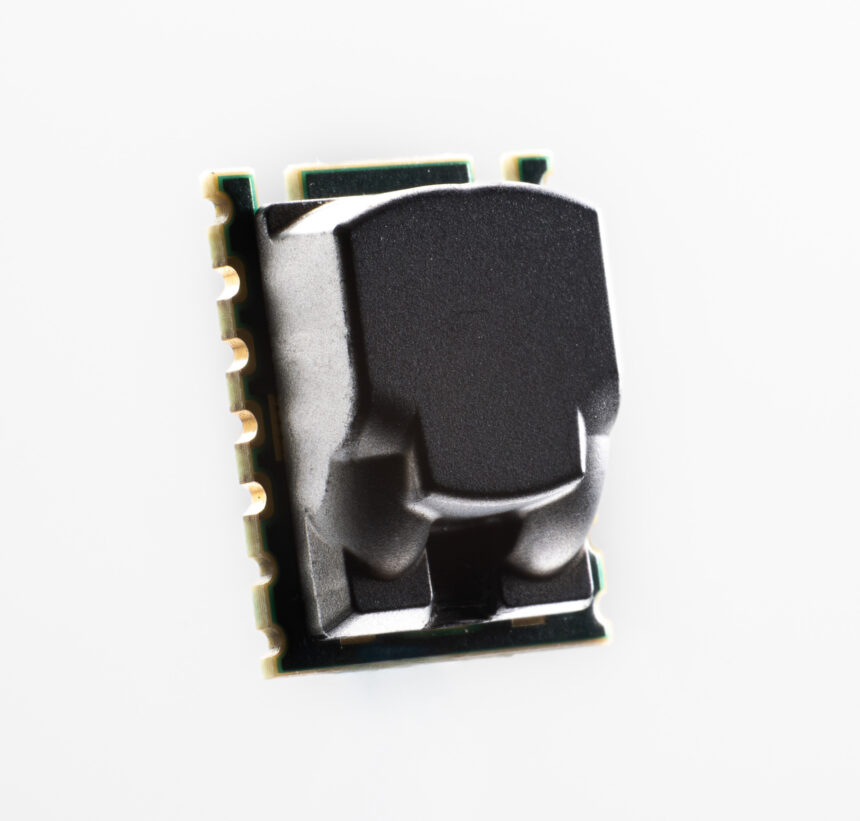
The new sensor is 75% smaller and features SMD-solderability
Senseair, the Swedish subsidiary of Asahi Kasei Microdevices, has developed a next-generation CO2 sensor, the S12 CO2, for demand-controlled ventilation (DVC) in zero-energy buildings and battery-powered indoor air quality (IAQ) monitoring
The new model is 75% smaller in volume than its predecessors and can be used as a surface-mount (SMD) on circuit boards while retaining high accuracy and low power consumption. This allows sensor integration in applications where installation was previously difficult.
Globally, legal frameworks to enhance building energy efficiency have become stricter. Especially within the EU, the Energy Performance of Buildings Directive adopted in 2024 requires new buildings to comply with the zero-emission standard. These buildings have low energy needs, largely covered by onsite and nearby renewable energy sources. This legislation is set to come into effect for new public buildings by 2028 and for all other new buildings by 2030.
To achieve this zero-emission level for buildings, intelligent DCV systems are becoming an effective alternative to conventional temperature-controlled ventilation. DCV systems adjust ventilation based on CO2 levels, enabling reduced energy consumption and a more comfortable IAQ. However, DCV systems require CO2 sensors installed throughout the entire building, and constraints on design and installation space have proved challenging.
Senseair’s new S12 CO2 sensor has a redesigned structure based on the company’s non-dispersive infrared absorption (NDIR) sensor technology. With a measurement range of 400 to 10,000ppm, and an accuracy of +/- (30ppm + 3% of reading), the new sensor maintains the performance of its predecessor CO2 sensors, “Sunrise” and “Sunlight”, but comes with a smaller packaging size.
Having a compact size means available space can be used more effectively, enabling SMD reflow surface mounting on circuit boards and discreet installation in air conditioning equipment or wall-mounted monitors without compromising aesthetics.
For the retrofit market, where cable installation can be a challenge, the Senseair S12 CO2 sensor offers the same ultra-low power consumption as its predecessors. Its energy efficiency, SMD-solderable design, and compact size enable battery-powered CO2 monitors that allow easy installation with a wide degree of freedom.
The S12 CO2 sensor will be deployed for IAQ monitoring in building energy management systems (BEMS) within office buildings and commercial facilities. Further applications include air conditioning units and heat exchangers in the residential sector.