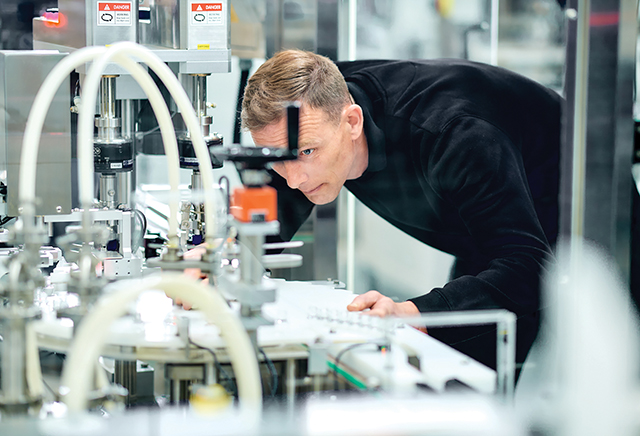
As production demand increases, many liquid manufacturers eventually reach the limits of semi-automatic processing. While moving to fully automated production can significantly improve throughput and consistency, the transition presents a range of engineering challenges that extend beyond simply increasing machine speed
THE CHALLENGES
One of the primary difficulties is maintaining product consistency at higher outputs. Semi-automatic systems often rely on operator adjustments to compensate for variations in viscosity, foaming characteristics or fill tolerances. At increased production speeds, manual intervention becomes less practical, making accurate process control far more important.
To achieve consistent performance, filling systems must work in close synchronisation with conveyors, cap feeding systems, labelling equipment and downstream packaging machinery. In many cases, production inefficiencies are caused not by the filling process itself, but by instability elsewhere on the line. Poor conveyor management, accumulation issues or inconsistent product spacing can quickly reduce overall throughput and increase downtime.
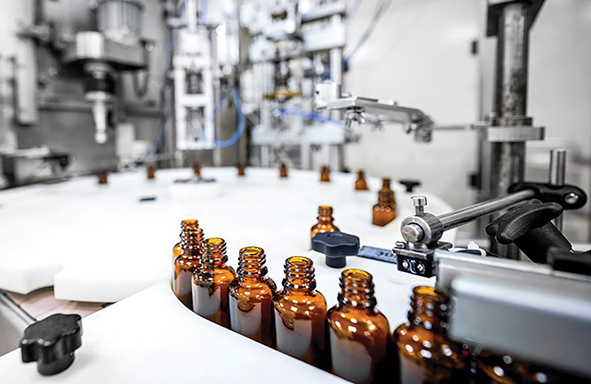
Container handling also becomes more challenging as line speeds increase. Lightweight plastic bottles and non-standard packaging formats can become unstable during transfer between machines, particularly where conveyors are not correctly configured for product type or speed. This can lead to rejected products, inaccurate labelling or interruptions further downstream.
LOOKING LONG-TERM
Another important consideration is scalability. Many manufacturers cannot replace entire production systems in a single phase and instead choose to automate gradually. This requires new equipment to integrate with existing machinery, controls and factory layouts while still allowing future expansion. Modular line design and flexible automation architecture are therefore essential when planning long-term production growth.
LIFECYCLE SUPPORT
As production lines become more integrated, downtime reduction also becomes increasingly important. Automated systems can improve efficiency and reduce labour dependency, but they also place greater emphasis on preventative maintenance and technical support. A fault in one section of the line can quickly affect overall production performance, particularly in high-speed environments where interruptions rapidly create backlogs.
For this reason, manufacturers are placing greater importance on lifecycle support, planned servicing and remote diagnostics when investing in automation. Long-term operational reliability is often determined as much by engineering support and maintenance strategy as by the equipment itself.
Ultimately, scaling from semi-automatic to fully automated liquid production requires a balanced engineering approach focused on stability, flexibility and long-term reliability
DATA AND ENERGY CONSIDERATIONS
Data monitoring is also playing a larger role within automated liquid production. Modern systems can provide detailed information relating to throughput, reject rates and machine efficiency, allowing manufacturers to identify recurring issues and improve overall line performance. However, effective automation depends on using this data to support practical operational improvements rather than simply increasing system complexity.

Energy efficiency is another growing consideration. As production capacity increases, manufacturers are looking more closely at reducing utility consumption, minimising product waste and improving overall operational efficiency through smarter system design.
Ultimately, scaling from semi-automatic to fully automated liquid production requires a balanced engineering approach focused on stability, flexibility and long-term reliability. Manufacturers that prioritise full-line integration and ongoing support are typically better positioned to increase throughput while maintaining consistent product quality and operational performance.
Grant Gomersall is at Advanced Dynamics: www.advanceddynamics.co.uk