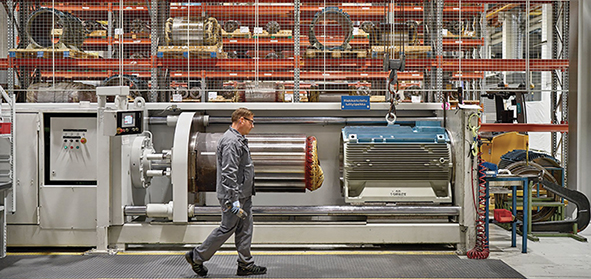
Reporting from the factory floor of ABB’s Vaasa manufacturing facility
Across the globe, more than 300 million industrial electric motor-driven systems are operating today, consuming nearly half of the world’s electricity. If these motors were replaced with optimised high-efficiency versions, worldwide electricity consumption could be cut by up to 10%. That’s the equivalent of taking millions of cars off the road, or powering entire countries without building a single new power plant
ABB has long recognised this opportunity. Since pioneering magnet-free synchronous reluctance (SynRM) motor technology in 2011, the company has steadily pushed the boundaries of motor performance. The portfolio now delivers IE5 Ultra-Premium efficiency as standard and has expanded to include increased safety, liquid-cooled and even IE6 Hyper-Efficiency options.
The latest development marks a turning point. ABB has extended the size and power range of its Safe Area SynRM motors to cover applications from just 0.75kW up to 450kW. This means that customers who previously could not benefit from SynRM technology due to size limitations can now upgrade entire fleets to ultra-efficient solutions.
At a recent press event in Vaasa, ABB executives outlined the company’s progress and ambitions in this area. Their message is clear: the time to act is now, and the technology to make an impact already exists.
“The challenge of climate change is real. We cannot ignore it,” emphasises Stefan Floeck, division president, IEC low voltage motors. “But the solution is often simpler than we think – and within our grasp.”
THE ‘SAY-DO’ GAP
Ivor Vidjen, head of strategy and business development, IEC low voltage motors, framed ABB’s mission within the broader climate crisis. Despite international agreements and rising awareness, global emissions continue to climb. In 2024, the world saw record temperatures and came alarmingly close to breaching the Paris Agreement’s 1.5ºC threshold. The frequency of billion-dollar climate disasters has also skyrocketed from one in every 85 days in 1970 to one every 15 days in 2024.
Vidjen pointed to what ABB refers to as the ‘Say-Do’ ratio: the gap between promises and action. Current projections show that announced policies might limit warming to 1.8ºC, but actual implemented actions put us closer to 2.8ºC. Bridging that gap requires practical, scalable solutions.
“The message is quite simple, we have to double down on the implementation of energy efficiency and accelerate the deployment of the latest and most efficient technologies in the market in order to curb the temperature rise, and ensure that we stay below the 1.5ºC limit,” he notes.
Energy efficiency, according to the International Energy Agency (IEA), is the fastest and most cost-effective lever for reducing emissions. Upgrading industrial motors is a textbook example: minimal downtime, relatively low capital cost, fast return on investment and significant operational savings.
“The significance of what we’re announcing today with the smaller frame size is that smaller motors are in use predominantly in lighter industries,” Vidjen adds. “While these industries account for roughly a quarter of total energy consumption in the energy mix, they employ more than two thirds of the workforce in G20 countries. So that is exactly why, at ABB, when we speak about future-proofing our customers’ operations, high efficiency doesn’t just reduce costs, but it also improves competitiveness and, ultimately, saves jobs. The replacement of electrical motors can be categorised as quick wins, meaning it’s less intrusive to daily operations, less capital intensive and can be done in a fast and simple way.”
THE SYNRM STORY
Externally, a SynRM motor looks like a traditional induction motor. Even the stator is conventional. The innovation lies in the rotor. Made from laminated iron layers precisely shaped to guide magnetic reluctance, the rotor ‘locks’ into the stator’s magnetic flux, enabling it to rotate synchronously. This seemingly simple change delivers a cascade of benefits. SynRM motors combine the performance of permanent-magnet motors with the simplicity and service-friendliness of induction motors, without using rare earth elements. The rotor has no magnets or windings and suffers virtually no power losses, reducing maintenance and extending lifespan.
“SynRM motors empower customers to maximise energy efficiency, reliability and sustainability in more applications than ever before,” explains Daniel Eberli, global business line manager for ABB IEC LV Motors. “We’re now at the point where practically every industrial motor application can be covered by the SynRM portfolio.”
MORE THAN JUST EFFICIENCY
ABB’s SynRM motors offer up to 30ºC lower winding temperatures and 15ºC lower bearing temperatures than comparable induction motors. Bearing failures cause about 70% of unplanned motor outages, so cooler bearings dramatically improve reliability and reduce lifecycle costs. Energy use dominates total cost of ownership (TCO) for motors. Over a typical 20-year lifespan, the purchase price of a motor represents just 2% of its TCO, maintenance 1%, and electricity costs 97%. This means high-efficiency motors pay for themselves quickly.
For example, a 110kW, 1500rpm drive system in pump or fan duty achieves 92.5% package efficiency with an IE3 induction motor. With an IE5 SynRM motor, package efficiency rises to 94.2%. At partial loads, the efficiency gap can reach 6–7%. For a 90kW installation operating at an average 75% power, the IE5 SynRM package saves approximately €3,990 a year – or €79,800 over 20 years – with a five-month ROI (assuming €0.30/kWh energy costs). At the same time, it cuts 95,760kg of CO2 over its lifespan.
COMPACT DESIGN
High power density allows SynRM motors to be up to three frame sizes smaller than conventional motors for the same output. This flexibility benefits customers in two ways: machines can be built smaller, lighter and more cost-effectively, and they can deliver up to twice the output of an induction motor of the same size.
The latest expansion to ABB’s SynRM range addresses a critical customer request: smaller motors. Previously, the smallest IE5 SynRM motor available was 5.5kW (frame size 132). ABB has now introduced three smaller frame sizes – 90, 100 and 112 – to cover applications down to 0.75kW, while also extending the top-end power range to 450kW. This consistency across power classes allows industrial operators to standardise on a single technology platform for pumps, fans, compressors and other equipment.
BRINGING SYNRM TO HAZARDOUS AREAS
Until recently, SynRM benefits were limited to non-explosive atmospheres. Yet, potentially explosive environments are common in industries like chemicals, food and beverage, oil and gas, pulp and paper, and pharmaceuticals. ABB became the first manufacturer to provide IE5 SynRM Increased Safety Motors certified to ATEX and IECEx requirements.
QUIETENING DOWN
ABB has also developed the world’s first complete range of IE5 SynRM Liquid-Cooled motors, spanning 37kW to 710kW. Liquid cooling boosts power density without increasing size, enabling high-efficiency drop-in replacements for less efficient motors. Sealed designs keep out moisture, dirt and dust, while smooth outer surfaces prevent build-up. This makes them ideal for tough applications like marine propulsion, rubber and plastics extruders, and food and beverage equipment. Additionally, liquid-cooled motors eliminate the need for fans, minimising airflow disturbances in sensitive processes such as chocolate production.
THE LEAP TO IE6
While IE5 SynRM motors are today’s benchmark, ABB is already driving the next leap forward with the world’s first magnet-free SynRM design to achieve IE6 Hyper-Efficiency – an anticipated efficiency level defined as a 20% reduction in energy losses versus comparable IE5 motors. According to ABB, early adopters are already benefiting from reduced energy costs, increased productivity and leadership on sustainability targets.
VAASA: THE FACTORY BEHIND THE TECH
While the SynRM portfolio grabbed the headlines of this particular press trip, ABB’s Vaasa factory in Finland underpins the innovation. Established in 1944 and expanded into a 75-hectare industrial park, the site produces motors with IEC frame sizes ranging from 71-500, and up to 2,000kW. With 700 professionals, the plant produces 125,000 motors annually, 90% customised to customer specifications.
The Vaasa site not only produces energy-efficient products but also operates with sustainability at the forefront. The net-zero plant prides itself on numerous initiatives:
- Heat recovery systems saving 7,000+ MWh per year
- LED lighting, new HVAC systems, and smart automation
- The world’s first closed-loop paint line reusing heat from the painting process
- Fully electric truck for daily supplier pickups
- 100% electric forklifts for indoor and outdoor use
So far, these measures have delivered 15,000MWh in annual energy savings and reduced CO2 emissions by 6,500 tonnes – equivalent to powering 10,000 Finnish homes. Employee-driven ideas continue to push the site forward, embedding sustainability into its culture.
POWERING THE TRANSITION TO NET ZERO
With the latest SynRM portfolio expansion, ABB is making its most advanced motor technology available to more customers, across more applications, than ever before. By plugging efficiency gaps in their operations, manufacturers can achieve greater energy savings, lower lifecycle costs and higher reliability across their entire motor fleet.