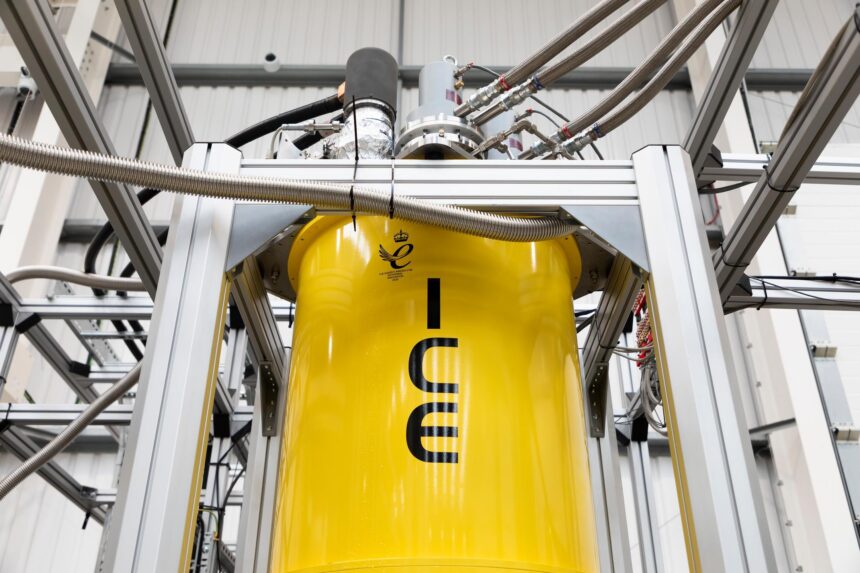
Elsa can produce temperatures between 20 and 70 Kelvin
The UK Atomic Energy Authority (UKAEA) has revealed its latest test rig, Elsa, located at its Fusion Technology Facility (FTF) in South Yorkshire, UK, which utilises extreme temperatures to inform engineering and design under fusion-relevant plant conditions
Elsa produces temperatures between 20 and 70 Kelvin, or -253.15 to -203.15 degrees Celsius, to simulate the operating temperatures of the high-temperature superconducting (HTS) magnets.
HTS coils are crucial for confining and shaping the plasma in a fusion machine by generating high magnetic fields with minimal resistive losses. UKAEA engineers hope to achieve resistances of one millionth of that found in consumer electronics. Lowering the temperature for the strongest magnetic fields requires the lowest possible energy use, decreasing operational costs and helping the commercialisation of fusion energy.
Elsa is currently testing novel ‘remountable joint’ (RMJ) components with extremely low electrical resistance, which will be significant in ensuring efficient maintenance in future fusion power plants.
RMJs are part of a fusion machine’s toroidal field coils, which confine plasma. They are fitted around the magnetic cage of a tokamak to enable quick access for maintenance during plant operations.
This novel RMJ design is a vital part of the UK’s STEP Programme, a prototype fusion energy power plant, to be built in West Burton, North Nottinghamshire, targeting operations for 2040. The success of STEP Fusion depends on RMJs, as they provide quick access for maintenance during power plant operations.
The UK Industrial Fusion Solutions (UKIFS), a wholly owned subsidiary of the UKAEA, is responsible for delivering the STEP Programme.
Chris Lamb, UKIFS’s RMJ engineering manager, said, “Remountable joints, and other aspects of High Temperature Superconducting magnet technology require cryogenic facilities like Elsa to test various aspects of the technologies, and are few and far between. Having the Elsa facility come online at the Fusion Technology Facility, on the doorstep of both STEP’s West Burton site and the rich vein of manufacturing capability at the Advanced Manufacturing Park, will be fantastic in helping the engineers get up close and personal with realising these critical HTS technologies.”
Professor Matt Stephenson, head of the UKAEA’s Fusion Technology Facility, said, “Here in South Yorkshire, we are tasked with answering the ‘how?’ in the delivery of commercially viable fusion energy. Our team is working hard to test and provide accurate results that inform us of the optimal environments and materials for durable power plant design. This work also involves looking into the most cost-effective solutions to ensure fusion energy is achieved and maintained sustainably.”
A report from Amion, on behalf of local authorities in the area, estimated that the STEP project would create 6,500 jobs on site when the power plant is fully operational, and more during construction, as well as leading to infrastructure investment in the broader area for transport and skills. The STEP campus is expected to become a global centre for fusion research and development, working with local education providers to develop a pathway into fusion-related jobs.
The success of STEP in demonstrating this commercial viability will pave the way for the development of a global fleet of fusion power plants.
Dr James Cowan, STEP programme director at UKIFS, said, “Harnessing the power of the stars to generate clean, sustainable energy on earth requires meaningful collaboration across scientific, engineering and construction disciplines. UKIFS is committed to bringing the best people and organisations together to deliver STEP, and Elsa is a perfect example of this approach in action.”