Freudenberg Sealing Technologies’ new design for sealing in-wheel motors
Jake Holmes explores how advanced seals can provide heightened protection for in-wheel motors
In-wheel motors, otherwise known as hub motors, can provide significant added-value to vehicles in the form of improved torque response, enhanced handling, and faster acceleration. Recent years have seen this type of motor rise in popularity amid the increased adoption of electric vehicles (EVs).
As a result, vehicle designers are moving new drivetrain technologies to different locations within their designs. Many are leaving traditional designs behind as EVs allow for motors to be placed closer to a vehicle’s power source. Public infrastructure can also benefit from in-wheel motors, as buses can operate with tighter turning circles whilst at a higher load capacity.
However, without protection, in-wheel motors can become defective, leading to the entire vehicle becoming stationary. To prevent this, Freudenberg Sealing Technologies has released its new design for sealing in-wheel motors.
The new sealing geometry is not just for passenger cars but also for use in various commercial vehicle components produced by OEMs. The seal boasts optimal protection against dirt and water regardless of speed. Crucial to the design is the sealant’s ability to adjust effectiveness and friction in accordance with the rotational speed of the wheel.
Luca Breusa, product developer at Freudenberg, explains: “The technical challenges for the seal are mainly to ensure reliable protection against dirt and water while minimising friction losses.”
Breusa adds: “As a solution, Freudenberg has positioned the sealing lip in such a way that high contact pressure maximises sealing performance at low rotational speeds. At higher speeds, both the contact pressure and the friction are significantly reduced by the generated centrifugal forces. Depending on the customer’s requirements, the seal can even be fully lifted off the stator, which also eliminates friction, thus significantly increasing the lifetime of the seal.”
FLEXIBLE OPTIONS
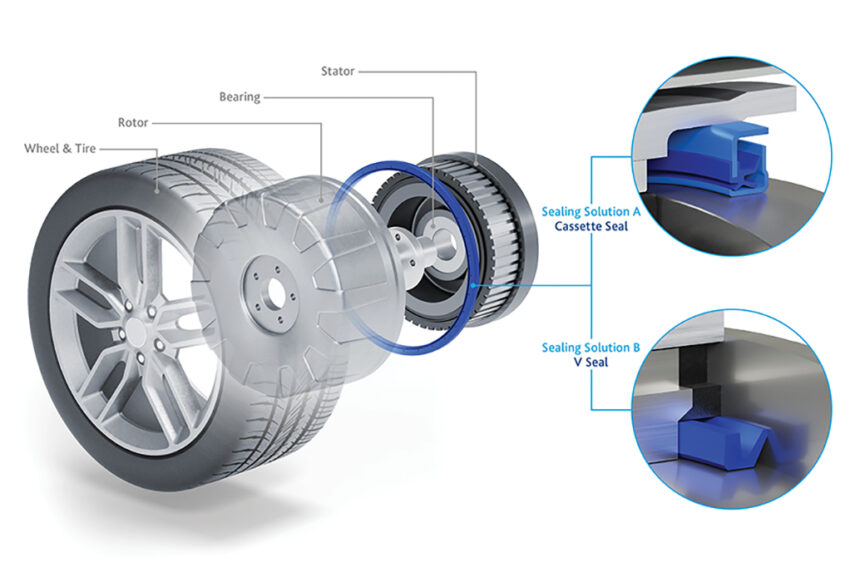
Two different seal designs have been engineered by the company. The first – the cassette seal – is installed in a closed system, featuring a sealing lip and a mating contact surface. Stainless steel and special rubber components are precisely matched to manufacture the materials, while speed ranges and contamination protection can be scaled to requirements.
Benefits of the cassette seal option include its long lifespan and high functional reliability. It can last up to 500,000km with a protection class of IP67. The seal is therefore maintenance-free and self-lubricating throughout its entire service life. This not only improves performance but also brings down costs, as replacements are no longer required.
The second design is the V-seal, which is suitable for open systems. The V-seal has wear-resistant elastomers with high-performance sliding properties. These features work well for manufacturers as they help to bring down costs and create a plug-and-play solution designed for flexible applications.
The two solutions bridge the gap between requirements for high sealing performance and low friction loss. The seal’s geometry can be scaled up to a diameter of 530mm to meet the installation space and can be adjusted to the respective speed range.
Applications include both passenger cars and commercial vehicles, with Freudenberg available to work with in-wheel motor manufacturers to create a better product. By being involved earlier in the process, manufacturers can ensure the seal is optimised for specific applications. This speeds up the design process and reduces any additional modification down the line.
IN-WHEEL ADVANTAGES
In-wheel motors work in the same way other traditional motors do, but this time in reverse. Where most car axels turn the wheels, within in-wheel motors the body of the motor turns. The motor’s power is determined by the copper coil windings around it, and most also have gears to increase torque.
A key benefit to in-wheel motors is their compact size, as they are smaller than even the tiniest of combustion engines. This not only provides them with good fuel efficiency but also creates additional space in vehicles for other components. In-wheel motors can help achieve weight reduction, as they are generally much smaller than traditional alternatives. A vehicle’s chassis therefore benefits from the weight distribution change, shifting the load away from the centre and onto the wheels.
In the move towards net-zero, in-wheel motors also have a role to play. E-Traction has released its RetroMotion technology for e-bus conversion by using in-wheel motors, where electric drive technology can be retrofitted to ensure stability for transit buses. Being able to convert fleets rather than replace them contributes to sustainability efforts as well as bringing down costs for operators, making maintenance easier. Adding in-wheel motors allows for shorter lead times, as it’s a faster process than ordering a new fleet of buses.
With the savings on metal and time, it may be more fiscally and environmentally friendly to convert existing vehicles to use in-wheel motors rather than replacing entire fleets. This would limit downtime, lead times, recycling, and would cost significantly less than other routes. This may be the direction we see investment being funnelled as governments push further for clean air in their cities.