Retrofitting electric and hybrid vessels for net zero marine transport
How a decarbonisation retrofit project is looking to unlock the circular economy potential of electric and hybrid vessels
Tidal Transit pioneers electric-powered access, transport, and crew transfer services for the offshore energy sector in the UK and Europe. Based on the Norfolk coast in the UK, the company’s mission is to propel the offshore wind industry into a new net zero era by working with partners to design, build, retrofit and run fully electrified crew transport and charging infrastructure.
Now, the company is taking this goal one step further through spearheading a new project to unlock the economic potential of electric and hybrid vessels in the offshore sector. The project brings together a consortium of industry partners such as Blackfish Engineering and MJR Power & Automation to form a new venture – Charge Offshore – which develops charging infrastructure that enables electric vessels to charge directly from wind turbines.
International Transport Manufacturer sat down with the CEO of Charge Offshore, Paul Cairns, to find out more.
MAINTENANCE IS CRUCIAL
“Operations and maintenance (O&M) fleets are essential for the operation and maintenance of offshore wind farms, and they include highly specialised vessels designed to provide reliable, safe and efficient services to energy infrastructure at sea,” Cairns explains. “There are two different sizes of vessel typically used in the development and maintenance of offshore wind farms: crew transfer vessels (CTVs) and service operations vessels (SOVs).”
Due to their compact and agile size, CTVs are ideal for transporting small service teams of up to 12 people between ports and windfarms on a daily basis. SOVs, however, are much larger in size and have the capacity to transport up to 40 technicians at a time. “They can travel longer distances than CTVs and handle rougher seas,” Cairns says. “What’s more, they can stay at sea for longer periods – often up to several weeks – making them especially suitable for accessing remote areas.
“Although both vessel types are fundamental to offshore windfarm operations and maintenance, they’re typically heavily reliant on diesel. Finding alternative power sources therefore remains a key priority for the sector.”
ELECTRIFICATION JOURNEY
But can O&M fleets be electrified, and where is the industry on its electrification journey?
“In short, absolutely,” Cairns confirms. “However, it isn’t quite that simple. Although there are a number of projects trialling e-CTVs and e-SOVs in the North Sea and beyond, charging infrastructure is not yet at the stage where electric vessels can be widely adopted.”
Compared to electric road transport, offshore charging is still very much in its infancy, Cairns observes, “The transition towards vessel electrification has moved much more slowly than on land and, as such, maritime charging infrastructure remains relatively nascent.”
Despite this, change is clearly in the air, with the UK Chamber of Shipping setting out £700m of net zero investment priorities as part of its ‘Route to Decarbonisation’ roadmap. The roadmap proposes a 2030 deadline for offshore wind installations to be fitted with vessel charging capabilities. “With this proposal acting as a much-needed catalyst for investments and R&D into offshore charging and infrastructure, we can expect to see an accelerated transition to electrification over the next five years,” says Cairns.
STATE-OF-PLAY
According to Cairns, while a selection of shoreside charging devices are beginning to enter the market, it’s offshore charging solutions that truly hold the keys to electrification.
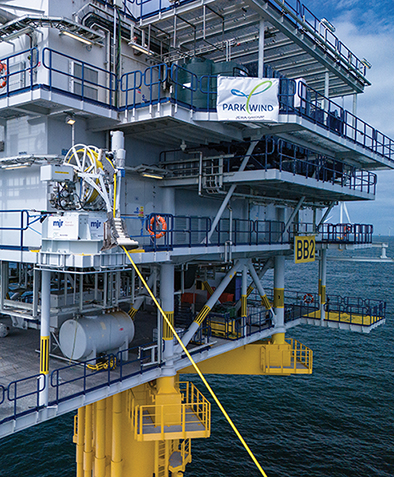
“Offshore charging can provide 100% emissions-free electricity by drawing power directly from renewable sources, like offshore wind, without vessels needing to return to port to charge, significantly reducing downtime by extending their operational time on water,” he says. “At Charge Offshore, we have recently introduced a range of offshore charging solutions specifically for O&M fleets. Our Aquarius Eco device can supply 0.5-2MW of power, making it the ideal choice for crew transfer vessels, while Aquarius Plus can supply 2-8MW to larger SOVs. Both devices have been designed from the ground up to deliver emissions-free power to electric and hybrid vessels at sea by connecting directly to wind turbines, offshore substations, floating and fixed foundations, and other structures.”
ELECTRIC BENEFITS
“There are countless benefits of embracing electrification,” Cairns continues. “Aside from offering more comfortable travel unaccompanied by the whir of a turning engine, lower noise pollution for passers-by and wildlife, zero water and air pollution and much higher safety standards than traditional ICE-powered engines, perhaps the most important advantage to switching from diesel to battery-power is the ability to significantly reduce operational costs.”
As Cairns explains, using electric propulsion eliminates dependence on volatile oil prices and reduces requirements, as the vehicles contain fewer moving parts. In the long-term, switching to electric could help operators to avoid hefty non-compliance costs associated with strengthening decarbonisation regulatory requirements.
“For example, the emissions trading scheme (ETS), which imposes taxes on high carbon-emitting freight and cargo fleets, is currently being expanded to include smaller vessels,” Cairns explains. “Now under discussion to commence in 2027, many SOVs will fall under the new weight category and be liable for such taxes. As the legislation evolves over time, we’d fully expect the scheme to be expanded further to include even lighter vessels, including CTVs.”
Additionally, battery-powered vessels that are supported by robust charging infrastructure could help wind farm operators to avoid these costs without needing to develop the high CAPEX and OPEX supply chains required by alternative fuels like green hydrogen and ammonia. “Batteries offer significantly more energy-efficient propulsion by eliminating the energy lost during electrolysation, storage, transport and combustion of such fuels, providing a much more direct and cost effective transfer of energy,” Cairns adds.
CHARGING CHALLENGES
Vessels operating in offshore environments face harsh conditions, from saltwater corrosion and high winds to rough seas. These conditions impose very specific constraints on equipment design, meaning it is absolutely critical to develop durable, low-maintenance systems for long-term viability and cost effectiveness that rival diesel refuelling infrastructure.
“In-air charging systems, which are attached directly to fixed and floating platforms, are the perfect solution for overcoming this technical requirement,” says Cairns. “Being positioned out of the water and well clear of the splash zone, in-air systems are far more durable and easier to maintain than buoy-based alternatives and offer more cost-effective long-term charging capabilities.”
He continues, “The second, even more vital piece of the puzzle to be addressed is safety. O&M fleet crews need assurance that they’re able to safely handle battery charging in all weather conditions. It’s therefore critical that hands-free connection, disconnection and overload release protection are built into offshore charging solutions as standard.”
INTO THE FUTURE
Looking ahead to what the future could hold for electric propulsion within the offshore sector, Cairns reasons, “Although we’ve seen a recent uptick in electric and hybrid marine solutions, it is unlikely that a fully electric fleet will be functional by 2050 without effective and robust shoreside and offshore charging capabilities.”
However, he predicts advanced charging systems will be the key enabler for wind farm operators and the wider maritime industry to achieve a low carbon maritime future. “As the decarbonisation agenda and regulatory environment continues to evolve, fleet operators will be encouraged to rethink their vessel requirements and increasingly opt for lower carbon yet cost effective alternatives,” he foretells.
“To fully realise a net zero future, governments, the supply chain and technology providers must collaborate on scaling solutions, ensuring that the necessary infrastructure, regulatory frameworks and financing are all in place,” Cairns continues. “By investing in offshore charging systems today, we are not only addressing the immediate need for maritime decarbonisation, but also building a sustainable foundation for the clean energy economy of tomorrow.”