Power in small packages
Smaller, lighter, more efficient systems offer advantages, but miniaturising drive systems is more than just scaling down existing motor designs. It must balance torque, power density, motor type, and thermal management
Accelerating miniaturisation
Medical devices, such as minimally invasive surgical tools, diagnostic sensors, and compact implantable systems, require tiny, high-performance components. For example, in robotic-assisted laparoscopic surgery, miniature drive systems are used to actuate wristed end-effectors in instrument shafts, often less than 10mm in diameter. These systems must provide high torque at low speeds to enable precise articulation while maintaining minimal backlash and low inertia for accurate, repeatable motion. Thermal performance is constrained because heat generated within the motor or gearbox must remain below thresholds that could affect surrounding tissue. As a result, the motor’s architecture, gear reduction, material selection, and thermal modelling are critical at the initial stage of design.
In aerospace and automotive applications, every gram of weight removed can enable greater fuel efficiency, reduced payload, and better design flexibility. In industrial automation, robotics, and consumer electronics, compact motors and electronics increasingly deliver power and precision in confined spaces.
While each sector requires different benefits of miniaturisation, they all share the same pressures: limited space, demand for mobility or portability, and the need for functionality without bulk. This has led to shrinking component size becoming a strategic choice, and designers are rethinking the architecture, materials, and manufacturing techniques to meet these demands.
Compromising
Reducing the size can bring trade-offs. Small motors do not automatically deliver the same output as large ones. To meet the same standards, engineers must consider factors such as torque output, power density, load-handling capability, and energy efficiency. Smaller motors often have lower torque, so designers may need to compensate with gearing, high-performance materials or alternative motor types.
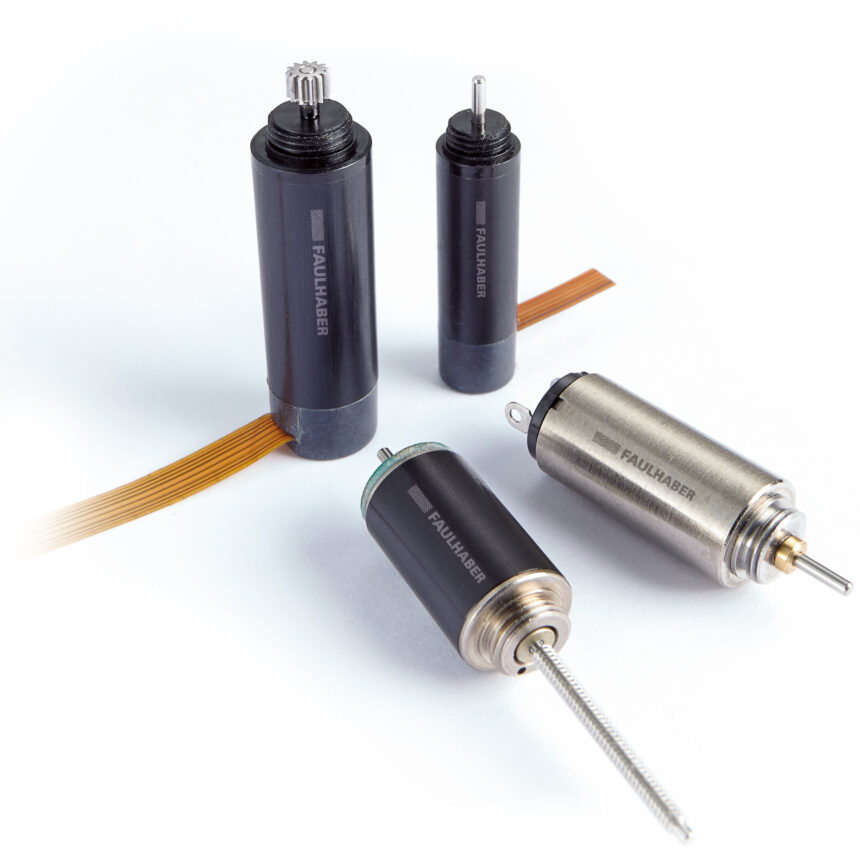
To do this, selecting the correct micro-motor technology is critical. For example, coreless DC motors can be suitable for applications where dynamic response and low inertia are important, such as medical or robotic systems. On the other hand, brushless DC motors, such as those from Faulhaber, could offer better balance and efficiency, lifespan, and power-to-weight ratio for aerospace applications.
Although they provide precise control, stepper motors can be less efficient and more challenging to integrate at small scales. In each case, motor type, winding geometry, magnet strength, gearheads, feedback systems and controls must be tuned to ensure performance without exceeding size constraints.
Achieving precision
Another engineering challenge related to miniaturisation is thermal management. As motors get smaller, they lose surface area relative to the amount of heat they generate. High power density in a compact space can result in heat accumulation, which degrades performance, reduces efficiency, and damages components.
To mitigate this, designers must address heat as an integral part of the design process. Solutions could include optimising magnetic materials, improving insulation, designing housings or airflow paths to aid heat dissipation, or embedding thermal sensors. In some scenarios, compact systems might feature heat-spreading housings, micro-cooling channels, and other advanced thermal management features.
Addressing these considerations at the beginning of a concept is critical, as thermal limitations can dictate the performance envelope of a miniature motor. This is where precision manufacturing becomes essential, as off-the-shelf motors and gear systems often fail to meet the tight spatial, mechanical and performance constraints of tiny applications.
For bespoke solutions, consider selecting a partner such as EMS, which provides a comprehensive custom design and manufacturing service from its UK-based facility.