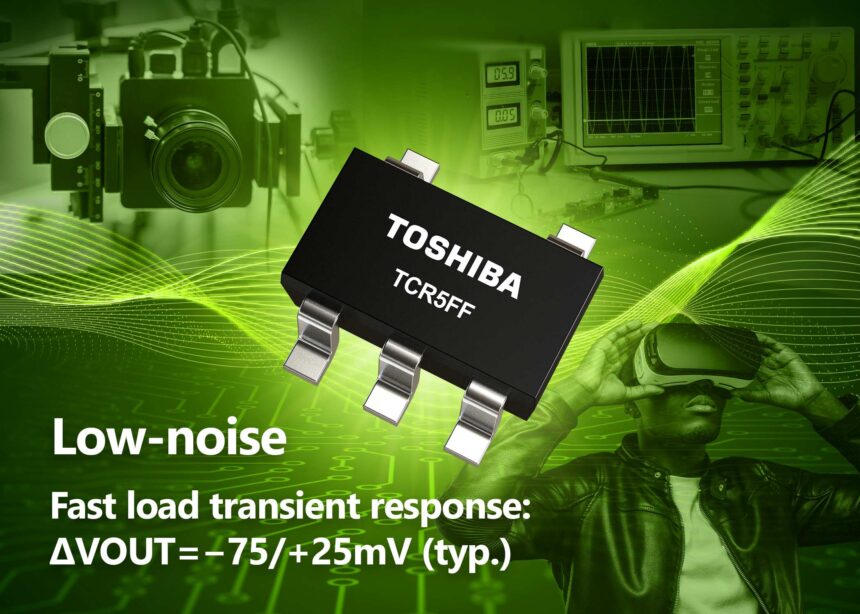
Toshiba Electronics Europe has expanded its low-dropout (LDO) regulator portfolio with the TCR5FF series, a family of 35 devices designed to maintain stable power supply rails under rapidly changing load conditions.
Available in a compact SOT-25 package, the regulators target noise-sensitive consumer and industrial applications, including security cameras, industrial cameras, high-precision sensors and Internet of Things (IoT) equipment.
Modern electronic systems increasingly combine high-speed digital processing with sensitive analogue circuitry. Transitions between standby and active operating modes can cause sudden load changes, resulting in voltage fluctuations and unwanted power supply noise.
The TCR5FF series addresses these challenges with an improved load transient response, approximately 80% faster from standby than Toshiba’s TCR3RM series, helping to minimise output voltage variations.
The LDO devices also offer a typical ripple rejection ratio of 91dB at 1kHz and typical output noise voltage of just 5µVrms. These characteristics are achieved through a combination of a bandgap circuit, low-pass filter and high-speed, low-noise operational amplifier, supporting stable power delivery to sensitive analogue, RF and sensor circuits.
Flexible voltage options
The TCR5FF series combines the electrical characteristics of Toshiba’s existing TCR5FM family with the SOT-25 package. This provides a compact footprint while allowing straightforward visual inspection following PCB assembly.
The regulators support output currents of up to 500mA and operate across an ambient temperature range of -40°C to +125°C. Fixed output voltage options extend from 0.9V to 5.0V, giving designers flexibility when specifying power rails for different system components.
The combination of fast load transient response, high ripple rejection and low output noise is intended to help engineers maintain supply stability in systems where both digital and analogue performance are critical.
Back in April, Toshiba launched a 40V N-channel MOSFET to enhance power supply efficiency for switched-mode power supplies used in data centres and industrial equipment, including high-efficiency DC-DC converters, motor drivers, and switching voltage regulators.