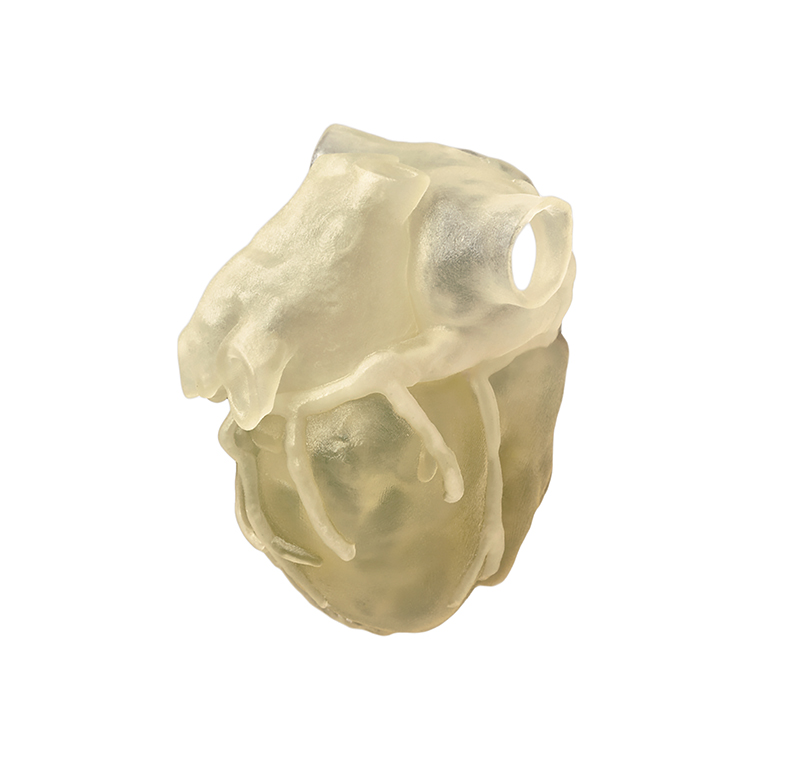
How Stratasys 3D printing technology is helping to enhance medical training
Jake Holmes learns how Stratasys 3D printing technology is helping to enhance medical training
For some time now, 3D printing has been transforming the nature of medical training by providing affordable, customisable and ultra-realistic anatomical models for education and surgical practice. Created from patient-specific data, these models allow medical professionals to plan and practice surgical procedures and techniques with increased accuracy and confidence.
At TCT3Sixty, Arnaud Toutain, business manager of medical EMEA at Stratasys, outlined the different ways additive manufacturing can be useful within medical training settings.
WHY USE 3D PRINTING?
The phrase, ‘this is my first time doing this,’ is not what most people want to hear from their surgeon just before going under the knife. Thankfully, 3D printing can provide surgeons – and their patients – with confidence when carrying out new procedures.
Current mainstream medical training diverges down one of three routes: plastic mannequins, deceased humans or cadavers, and animals. All three of these have their own unique problems, but the overarching one is they all lack the exact realism akin to what medical professionals face in a real-world setting.
However, students can be supplied with more lifelike practice resources through 3D printing, which allows for real feel and feedback of the materials and simulates almost exactly how live human bodies react and respond. Practice is vital in medical training, and being able to readily print these resources allows far more opportunities for students to learn, so when they are eventually confronted with conducting the procedure for the first time, they will already be experienced and confident.
“Now we’re getting to a level of expertise where we can bring the colour, texture and haptic feedback, adding to the realism… if it is in the body, we can probably mimic it,” Toutain said. “The good thing is we have a great technology called PolyJet, it fits pretty much perfectly with what we are trying to achieve here. It is a multicoloured, multi-material high-resolution printer that can print everything in one go. This is our go-to solution for this type of training.”
Stratasys’ J850 Digital Anatomy is the company’s most advanced medical modelling printer, giving users the ability to create biomechanically accurate anatomical models, as well as radio-realistic phantoms and models.
No assembly or painting is required after printing, as the PolyJet technology is capable of printing the complete model in one go. Super soft materials developed by Stratasys are being used for cardiovascular printing in particular, but can be used throughout the body.
Stratasys’ BoneMatrix was developed to simulate bone, and GelMatrix is used to print the soft abdominal organs, such as kidneys and livers. The company’s TissueMatrix claims to be the softest commercially available 3D printing material, creating models that respond like native organ tissue when force is applied. These materials are what gives the 3D printed models their human-like feel and haptic feedback, enabling it to be used for medical training purposes.
BENEFITS TO TRAINEES
Traditional training methods, such as operating on cadavers, has its limitations. There is little haptic feedback, and there is little room for customisation or specific issue training.
Toutain explained: “A dead human might be close to what people would experience in real life, but in the meantime it’s dead tissue, so it’s dry. It does not feel like a human, and most likely won’t have the pathology we are looking for. If you want to train someone on a very specific fracture, for example to install a plate, you will have to recreate the fracture, which is not easy to recreate the exact way you want it.”
3D printing alleviates these issues as trainees can be given 3D printed models dealing with the exact scenarios they will face to practise on, with haptic feedback.
“There is freedom if you need to create a specific fracture, or if you need a specific tumour in the brain, you just need to design it,” Toutain added. “Then you can have it in your digital inventory and you can print it.”
Using 3D printing also allows for consistent training. Human bodies have variations per person, meaning 10 different surgeons will have 10 different training experiences if using cadavers. By implementing 3D printed models instead, consistent training can be implemented across the board, making it easier for training managers to help students.
BENEFITS FOR HOSPITALS
Human bodies are expensive, not necessarily the cost of the body itself, but due to the transportation and storage of them. They need to be kept frozen, and due to a lack of availability, sometimes have to be shipped from other countries. The scarcity of bodies can be an issue for training purposes.
At a time of budget squeezes for hospitals, and in countries such as the UK where there is growing healthcare demand, reducing costs is critical. 3D printing can help hospitals that need to reduce their overhead costs or are looking to make their budget stretch further. The improved benefits of 3D printed models, such as haptic feedback and specific injuries, can also allow for better educated professionals, raising the standards of medical care.